

A lot of the data center debate is guided by status quo bias, where people are much more likely to oppose any change or new externalities regardless of the upsides.
To override this, a simple trick I use when I’m talking to people about data centers is to imagine a situation where not building the data center violates the status quo. I usually don’t use the word data center for this at all, and instead just frame it around lost tax revenue. I just ask “Would we spend this much in tax revenue to avoid the externalities of the data center?” This brings the effects of losing out on the tax revenue into the spotlight. If I could just have everyone in the debate communicate this way, I think the whole thing would be clarified.
An example
Loudoun County Virginia has come up with a new plan. They are going to spend $1.3 billion of their citizens’ tax money every single year1 to improve the county’s environment through a series of projects. This is about 38% of their general fund,2 about $2800 per resident per year.3 These projects will in total:
Reduce the county’s CO2 emissions by about 80%.4
Reduce the county’s water use by 10%.5
Make 3% more of the county’s land available to be used by businesses or kept as nature.6
Save the average household and business about $6 each in electricity bills each month, for a total savings of about $15-20 million per year, about 1/65th of the cost of the program.7
Reduce regional NOx air pollution by 4%.8
The second they stop spending this money, all these impacts come back. Is it worth spending $2800 per person per year forever to maintain these gains?
I think it would obviously be a terrible idea to spend money this way. For each of these, there are way less expensive ways of getting the same results. Some of these might be wrong or not work, but I think the type of comparisons I’m doing here need to be how the debate is framed:
Carbon
Carbon emissions are the only truly difficult externality to deal with here. The main problem with climate change more broadly is that we as a society are consistently failing to price in the carbon cost of what we do and invest to reduce it, because doing this is expensive. Here we have 11 million metric tons of CO2 per year and $1.3 billion dollars, so about $118 per metric ton.
One way to do this is via the Regional Greenhouse Gas Initiative (RGGI) that Virginia will rejoin on July 1, where anyone, including a county government, can buy allowances that shrink the number of tons the region’s power plants are allowed to emit. Covering all 11 million metric tons takes about 12 million allowances, around $300 million a year at this spring’s clearing price, or $620 million at the higher prices traders expect by December. So we have one way of reducing emissions that would cost up to 50% of the full money available in the program.
But this probably isn’t the cheapest way to reduce emissions. Eleven million tons is the emissions of about 26 TWh of gas generation, and that can be replaced by building about 12 GW of solar at Virginia capacity factors, or 8 to 9 GW of wind. Building the solar itself actually costs close to nothing on net. Unsubsidized utility solar costs about $38 to $78 per MWh, and PJM’s (the Regional Transmission Organization serving a lot of the mid-Atlantic) wholesale market paid an average of about $51 last year, so the power earns back most or all of its cost.
The thing preventing us from just building out huge amounts of basically free solar is issues with the grid. Since 2020, PJM has signed interconnection agreements for 103 GW of new power generation, but only 23 GW have come online. New power projects are routinely dying when they’re billed for the grid upgrades, which cost about $240 per kilowatt on average. Loudoun can just pay those bills to help build the plants. Covering the upgrades for all 12 GW at that average is about $3 billion as a one-time cost. Financed at 4%, the interest is about $120 million a year, under a tenth of the program’s cost and about $11 per ton against the program’s $118.
Water
10% of the water the county consumes is roughly 4,900 acre-feet. An acre-foot is about 326,000 gallons, it’s literally an acre covered in a foot of water.
Loudoun could pay to convert ocean water about 70 miles away in the Chesapeake Bay to drinkable water. The Carlsbad plant near San Diego turns seawater into drinking water for about $3,400 per acre-foot.9 This is about the most expensive drinking water in America. Treating this much water at this rate would cost $17 million per year, only 1.3% as much as the program.
Surely it would cost way too much to get the water all the way to the county? You need to consider that $1.3 billion per year is just so, so much money that stuff like this becomes possible.
4,900 acre-feet a year is about 4.4 million gallons a day, which can be delivered by a single 24 inch pipe.10 This pipe would have to raise the water about 500 feet above sea level over its journey. Pumping water over let’s say 100 miles costs about 1,000–2,000 kWh per acre-foot11, about half a million a year. So the cost of pumping the water gets us from $17 to at most $18 million.
What about building the pipe? Pipes like this can cost about $2-3 million per mile12, so this would be a one-time cost of $200-300 million. If we run with the interest-only cost this gets us $8-12 million per year. So altogether this plan to supply 10% of Loudoun’s water with ocean water from 100 miles away would cost maybe $30 million per year, or 2% of the cost of the project. The project is just so so expensive!
Land
3% of Loudoun’s land is about 10,000 acres of 333,000. More than 85,000 acres in Loudoun County are permanently protected by conservation easements, where a landowner sells off the right to ever develop the land while continuing to own and farm it.13 The federal ACEP program pays 95% of fair market value for these, capped at $16,000 per acre in Loudoun. Ten thousand acres of permanent easements at $10,000-16,000 per acre is $100-160 million, and this is a one-time cost. If the county borrowed that money at 4% and only ever paid the interest, that’s $4-6.5 million a year. 0.5% of the cost of the program.
Electricity bills
The program saves the average household and business about $6 a month on electricity, $15-20 million a year county-wide. So already that’s just 1/65th of the cost of the program. One way to save this money would be utility efficiency programs, like paying for insulation, heat pumps, lighting upgrades, and smart thermostats. Across the country, these programs save electricity at an average cost of about 2.5 cents per kilowatt-hour, while Virginia residential customers pay around 14-15 cents for each one.14 To produce $15-20 million in annual bill savings, you need to save about 110-140 million kilowatt-hours, which costs about $3-4 million a year in program spending. So we could get the program’s entire bill benefit for about 0.3% of its cost.
NOx air pollution
We need to cut regional NOx pollution by 4%, about 3,000 tons per year. The federal government already runs the Diesel Emissions Reduction Act (DERA), which is basically a procurement market for NOx reductions. From 2008 through 2018, $801 million in DERA awards bought 491,000 lifetime tons of NOx reductions, which means they get about $1,630 per ton. This also removed 16,800 tons of PM2.5 and 5.3 million tons of CO2.15 Removing 3,000 tons a year at that price is about $5 million a year, about $1700 per ton. For a sanity check, power plants buy and sell NOx allowances under EPA’s Cross-State Air Pollution Rule, and those mostly trade between $3,000 and $6,500 per ton. Even if we assume a pessimistic $10,000 per ton, we’re at $30 million a year.
Adding them up
Altogether, these would cost maybe $150 million a year, a little over a tenth of the cost of “the program.” 9/10ths of the money spent on avoiding these externalities would just be wasted. That’s about 1.1 billion dollars wasted per year, $2500 for each individual citizen every single year for nothing at all.
Spending this much money is exactly the same as banning data centers in the county. The effects are exactly the same. You lose out on x amount of tax revenue for the sake of avoiding y and z externalities. But here, it’s obvious how ridiculous it is.
Maybe you think there are other externalities I haven’t considered, like heat or noise. Instead of saying “you’re leaving those out!” try to figure out how much is actually happening and what you think it would be reasonable for a county to pay to remove the externality.
Other ways this helps
We can also frame other talking points about data centers this way. Some people have been worried the “buildout is happening too fast” and that might be true in specific places, but consider how you’d react if this program were happening, and someone said it was being “scaled down too fast.” That could be true, but you’d want specific evidence for why scaling it down slower would be worth the trade-off of all that huge cost to the taxpayers.
This can also help us select which comparisons to data centers actually help us understand them. Saying “this data center consumes a million bottles of water per day” sounds compelling, but if you ask “should the county pay $50 million dollars to use one million bottles of water less per day” you notice how the comparison doesn’t give you much useful info. You’d want to know how much water the county has available or what other industries use similar amounts in order to figure out if this is a good trade, not how many bottles of water the data center uses in a vacuum.
A lot of people are worried about data center tax cuts, and sometimes imply that the tax cuts mean that data centers shouldn’t be built. It’s true that data center tax rates have been cut in specific places, but they mostly still pay huge amounts of taxes in total. Here’s how much a $1 billion data center would pay in taxes every year in some of the places that are building the most:
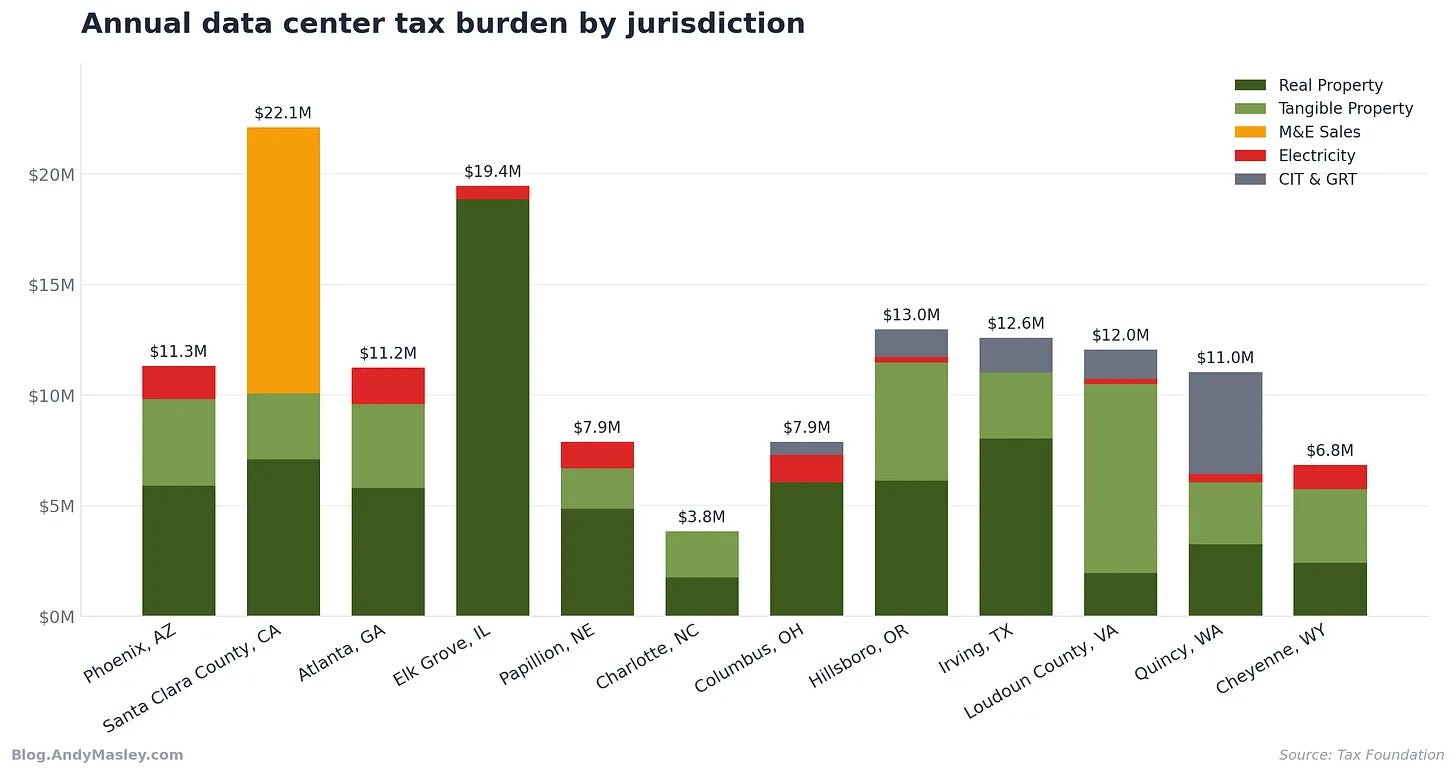
Data centers pay different types of taxes in different places. Notice that Santa Clara County is the only place on the chart with a yellow bar for M&E (machinery and equipment) sales tax on data centers. Every other place here exempts data center equipment from its sales tax, or in Hillsboro’s case has no sales tax at all. One of the most influential articles on how people think about data center taxes is CNBC’s “In race to attract data centers, states can forfeit hundreds of millions of dollars in tax revenue to tech companies.“ That article is mainly about the sales tax in that one yellow bar. CNBC counted 42 states that either give data centers full or partial sales tax exemptions or have no sales tax to begin with. California is one of just eight sales-tax states that offer no exemption. And it’s true that states are forgoing real money this way. Virginia’s exemption alone was estimated at more than $730 million for 2024. But Loudoun County is still doing very well despite taxing data centers at a much lower rate than Santa Clara. In the Tax Foundation’s model, the same $1 billion data center pays about $12 million a year in Loudoun taxes against $22 million in Santa Clara County taxes. Maybe it’s a problem that data centers aren’t also paying this additional revenue, maybe they could pay more, but that’s a separate question from whether completely blocking the data center would be a good decision. If I said “This Loudoun program for helping the environment will only cost $2800 per person instead of $5100” that gives us new information, but the big drop still isn’t close to enough to make the program worthwhile. Similarly, tax cuts tell us data centers could maybe pay much more, but that isn’t the final word on whether they should be banned, or whether it’s worth getting merely $2800 per person in new tax revenue instead of $5100, and we can be much more precise than simply saying “Data centers have all these externalities, and now they have all these tax cuts too. Who’s to say if they’re good?” We need to make the actual specific comparisons with the numbers we have.
Data centers provide so much tax revenue that in many places a fraction of the money could be used to completely offset their environmental externalities, but people seem to have trouble thinking this way, and see the externalities as brutally real whereas the tax revenue is either abstract or a lie. People bring up these long lists of the harms of data centers, and then at the end gesturing vaguely at their tax revenue. For Loudoun they might say “They use so much water and pollute the county and raise electric bills and use our land… oh and yeah they do provide tax revenue, but is it worth it?” I always read this as a form of learned helplessness. We’re adults. We can take the next step and just give the specific numbers for each, including the taxes, and then find ways to decide “Is this revenue worth the cost?” We don’t have to waffle in this weird “Oh they use so many resources, who can say if they’re good?” mode so many people go into. We don’t think this way about any other industry. We can come up with different ways of comparing the costs and benefits. My personal favorite is to just ask “What if we were spending this much tax money to avoid the externalities?” to break the status quo bias. When we do that, I think the debate is clarified.
Why aren’t places with data centers already completely offsetting their impact like this? The reason is that voters don’t actually rank these as the most important problems. If people could get better funded schools at the cost of additional percentage points of water use, they usually opt for the better schools over saving water. Local governments could spend way more data center revenue to offset the environmental cost specifically, but a part of the reason they don’t is the revealed preference of locals for spending on other things instead. They seem to think the trade-off is worth it.
This is what Loudoun’s data centers actually pay. The FY2027 budget expects $417 million in real property taxes and $879 million in personal property taxes from data centers, about $1.3 billion, nearly half the county’s tax revenue.
The county’s own figure: data centers sit on 4% of commercial parcels and provide 38% of general fund revenue.
Loudoun has about 454,000 residents. $1.3 billion / 454,000 = $2,860.
Still typing up the footnotes for the carbon section, will circle back later today.
Loudoun Water data PEC obtained by FOIA: data centers used 1.6 billion gallons in 2023, nearly 10% of county water use, with potable use up 250% since 2019. 1.6 billion / 325,851 gallons per acre-foot = about 4,900 acre-feet.
County officials’ own framing: a third of the budget on 3% of the land. Loudoun is about 333,000 acres, so 3% is about 10,000.
When the 2026 General Assembly weighed shifting capacity and distribution costs onto Dominion’s data center rate class, the SCC estimated typical residential customers would save $5.52 a month, a 3.4% cut. That’s what data centers currently add to an ordinary bill. Business bills are larger, so the same percentage is worth more than $6 to them, which is how Loudoun’s roughly 150,000 households and 11,000 businesses get to $15-20 million a year.
JLARC’s December 2024 report: data center generators at permitted levels are less than 4% of Northern Virginia’s NOx, and 0.1% or less of its CO and particulate matter. Against the regional inventory, 4% is about 3,000 tons a year. Actual use runs around 7% of permitted levels, so this prices the benefit at its ceiling.
The Water Authority’s contract price for Carlsbad water was about $3,400-3,500 per acre-foot in FY2025, three to four times the cost of imported water and by far the region’s most expensive supply. 4,900 x $3,400 = $17 million a year.The Chesapeake Bay is brackish, roughly a third the salinity of the seawater Carlsbad treats, and desalination cost scales with salt, so the Carlsbad price actually significantly overcharges me.
4.4 million gallons a day moves through a 24-inch pipe at about 2 feet per second, the bottom of the normal 2–7 ft/s design range for transmission mains.
Lifting an acre-foot (1.23 million kilograms) 500 feet takes about 510 kWh of pure physics, or 680 kWh through real pumps at 75% efficiency. Friction over 100 miles of pipe adds a few hundred more. Let’s say it’s 1,000–2,000 kWh per acre-foot. Moving Colorado River water to Southern California takes about 2,000 kWh per acre-foot, and State Water Project deliveries over the Tehachapis around 3,000, while Carlsbad uses about 4,900 just making and delivering its water. 4,900 acre-feet × 1,000–2,000 kWh at commercial rates is $0.5–1 million a year.
A planning rule of thumb for installed transmission mains is $15–25 per inch of diameter per linear foot, $2–3 million per mile for a 24-inch line, and that’s actually generous. EPA-derived estimates from 2011 put 48-inch pipe at $1.3–1.8 million per mile. Virginia has also built much bigger than this: the Lake Gaston pipeline moves 60 million gallons a day through a 60-inch pipe for 76 miles to Virginia Beach. Construction took about three years.
The county reports over 85,000 acres under conservation easement. On price, Virginia NRCS pays 95% of appraised value on permanent ACEP easements, capped at $16,000 per acre in Loudoun, one of 18 Chesapeake Bay counties at that cap. Those are the wetland-reserve terms; the farmland side pays up to 50% federally with the land trust covering the rest. Either way, retiring development rights in Loudoun runs $10,000-16,000 an acre. 10,000 acres is $100-160 million once; at 4% interest only, $4-6.5 million a year.
LBNL reviewed 8,790 utility efficiency programs in 41 states: average cost 2.5 cents per kWh saved. Counting participants’ own spending, the all-in figure is about 4.6 cents, which doubles this line to $6-7 million, still half a percent of the program. Virginia residential customers paid about 14 cents per kWh in 2024 and 15-16 by late 2025, per EIA. $15-20 million at 14-15 cents is 110-140 million kWh; times 2.5 cents is $3-4 million a year.
EPA’s Fifth Report to Congress on DERA: $801 million from FY2008 through FY2018 replaced or retrofitted 73,700 engines, cutting lifetime emissions by 491,000 tons of NOx, 16,800 tons of particulate matter, and 5.3 million tons of CO2. CRS summary here. $801 million / 491,000 = about $1,630 per ton.
Thank you for writing these articles. But ultimately I feel that environmental arguments against AI are a smokescreen. Really there is a deep discomfort with AI itself, with machines that appear to talk like humans. People feel it is a threat to their humanity in a way that previous technologies weren't. This is an emotional reaction and we can't talk people out of it. All these other arguments about water and global warming are covers from that.
I like this article and premise a lot and agree with it broadly, but I don't think the math in the "Carbon" section checks out. I think perhaps "the things we can buy with the tax revenue makes the negative externalities worth it" is a stronger argument than "we can use that tax revenue to explicitly cancel out the negative externalities" when it comes to carbon emissions, since I don't actually know that that's feasible (it might be, but I think the math makes it a lot closer). In particular:
1) I'm extremely skeptical of the RGGI's claimed reduction in emissions. Even if you were to somehow buy the amount of allowances required at $600 million/year, you'd only expect something like a 10-50% reduction in CO2 emissions causally from that. Much of the reduction in emissions commensurate with the implementation of RGGI came from the shale boom shifting from coal to less emissive gas, as well as other incentives for renewable energy production.
2) In general, these carbon allowances/offsets only make sense when you are *not increasing energy demand through your actions*. Imagine I am going to create a new giga-mega-hyper-datacenter that is going to consume as much energy as the entire US. This will be powered by new natural gas plants, but, I say, don't worry, we're going to finance a shift for the rest of the US grid onto renewable energy by paying allowances per tonne emmitted, and our entire emissions will be offset in this manner. Well... I think you can see why this could not possibly work. It's equally implausible at much smaller scales. It only works to a very small extent on the margins, not when we're talking about something like >50% of the entire county's energy consumption.
3) Solar/wind simply cannot replace gas generation for data centers. Currently basically no data centers run on renewables and nearly all run on gas. You'd (1) have to build a ton of very expensive 24-hr storage, (2) have to build a ton of very expensive grid improvements/modernization infrastructure, and (3) have to permit all of this stuff, which is very, very hard and would take a long time! You do mention a couple of these caveats, but I'd guess that it would be way more expensive, like maybe a factor of 10 more! If it wasn't actually that expensive, then people (Microsoft/Google) would be doing it right now (they're not).
4) Energy costs would rise a lot (demand is rising a lot!), likely more than offsetting the reductions from the program. This has to be factored in, no?