

I find that when I try to think about the future of AI, I’m very strongly motivated by the type of guy I’d be if I held a given belief. I’m temperamentally upbeat, I like markets and complex abstract systems, I broadly trust the government, and I think technology has largely made life unbelievably better than it was before the Industrial Revolution. Whatever axis has the Unabomber on one end, I’m on the other, and I’m drawn to beliefs about AI that would be on that same end too.
I’m attracted to a particular aesthetic of weathering the storm of societal change to allow fundamentally new things to happen that we couldn’t have imagined before, and of slowly waking up to the fact that most of what we see as foundational, normal, and eternal is actually shockingly contingent, provincial, and recent. There was a time in the not-too-distant past when pizza restaurants and movie theaters didn’t exist, and in 50 years there will be new aspects of the world that feel at least as fundamental to life as pizza restaurants and movie theaters do to me. I associate this vibe with a particular type of minimalism that leaves music, images, and buildings open to being interpreted in wildly new ways as the society around them changes. Some examples are the abstract brutalist monuments to World War 2 in Yugoslavia, which itself no longer exists:
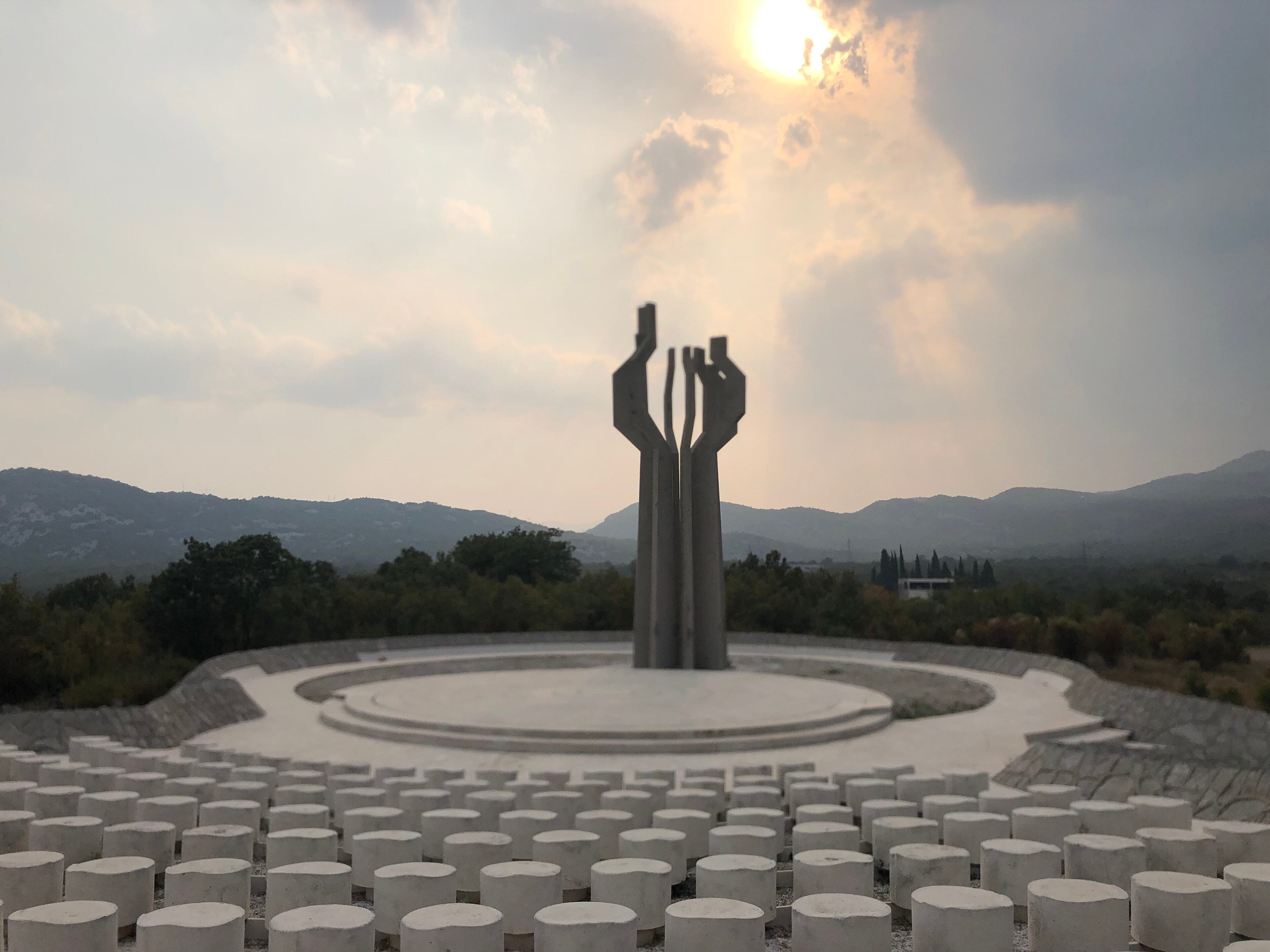
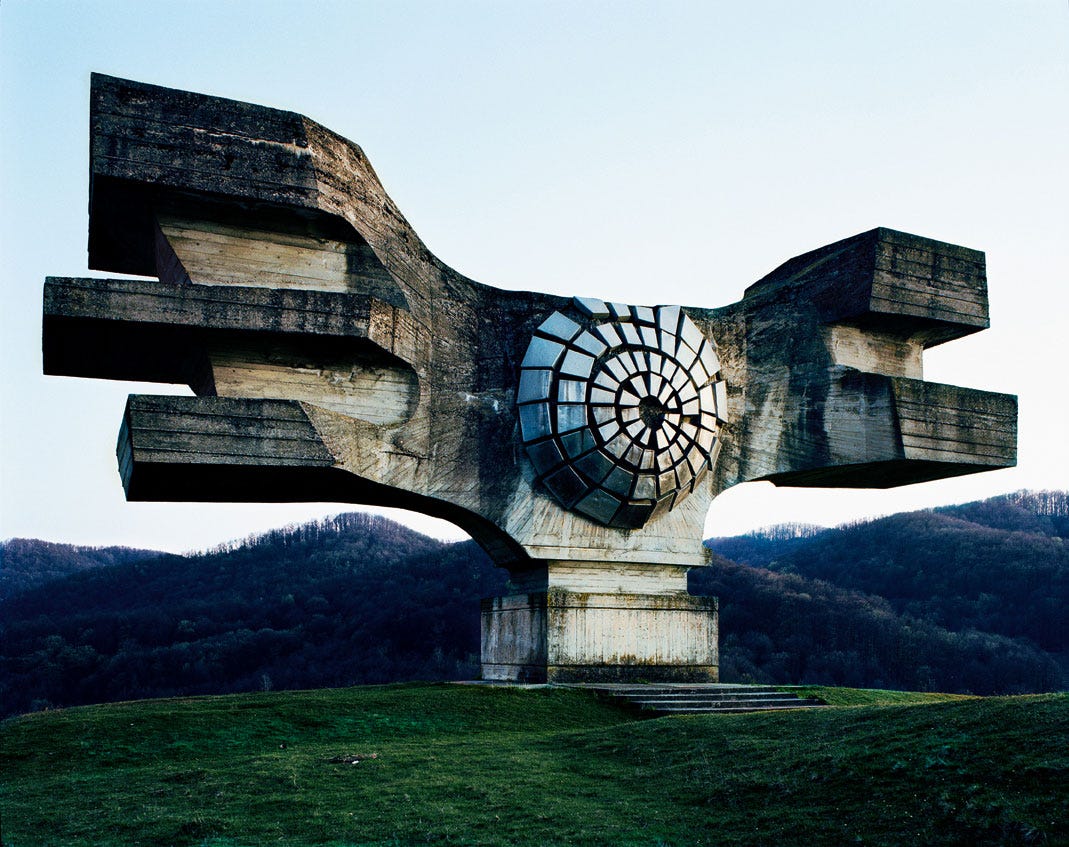
Or specific songs by Brian Eno where he lets a simple, almost silly melody repeat and build until it becomes overwhelming:
Or a lot of New Order songs with such simple melodies and general lyrics that they feel timeless, even though listening to them in 2026 is probably a wildly different experience for me than it was for someone in Manchester in the 1980s:
I like the idea of keeping a part of myself a little detached from the particularities of culture at this exact moment, in the same way these songs and buildings are, so I can learn to let those particularities go as culture changes.
For all these reasons, I’m very attracted to the view that AI will not endanger our survival but will make the world unbelievably weird and new. That’s a world I feel emotionally prepared to handle. I can calmly adjust myself and hold onto the vibes and feelings I experience as most important, which depend so little on the specifics of the here and now.
I find that I’m also tempted by this intuition when I’m walking around DC, thinking about what could change. When I walk by my local cafe or bookstore, I feel this deep sense that the writing I was reading earlier about AI risk or potential dystopian futures with AI is so abstract that there’s something fundamental about the world it can never touch. The bookstore or cafe feels much more fundamental to what I experience as real, with its ties to my core memories of other cafes and bookstores far away and in the past. It’s like these everyday things flow from some deep, wise center of the world, whereas conversations about AI risk are just surface-level. While I expect the world to change a lot, it feels like this flow from the “real” world will be what changes it. I can’t really describe the feeling better than that, but it’s a very strong and noticeable experience. It’s as if the deep normality of these everyday buildings around me is forming a barricade protecting me from the weirdness of speculative AI risk. I want to be the type of guy who can respond to the subtleties of navigating a bookstore more than I want to be the type of guy who can write and argue about AI risk. Knowing about some specific relation between two obscure used continental philosophy books while sipping a coffee and wearing a tasteful overshirt feels like I’m accessing some deep part of the world that was always there waiting for me to find it, whereas AI risk feels like something shallow and two-dimensional, or like a language game I’ve learned to play with myself.
However, when I step back and ask what’s attracting me to this view, what’s making me feel protected by the everydayness of my specific experience in DC, and what’s making me feel like AI risk is low, it seems pretty obvious that thinking about society-level catastrophe just doesn’t fit with the type of guy I want to be. It feels a lot like I’m looking down at a buffet of options, choosing a bit from effective altruism, a bit from Tyler Cowen-type beliefs about capitalism and change, a bit from the normal techno-optimism that’s defined a lot of my life so far. I put all these vibes on my plate and enjoy the combination of flavors and what they say about my own ideological taste.
I don’t think any of this is an adult way to think about the next 10 years or my relationship to them. All these same impulses would’ve caused me to downplay the threat of the World Wars before either happened, or nuclear risk during the Cold War. I have a strong aversion to thinking seriously about catastrophe. It’s very emotionally intense for me, but also (maybe more importantly) it just doesn’t give off the vibe I want. I suspect a lot of other people have a similar experience.
I’m pretty proud of how I’ve resisted this impulse in the past. In the weeks before COVID hit, I became the local prophet of doom at the school where I was teaching. About a week and a half before we shut down, and before other teachers were giving the same advice (most of them were still laughing off the idea that school would actually close), I started announcing to my class that they should all take their stuff home with them every day, because I expected school to close pretty soon. I wasn’t excited to play that role, but it was pretty easy to see then that COVID was spreading very fast, was gonna be all over the US very soon, and had a reported death rate high enough that it was probably going to cause a lot of things to shut down for a while. I had a record of never crying wolf. I had been pretty cool-headed about other past threats and cataclysms. One day when an anonymous school shooting threat came in, I went into work anyway, knowing the base rates of dying in schools are so low and the false positive rate for threats is so high that being there was still safer than my drive to and from work. I also ended up spending more time than I expected talking students through their unreasonable levels of climate doom, trying to show them that it was possible to be very concerned about climate without believing it would wipe out society in just a few years. But I was able to override my fun, upbeat, cool-headed vibe for COVID because the trends became so obvious that I couldn’t carry them forward without seeing schools close. I was willing to risk crying wolf and break with my normal persona. The buffet option of staying chill was tempting me the whole time, and I had to be more adult, ignore it, and try hard to think about what I actually believed. That turned out to be the right decision!
None of this is to say that our mental aversion to thinking about big cataclysms is any evidence that AI will actually cause one. That’s a separate argument. But in thinking through what you actually believe about AI and its effect on the world, it’s extremely important to avoid this specific move of simply choosing the option that coheres best with your vibe. Instead, you need to look for things to grip onto in the real world. The future of AI might be impossible to fully understand or predict, but we can at least try to think through what our best knowledge of AI, economics, geopolitics, government, and human behavior tells us, and be honest about what they’re actually implying along every step.
This is one reason I’ve been pretty disappointed to see the phrase “I’m not dooming” about AI come to mean “I’m not giving in to negative emotions.” Beliefs about AI shouldn’t come from your emotional state either way. Most people I know who worry about AI catastrophes (myself included) are not predisposed to “doom” about other things. If anything, we tend in a techno-optimist direction otherwise. This general implication that “doomers” believe what they do because they’re neurotic just doesn’t fit my own experience. I constantly have to drag my own mind kicking and screaming to think through AI risk arguments, because they just don’t match my emotional temperament or vibe at all. And yet many of the arguments are so straightforward and compelling to me that I’d easily be classified as a “doomer” (in the sense that I think there’s a real chance AI destroys civilization) despite having pretty low neuroticism. Of course I could be getting those wrong, but my and your emotional state don’t really help in figuring that out. As a claim about your emotional state, “I’m not dooming” is pretty uninteresting, because your emotional state gives you basically no access to the actual future of AI.
Many people understandably think of a lot of talk about AI risk as a kind of social game, and their own belief as something like a specific style of clothes to wear in this game. That might have made more sense 10 years ago, but the trends in near-term AI are looking uncertain and potentially wild enough that it’s time to start thinking about it at the level of seriousness you would have wanted in the early days of the Industrial Revolution or the Cold War. Simply testing out different beliefs about AI as if you’re sampling buffet options isn’t a sufficiently adult way of thinking about the next 10 years of your own life.
I don't think there is much risk that AI will wipe out humanity, but I do worry what governments, and the people who run them, might be able to do with AI. Especially the ability of AI to search every detail of our lives. I believe it was Beria, head of Stalin's KGB (or its predecessor) who is quotes as saying, "Show me the man, and I'll show you the crime."
In conjunction with all the regulations that are on the books, but almost never enforced, AI could easily be used as a control tool, where anyone who rises to the notice of the authorities in a way that annoys them could find themselves under an AI microscope, where inevitably something will be found with which to convict them.
This is not a problem with AI, per se, but as a tool for control of a population, it is far beyond anything previous totalitarian regimes could have dreamed of. I can fantasize that we could also use AI to fight such controllers, but let's be real. Government officials make the rules, and have the legal power to enforce them by all means necessary.
I've faced a similar issue. My favorite period in history is the Industrial Revolution, I regard technological progress as the largest driver of human flourishing, and I have a powerful intuitive optimism about the future. Whenever I watch Avatar I root for the humans.
AI risks don't gel with my natural intuitions. I understand them, I recognize they're real, I argue for their severity. But it took a long time for them to sink in. When it finally happened, I had a period of panic. It felt like I had to urgently convince myself that the risks weren't real, like the idea itself had become radioactive. Adjusting was a long, slow process.
Even then, it's hard to treat the considerations as real. How could AI doom be a risk if technology is so cool?