

The underlying idea of political liberalism is that free, reasonable people will come to drastically different conclusions about ethics and metaphysics: what counts as violence, how scarce resources should be distributed. This gives them lots of reasons to come into conflict, and even to turn violent, since each side sees its own retaliation as justified and the spiral escalates. Either we build complex societal structures that mediate these differences, or people sort into rival states and small bands that share one set of values, enforce it strictly, and keep their members unfree. Liberalism is about maintaining these mediating structures between rival value systems, so that we don’t slip into those situations of unfreedom. I have a longer post on how I think about liberalism here.
In a lot of my writing on the environment, I find myself implicitly standing up for political liberalism over what I see as attempts to use the environment as an illiberal cudgel against the writers’ identified enemies. Reading Vaclav Smil and David MacKay when I was young was incredibly useful for thinking about the current AI data center debate, but I think actually less useful than reading Rawls, and Joseph Heath’s summaries of Rawls. That’s because most of my disagreements with public commentary on AI and the environment are not actually factual disagreements (I often completely agree with the same underlying facts about the numbers involved as everyone else). They’re normative disagreements about what the facts imply we should do. For example, I agree with all the factual claims in this UN University report on AI and the environment, but I think its framing of those facts is completely off the wall. Here are six especially strange framings from the report:
GPT-4’s training carbon footprint of 25,000 tonnes of CO₂e would require the sequestration capacity of 420,000 tree seedlings grown for 10 years, or about equal to the number of trees in 105 Hyde Parks in London.
The land footprints of training GPT-4 and GPT-5 are estimated at roughly 0.9 km² (126 football fields) and 1.5 km² (210 football fields), respectively.
A typical ChatGPT-style text query is about 200 times more energy-intensive than text classification (such as spam filtering).
Video generation represents the most energy-intensive frontier with high-resolution long clips on large models drawing more than 415 Wh per clip, drawing as much electricity as 200,000 spam classifications.
The water footprint associated with training GPT-4 was about 600 million liters, enough to meet the minimum annual domestic water needs of 81,000 people in Sub-Saharan Africa, or to fill 237 Olympic-sized pools.
The land footprint of 2025 data centers’ electricity demand was 6,900 km², nearly 4.5 times the size of Greater London.
My complaint is that each of these leaves the reader less capable of comparing AI to other parts of their everyday life. None of these leaves someone with any way of understanding how AI compares to other industries, how it fits into the environmental picture it actually operates in. Each number is selected to be maximally alarming, and no industry would look acceptable if the authors applied the same comparisons. I don’t know why it would ever be useful to compare a chatbot to a spam filter. If my friend drove a few miles to film a video, I wouldn’t say “You know, for the energy you used to drive over to film that video, you could have filtered 1.5 million spam emails.” They’d give me a funny look. Household water use is a small fraction of anyone’s total water footprint, so any industry that uses meaningful amounts of water will always use as much as tens of thousands of households do, whether those households are in Sub-Saharan Africa or anywhere else. A back-of-the-envelope calculation suggests the water we use irrigating Christmas trees in America matches the household water use of 1.5 million people in Sub-Saharan Africa. Does this tell us anything about Christmas trees? Does it give us any useful normative information at all? The whole intro to the report is full of comparisons like this, I’d recommend reading it yourself.
Underlying wild comparisons like these is a philosophy I think is fundamentally illiberal and increasingly mainstream in environmental thinking. At the extreme end, some environmentalists argue explicitly that political liberalism is itself responsible for the climate crisis, a claim that usually relies on heterodox economic theories. I don’t want to get into that right now. I’ll instead assume that whether you’re a capitalist or a socialist, you’re sympathetic to the broad liberal goal of building societal structures that let people with radically different values and religions live and prosper together. It’s this general liberalism that I worry some environmentalism is being used to attack, and I’ll argue here for the opposite: approaching environmentalism through a broadly liberal lens.
This is the core of illiberal environmentalism as I see it: We the good people broadly know what is good and what is bad, how scarce resources should be spent to maximize people’s wellbeing, and which contentious ethical values are right and wrong. Because we’re in an environmental crisis, our main goal should be to make sure no resources are spent on the bad things, since any environmental cost paid for something bad is by definition pure waste, which we just can’t afford right now. We have no responsibility to mediate the complex, contradictory desires of the billions of people alive right now, or to think about how to trade off their desires for radically different goods and ways of living. Instead, the goal is to attack the bad guys, the people spending scarce resources on things we already consider bad for other reasons. All good people know what’s bad, or will once they’re awakened from the lies of the bad people.
To get across why environmental illiberalism is bad, I like to imagine a group of Catholic environmentalists who get together to figure out the most promising ways to help the environment. After a few days of research, they publish a report claiming to have found a powerful new way to help the climate: shutting down the places of worship of false religions. For the Catholics, every pound of CO2 or drop of water used to operate a Protestant church or a mosque or a synagogue or a Buddhist temple is wasted on something that’s actively sending people to hell and making society worse in the meantime. The value of all these rival places of worship is at best zero, and likely extremely negative. So there’s a huge opportunity to cut enormous amounts of CO2 and water use “without harming anyone,” while in fact making the practitioners of the false religions much better off by guiding them to the light of Catholicism.
If you sit down and try to explain why the Catholic environmentalists are wrong, the rules you come up with will either be some version of liberal environmentalism, or just a claim that your own religious beliefs are the true ones and should run society instead. After 20 years in the internet atheist trenches I don’t have much hope for converting the world to Quinean Naturalism, so my next best move is to participate in the subtle ethical and social dances we do to let each other pursue rival religious beliefs. My answer to the Catholic environmentalists is that their plan breaks a background social contract: we don’t use technocratic questions about society-level collective action problems as cudgels for imposing controversial religious beliefs on each other. If they break the rule, everyone else might defect too, and over time people will become less free to pursue their visions of religious truth, which harms Catholicism in the long run. This doesn’t require some deep shared belief about what’s good in the world. It just requires acknowledging that society rests on a delicate balance of mutual tolerance, and that any ethic we use to change society has to respect that balance, or it falls apart and leaves Catholics (and everyone else) worse off and unfree. Our ability to solve climate change will also collapse, as claims about climate become mere vessels to express unrelated value disagreements, and our ability to act on climate is stalled until everyone comes to a final agreement on all other major ethical disputes.
I always start with religious freedom, because it’s an extreme case most people agree on. Religious freedom is important, and the rights of religious minorities shouldn’t be squashed under the guise of solving climate change. But whether someone uses AI is obviously far less fundamental to their freedom than which religion they’re allowed to practice, so I need to take a few more steps.
I want to expand from religion to say that climate should not be turned into a cudgel to push any controversial ethical beliefs that aren’t about climate change itself. Our rules for solving climate would ideally respect all contentious beliefs about ethical questions in other areas.
For example, I think that industrial animal agriculture is among the very worst things that human society has ever done. Animal lives on factory farms are often extremely bad, there are an unbelievable number of animals in factory farms, and the suffering of those animals I think ethically matters enormously. In my ideal world there would be a global ban on industrial animal agriculture, which obviously under some interpretations is deeply illiberal, though I think this can be justified if we consider animals themselves as subjects of political liberal societies.
Given that I think factory farming is such a catastrophe, how should that affect how I talk about its climate impacts? Any time someone wanted a chicken sandwich, I could point out that it has a climate cost, and that since the chicken suffered so much, all of that cost went to something truly horrible. On that logic, the sandwich’s climate impact is much worse than almost anything else in the person’s life. The enjoyment they get from driving isn’t offset by an animal’s torture, so it’s better to spend the emissions on the car than on the sandwich. Would this be a reasonable way of talking about the climate?
I don’t think it would. To arrive at that claim, I’m measuring how much CO2 is wasted according to the contentious value I assign to different products. It looks something like “Harm = CO2 emitted / (Goodness of thing),” where goodness is my own contentious ethical assessment. But lots of other people don’t agree with my assessment of the goodness or badness of a chicken sandwich. And since my claim about the sandwich’s environmental harm mostly hinges on whether it’s evil for other reasons (producing chicken emits only a moderate amount of CO2e), I’m really using climate to smuggle in a completely separate contentious value. This is a shifty way of breaking the liberal compromise.
I’m choosing meat partly to show that liberals themselves don’t have to be neutral about their own values. I think meat is a moral disaster. But to live among billions of people whose values I wouldn’t want to live under, I have to do the complex social dance and play the game of value neutrality when talking about other problems in society.
A third and final category that I’d like to remain untouched is rival tastes. I find specific things a lot of people like boring or dumb, they feel the same about things I like. I shouldn’t be able to use climate as a cudgel for my taste. While I didn’t like the recent Wicked movies, I don’t think the emissions they caused were “wasted” and wouldn’t argue to stop going to see Wicked for climate reasons.
How then should we make moral claims about the climate? Because climate change is a massive problem, and we can’t just live and let live. The answer is that our climate rules need to be compatible with different value systems. We can make general claims about how people should sacrifice some of what they want to reduce their emissions, without making contentious claims about the value of the specific things they want, or about which of the things they cut are good or bad. If I’m talking to a meat eater, it’s fair game to say “Hey, it has a moderately positive climate impact to swap chicken for tofu,” because that’s just a correct, neutral statement about which emits more. It’s illegitimate to say animal agriculture is a unique problem for the climate because the animals are suffering. Similarly, Catholics have every right to ask Protestants to put solar panels on their church property, but they don’t have a right to tell them to cut services to keep people from driving there in the first place, on the grounds that the services provide no value anyway. For an environmental liberal, the equation for the social badness of emissions looks more like “Harm = CO2 emitted / (how much the thing lets people pursue their own values, or how much someone personally values it).” A little clunky, but I think it’s a better way of thinking about climate change in a world with wild value differences. This is also why I’m such a fan of charts that break down where the emissions in people’s lives show up. To let different people pursue different things, instead of saying “You should not do x evil thing,” we should say “You and everyone else are obligated to cut your personal emissions down to this amount. How you do that and what you cut is up to you, but this is what we need to do to hit our climate goals.” The second statement lets people with radically different values coordinate on solving climate change. The first one doesn’t.
This brings me back to the UNU report, and why I think its way of talking about the environment is illiberal. The report’s move is to choose confusing, disorienting comparisons that vilify a new industry without giving readers any way to weigh it against the other things in their own lives. You’re left not knowing, for example, that the water cost of the non-AI American internet equals the household water use of about 900 million people in Sub-Saharan Africa, and that this pales next to things like American beef, which withdraws as much water as 2.2 billion hypothetical people in Sub-Saharan Africa. Basically all American industries look bad under this metric, and this gives you no reasonable way of choosing between them. What the report is doing is identifying AI as a bad guy for unrelated reasons, then piling on alarming statistics to reinforce its badness, without the full environmental context that would let you say “Oh, now I know how AI fits into my day. I can structure my choices around what’s valuable to me and what emits the most.” They’re making the value judgment for you, and leaving you without a way of choosing for yourself how to make the sacrifices necessary to reduce your emissions. It’s incapacitating the reader, leaving them with less ability to make informed decisions about what activities they’d like to keep while reducing their emissions.
This may sound uncharitable, or even a little conspiratorial, so I want to step back and clarify that I don’t think the authors consciously decided to be illiberal or to impose their values on their readers. What I think is happening is that a lot of people haven’t internalized the fact of reasonable pluralism: people have wild disagreements about what’s good and bad, and there is no secret Manichean split between good and bad views that all rational people would sort into if left free. In environmentalism, people are often taught, more via background social norms than anything explicit, that the world contains good things all decent people agree on, and bad things only power-seeking evil people enjoy. People rarely even discuss the idea that environmentalism should leave value questions untouched and instead pull levers that cut everyone’s environmental harm while maximizing their ability to pursue their own goods. Instead they learn that there are bad things in society, like AI, and that because they’re bad they’re inherently wasteful. The specific amounts of emissions and water become decorative statistics, a way of articulating badness. They don’t give people who like these things the context to see how much they actually contribute to harm, and therefore to decide whether to keep using them and trade that off against cutting other things. Thus environmental language that uses large, contextless numbers to confuse readers seems subconsciously designed to control the behavior of other people based on unrelated value judgments.
Further, I think that a lot of people enter into social games with each other, where they’re mutually rewarded for attacking bad guys and for supporting good guys. This is deeply natural and human. Liberalism is an unnatural social practice that needs to be relearned and reinforced in comparison. But it leaves people with a strong reason to sneer at demands for putting very specific numbers on things, on comparing problems concretely to each other, and for giving listeners the information required to decide for themselves what values they want to pursue. For a lot of people, this sounds a lot like a naive blind trust that people will all come to the good values, or that we don’t need to attack our mutual bad guy and instead need to let people decide for themselves whether the obvious bad guys are in fact bad. This closes people off to making specific comparisons between industries and environmental impacts, and leaves them suspicious of people like me trying to actually make those full comparisons available. Thus, my own writing is often met less with “You’re getting the numbers themselves wrong” and more “Oh, you didn’t get the memo, these comparisons don’t matter because AI is a bad guy, why are you trying to defang our criticism anyway?” A few months ago I was giving a talk and got a question that basically amounted to “What nefarious effective altruist reasons do you have for making us okay with AI?” The person asking didn’t seem to have any disagreement with my specific numbers themselves, instead the question was more “Why are you disempowering us from attacking a bad guy?” My counter is that I’m empowering everyday people to just see where their environmental impacts actually are and how they can cut them the most. If AI’s a big part of them, or if they don’t like AI for other reasons, it becomes a more promising thing to cut. But I think the person asking the question hadn’t fully considered this idea that I might just not be an agent of the evil team and instead just get frustrated when people are incapacitated in their decision making about the environment by strange presentations of very simple numbers. I don’t think they or the authors of the UNU report received some top-down directive to promote illiberalism, instead they’re just succumbing to the natural human tendency toward Manichaeism over pluralism.
Liberal environmentalism may sound wishy-washy, or too lenient on bad guys, but it’s actually much more useful for solving the climate crisis than illiberalism, because a core problem with the crisis is that most of the things that cause emissions are incredibly useful to us. They’re not clear villains all good people want to destroy. If you look at a breakdown of exactly where global emissions come from, the most striking thing is how obviously useful almost all of it is.
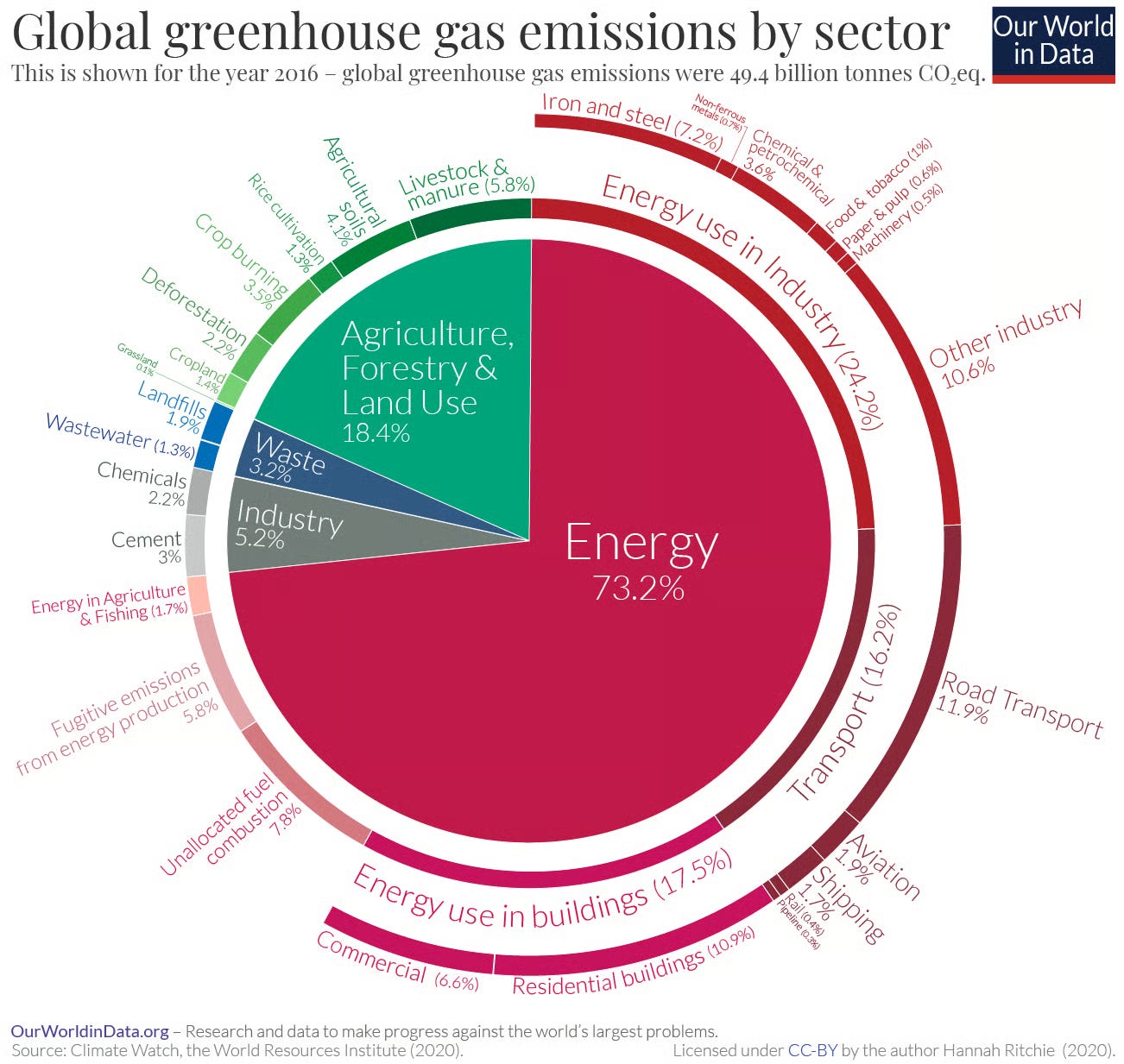
Liberal environmentalism also has more respect for the problem of climate change itself, because it’s more explicitly opposed to using climate as just a tool to win unrelated fights. How many times have you heard someone use the language of a climate emergency, and then instead of talking about the most promising ways of cutting CO2, pivot to their personal political enemies or unrelated problems in the world that happen to have some climate cost?
This also explains why liberals are often more excited about carbon taxes than illiberals. Carbon taxes neutrally price carbon regardless of what’s emitting it. This is in many ways a much more powerful method for changing people’s behavior around climate than targeting specific industries. It reaches into literally everything we do and modifies our behavior as much as prices do normally (a lot), while conveniently leaving the social value of what those emissions were spent on open to interpretation. If gas becomes a dollar more expensive, it’s equally more expensive to drive to either a church or a mosque or a UU service.
My simple application of liberal environmentalism to AI has been: “A lot of people want to use AI, and a lot of other people hate it. The people who hate it shouldn’t use it, and the people who love it should be allowed to make it part of their emissions budget, as long as they still make their overall cuts and AI doesn’t push them over the per-person threshold.” For chatbots specifically, pushing people over that threshold is nearly impossible, since their emissions are so low.
There are some criticisms of AI that I think completely respect the rules of liberal environmentalism, such as “AI uses more energy than the alternative to get the same quality stuff. Since you can get exactly what you want using fewer resources, you’re obligated not to use AI.” This is a legitimate form of criticism: it asks people to pursue the same values with fewer resources. The problem is that I think the background factual premise is just false. For almost any AI tool, running my laptop for as long as it would take me to produce the same thing by hand uses way more energy than just having the AI make it. The average AI image, for example, uses roughly 0.3-1 Wh, about 20 to 70 seconds of a laptop drawing 50 W. If you want a royalty-free image of exactly the thing you’d otherwise generate, you have roughly a minute to find or make one before the search itself uses more energy than the AI would have. If, like me, you want anime images of the Montague Bookmill, this might be hard.

People in the AI debate will often say we don’t “need” AI. Requiring people to use emissions on only what we “need” and not what we “want” pushes the conversation into a place where solving climate requires that we commit to contentious ethical claims about what’s necessary in life, again what looks like an illiberal move. In wealthy countries like America, most of what we spend our time pursuing are really “wants” rather than needs. Anything above rice and beans, a roof over your head, water to drink, and basic healthcare, is a contentious “want” for living your life in a specific way. But the people who say we don’t “need” AI don’t usually mean we need to reduce our lives to this bare bones minimum. Any move that says that climate requires us to cut our lives down to only what we “need” seems more like a way of reifying the author’s personal wants as needs. Thus again using climate more as a cudgel to smuggle contentious values. Make a list of all the things you spent your time doing today. How many of them are “needs”? I don’t think people “need” to see Wicked, but that doesn’t mean I get to use the climate to say the movie shouldn’t be released.
Illiberalism shows up in plenty of other areas of life. It’s the human default. I worry that when people lurch away from a full numerate picture of the world, it’s less that they don’t understand the numbers and more that their minds are already made up: there are specific bad guys to destroy, and statistics are only useful as weapons against them. Anyone giving other people ways of comparing and contrasting the full situation is suspicious, they’re providing avenues to be okay with the bad thing. On the environment at least, our ethics should let people with radically different beliefs and tastes live together. Enough people get real value from AI products that the decorative statistics critics hurl at them look to me like unjustified attempts to override a difference in taste among reasonable people. We owe each other the full numerate picture of what’s actually happening in the world, mainly because we shouldn’t deceive people into adopting our own contentious value systems. Going forward, I’d like environmental spaces to refocus on the project of building a pluralist world without carbon emissions, and, along the way, to respect the subtle societal and ethical structures that maintain that pluralism.
Very interesting piece, but I think it finds its limits towards the end. You admit it's legitimate even as a liberal to say "You could be achieving the exact same thing with fewer resources." But doesn't this just push the disagreement back a step to what is "the exact same thing"? If my friend chooses a flight that takes 4 hours 30 minutes door to door over a train that takes 5 hours because he wants to get to his week-long vacation 30 minutes sooner, I guess a truly even-handed liberal would say "I respect that you value that extra 30 minutes at the cabin enough that you are willing to blow your carbon budget on it", but I think even within liberalism there needs to space to say, "You are being irrational, that 30 minutes doesn't matter, you could be achieving *basically* the same thing with fewer resources."
Andy, this was spectacular - both in its particular application and its generalizable modality. I think liberalism is underdefended right now, and I think many attempts to defend liberalism either conflate it with status-quo institutionalism or with moralization about pluralism. What I think you’ve done instead, successfully, is dropped into a gears-level breakdown about why liberalism is the necessary design solution to i) the presence of competing moralities absent ii) an imperative to eradicate them.