

Note: Since I wrote this Charles Allen introduced a bill that would allow Waymo in DC, so things are looking really good! However, Janeese Lewis George is the likely next mayor of DC now, and seems interested in blocking it. This post doesn’t mention either and was written before either happened, but can still give lots of useful context for where we’re at and how Allen and George are thinking.
This post will be a very detailed overview for autonomous vehicle advocates to understand the situation in DC and pathways to legalization.
This post won’t have arguments for why we should legalize Waymo. I have a separate post on that, though I’d like to write an update to it since I think there are much stronger cases I can make.
You may have noticed that Waymos are already driving around DC (with humans at the wheel). They’ve been mapping the city and say they’re nearly ready to move forward, but the city currently has no legal path to commercial service. Two decisions are in the way: a driverless testing pathway and a commercial operating framework. Right now both are held up by a missing District Department of Transportation (DDOT) report that was supposed to arrive in October 2022, and by DDOT’s failure to open a permit pathway separate from the report that already exists in statute.
Contents
What’s blocking Waymo
The 2 things Waymo needs
Waymo needs two things from DC’s city government that it doesn’t have.
Driverless testing permits. Right now, every Waymo in DC is required to have a human safety driver. But Waymos need to be tested without a driver. This has been a standard step in every other city. DC law already authorizes DDOT to run an AV testing permit program that can include remote-operator (driverless) testing, and 2025 amendments specify that driverless testing requires that permit. But DDOT has never made the application for driverless permits available. Until DDOT opens the permit pathway and finishes the associated rules, testing can only continue with a human physically present, and the necessary driverless tests can’t happen.
A commercial operating framework. Even if Waymo got driverless testing permits tomorrow, current DC law has no structure for a commercial autonomous ride-hailing service. Things like insurance requirements, licensing structures, and rules for how a driverless vehicle interacts with police don’t exist. Autonomous ride-hailing is effectively illegal in DC.
For Waymo to operate normally, they need to get driverless testing permits, then begin commercial operations under a legal framework the council has passed. Neither step is available today.
The DDOT report and the separate testing permit framework
The Autonomous Vehicles Testing Program Amendment Act of 2020 gave DDOT authority over AVs and required the department to produce a report within one year of the law's applicability date of October 1, 2021, meaning the deadline was October 1, 2022. The report was to provide “recommendations to safely accommodate the deployment of autonomous vehicles on public roadways for commercial, personal, and any other use.” The report could optionally include draft legislation or regulations.
This report is more than three and a half years late, and is now the main political obstacle blocking Waymo.
The 2020 law tasked DDOT with setting up a formal AV testing program as a distinct obligation from the deployment report. DDOT hasn't indicated they're working on permits separately, so we may not get clarity on testing permits until the report comes out, if it addresses them at all.
It blocks legislation because Charles Allen, the DC Council’s transportation committee chair, has made the finished report a precondition for holding hearings on any AV bill. Former councilmember Kenyan McDuffie (one of the two leading candidates for mayor) introduced a comprehensive AV legalization bill (the Autonomous Vehicles Amendment Act, B26-0323) in July 2025. It’s been sitting in Allen’s committee ever since without a hearing, because Allen won’t schedule one until the report is finished. Nothing in the law says the council can’t legislate on AVs without this report. Allen’s position is a political choice.
The history of the report
December 2020: Autonomous Vehicles Testing Program Amendment Act of 2020, giving DDOT authority over AVs and required the initial report. The entire mandate says:
“Within one year after the applicability date...the Department shall transmit to the Council a report that provides recommendations to safely accommodate the deployment of autonomous vehicles on public roadways for commercial, personal, and any other use the Department determines. The report may include draft legislation or regulations.”
January 2022: DDOT publishes a notice of proposed rulemaking in the DC Register to create an AV testing program. This never gets finalized. This is a separate obligation from the report, more on this below.
Late 2022: The report’s deadline of October 1, 2022 passes with no public explanation. I can find no reporting on what, if anything, DDOT was doing on the report during this period.
2023: No report, no public explanation for the delay. There’s no reporting anywhere I can find on the reason it was delayed.
July 2024: A Wayback Machine snapshot of the mayor’s AV Working Group’s webpage (which has since been removed from the DMOI website) reveals that DDOT was still in the procurement phase for hiring a consultant to help define a regulatory framework. More than two years after the report was due, the work of writing it had not yet been contracted out.
March 2025: Congress freezes nearly $1 billion in DC’s local funds. Allen later attributes part of the report’s delay to this, but the report was already almost three years late at this point.
Spring 2025: Some expected the report to be finished around this time. It did not materialize.
Fall 2025: DDOT told Allen the report would be ready around this time. In September, DDOT backtracked, telling Allen it would be out “in the new year, timeline unknown.” Allen said he had been meeting with trial lawyers, safety advocates, and Waymo in preparation.
Late 2025: DDOT said the report was one of the programs affected by budget cuts. But this doesn’t explain why it wasn’t finished in 2023 or 2024, before the cuts happened. DC has since entered a new fiscal year and the funds have been restored.
Will the report be finished by summer? I’m skeptical. But there are three reasons to think this time could be different. Political pressure is higher than it’s ever been. The Washington Post editorial board has now published two pieces on this (one literally accusing DDOT of “sabotage”), Waymo is spending a lot more on lobbying, and the company got 1,500 residents to contact city hall. Also, DDOT appears to have finally contracted outside consultants to help write it. And the fact that DDOT gave a specific timeframe to both Axios and Waymo, rather than the usual vague non-answers, suggests at least something is happening.
What happened with that AV testing program?
DDOT published proposed rules in January 2022 to create the AV testing program. This is separate from the report. The 2020 law created two distinct obligations: a testing permit program and a deployment report. The proposed rules would have established how companies apply for testing permits and what the testing framework looks like. If DDOT had finalized them on any reasonable timeline, Waymo could have applied for driverless testing permits years ago.
DDOT never finalized them. The mayor’s now apparently dormant AV Working Group’s own page, as late as mid-2024, said the rulemaking was “still in the works” and they looked “forward to keeping the public informed when there is more to share.”
This is in my opinion more ridiculous than the delayed report. DDOT got far enough to publish draft rules for driverless permits and then just stopped. They should really be held accountable here. Waymo could begin driverless testing with permits while they wait for legislation to be fully legalized if DDOT could just get its act together on this separate thing, but instead they’ve gone completely silent on it.
This created an obvious problem when Waymo and other companies started showing up to test in early 2024. There was no permit system, so there were no formal rules. The council responded to this problem with the Autonomous Vehicle Testing Permit Requirement Amendment Act of 2024 (B25-0710), which Allen’s committee held a hearing on in June 2024. The law was simple: until DDOT’s permit program actually exists, driverless testing is prohibited. Any company testing AVs must have a human in the vehicle and give DDOT advance notice.
Because temporary legislation in DC expires and must be renewed, this had to be passed over and over, as an emergency measure in March 2024, a temporary law in June 2024, another temporary law in March 2025, and a congressional review emergency act in March, before finally being made permanent through D.C. Law 25-312 in the same month. DDOT’s inaction forced the council into a patchwork of reactive legislation instead of operating under the coherent framework that was supposed to exist by 2022.
Even if the deployment report appeared tomorrow, there would still be no finalized testing permit framework from DDOT. The report and the testing rules are separate obligations, and both are unfinished. Anyone who tells you the report is the only thing blocking Waymo is missing half the story. This is something I think a lot of AV advocates are missing in conversations about Waymo in DC.
It’s worth noting that the report could end up addressing testing permits. The mandate says the report “may include draft legislation or regulations,” so DDOT could bundle everything together. But there are reasons to think it won’t:
The 2020 law created them as separate obligations. The testing permit program was established under a different section of the law than the deployment report. DDOT published proposed rules for the testing program in January 2022, a completely separate regulatory track, and then abandoned them. The fact that DDOT initiated a standalone rulemaking for testing permits confirms that the agency itself originally treated these as distinct workstreams.
DDOT has never said the report will include testing permits. Despite nearly four years of delay, DDOT hasn’t publicly indicated that the report will address the testing permit framework. If they were planning to combine the two, you’d expect them to say so, especially given how much scrutiny this issue is getting.
The report and the permits are controlled by different bottlenecks. Allen’s precondition is about legislation: he won’t hold hearings on AV bills until the report is done. But testing permits are an executive function. DDOT could issue them under existing statutory authority without any new legislation passing. These are different problems held up by different branches of government, which makes it less likely that a single document resolves both.
What the report might say
The DDOT report’s content matters a lot. It’s possible that the report recommends heavy restrictions, and that would obviously be terrible for the prospects for AVs in the city anytime soon. There are maybe three possibilities:
A permissive framework would recommend clear pathways for testing and commercial AVs with standard requirements. This is basically what McDuffie’s bill already proposes. It would give Allen what he says he needs, and things could move pretty quickly.
A cautious, phased framework might recommend a limited testing period, geographic restrictions, fleet size caps, mandatory human oversight periods, and extensive reporting requirements before any expansion. This would still move things forward but could add a year or more.
A restrictive or inconclusive framework is the worst case. If the report emphasizes unresolved safety questions, calls for further study on labor impacts, or recommends conditions Waymo can’t practically meet (like requiring a human in every vehicle), it gives official cover to delay indefinitely.
A couple things would really help AV advocates: if the report addresses testing permits alongside deployment (rather than leaving those stuck in a separate bureaucratic track), and if it includes draft legislation (as the mandate allows), which could speed up the council’s work significantly.
The Three Gatekeepers
Three parties share responsibility for this block: DDOT, Charles Allen, and Mayor Bowser.
DDOT
DDOT is more than three and a half years late on the report. The agency has a lot on its plate, and when it received this assignment AVs were much more speculative.
Some people have speculated about internal opposition to AVs at DDOT, but I don’t see strong evidence for this. DDOT Director Sharon Kershbaum hasn’t publicly commented on AVs. Some have inferred anti-AV sentiment from her other unrelated positions that they read as anti progress, but I think that’s a stretch. Transit decisions are complicated and don’t map neatly onto a pro- or anti-tech progress axis. I’d identify as pretty pro-progress, but I share Kershbaum’s lack of enthusiasm for dedicated bike lanes (sorry friends), and I don’t think that means I’m anti-progress on other transit issues.
Stephanie Dock is the manager of DDOT’s Autonomous Vehicles Program and leads the team responsible for overseeing autonomous vehicle testing. She was on a panel on AVs presented by MIT in 2025 and had some useful quotes on the report:
We want to be adaptable, we want to be responsive to what’s going, and the industry is changing a lot faster than our rulemaking structure is allowing us to keep pace.
In order for us to do a permitting program, we have to have done a rulemaking.
Trying to figure it out before it comes. Anybody else who’s struggling with that prospect, you are not alone. We are also trying to figure that out.
These are notable because they’re the closest thing to a public explanation for why DDOT has been slow. She’s essentially saying the bureaucratic process itself (rulemaking requirements) is a structural bottleneck, not just a prioritization failure.
On the deployment report:
A deployment report with recommendations for legislation and regulation... that has to be gone through a lot of signatures, very similar regulations, so I have no promise on when the full report will be released, but I... fingers crossed, we’ll have made it through the procurement process so that... such that we can release the research aspects, kind of the background work.
This confirms the report was still going through procurement/signatures as of this talk in 2025, and that she herself couldn’t promise a timeline.
On industry vs. DDOT’s timeline:
Industry has slightly different plans. I am still looking at recommendations for deployment. Industry is certainly saying we would like to deploy. So they said they’re coming in 2026. I am eagerly awaiting how they’re going to figure out to do that.
But they also have political levers that they can pull that I, as a lowly staffer, do not.
So here it seems like she’s openly acknowledging that Waymo’s 2026 deployment plan doesn’t align with where DDOT actually is, and that the company has political tools (lobbying, public pressure) that she doesn’t.
On DC’s attractiveness and risk for AV companies:
I think everyone knows that the risks of coming into our market are relatively high, right? You’ve got to do it right, because if you want to convince Congress that you need less oversight of the AV industry, you better not be screwing up their travel on a daily basis.
On the depot/workforce concern:
Worried that if we are unable to bring in some of the maintenance and charging aspects of these fleets, that any of the workforce benefits that might accrue associated with this are actually going to go to us, because they’re going to go to Maryland and Virginia, where there is more land.”
“It also has a risk of increasing the zombie miles of empty VMT driving back as they deadhead to get to those facilities.
This shows she’s thinking about empty miles and workforce displacement to the suburbs. She’s not anti-AV here, but she’s clearly concerned about the impacts.
On where they actually are (no deployment framework):
You’ll note that my slides here with the timeline of where we are in legislation and regulation makes absolutely no mention of deployment. We do not have legislation for that at this time.
On the regulatory vs. investment mindset:
I spend a lot of time thinking about what we regulate. I get to spend some time thinking about what we incentivize, and I spend very little time thinking about what we could invest in. I’d like to change that eventually, but first we have to have these base frameworks in place.
She also brings up DC’s objectively weird transit situation:
Lots of places have motorcades. I would argue that we probably have more than most, and they look in all different sizes... it could be everything from the president or the vice president moving on street... but also, we run a lot of unannounced motorcades that are just a couple vehicles moving through, as perhaps a senator is coming up to Congress. There’ll only be two or three black cars running all sorts of red lights.
We are the central city in a tri-state region... on the one hand, we are a state, but at the same time, we’re also at the very middle of a region, and our region involves Maryland and Virginia, and depending on the commute shed that you’re looking at goes as far as West Virginia as well.
DC does not... is not an industrial city at all, right? That’s not why we exist. So we have a real shortage of land that can be used for anything like a depot. We don’t have a lot of big warehouses.
DDOT seems to have expanded the scope well beyond what the law required. The July 2024 Wayback Machine snapshot of the AV Working Group page says DDOT was trying to “procure consultant support to help the agency define a potential regulatory and legislative framework for the deployment of AVs.” That’s already broader than “recommendations” the original law called for. And Allen has added on additional expectations. In his public statements he’s talked about wanting the report to address job displacement, worker transition, and what he calls getting it “right” in a way that clearly extends beyond the safety focus of the original mandate. His December 2025 newsletter explicitly raised “the impact on jobs” as something the report needs to address. The law never called for that.
It’s crazy that after almost four years, we don’t know for sure if DDOT is planning to actually provide a permitting system along with the report. It would be nice if they would just make the general goals for the report clear, because even there we have very little to go on besides the original very short mandate.
Charles Allen
Allen is the single most important person on the legislative side. He’s the chair of the Committee on Transportation and the Environment, so he controls whether any AV bill gets considered. His making the DDOT report a precondition has given the department a total veto over the legislative timeline.
Allen has been careful to say he’s not opposed to AVs. He’s said he doesn’t “think we should be afraid of this technology or throw up obstacles” and that autonomous vehicles will “likely operate in the District” in the near future. But the practical effect of his position is indefinite delay.
His stated reasons are about process and safety. From his December 2025 newsletter:
The idea that we should authorize fully driverless vehicles without DDOT’s analysis in hand is not safe, nor is it even guaranteed to happen if the Mayor and DDOT don’t want to issue permits.
He’s also raised job impacts:
The questions also need a stronger conversation about the impact on jobs — DC residents working as taxi and rideshare drivers today would be replaced, and the money you pay for a ride would no longer go back into the community but rather be sent out of state to corporations largely located in California.
That one sounds especially bad, because there’s no way that Waymo (or buses, or bikes) could be legalized without reducing the number of rideshare jobs at least a bit.
Some other key quotes from Allen on how he’s thinking about this:
Autonomous vehicles hold promise, but DC residents should not be treated like test subjects while companies work through unresolved issues on busy city streets. Given recent nationwide examples of AVs making dangerous mistakes, a careful, data-driven approach is warranted. The questions also need a stronger conversation about the impact on jobs – DC residents working as taxi and rideshare drivers today would be replaced, and the money you pay for a ride would no longer go back into the community but rather be sent out of state to corporations largely located in California.
We’re committed to getting this right – advancing innovation without compromising safety – and to making sure autonomous vehicles are integrated thoughtfully into a transportation system that works for everyone.
I don’t think we should be afraid of this technology or throw up obstacles. But my job isn’t to say, ‘How fast can I roll this out?’, but rather, ‘How can we get this right?’ I’d rather get it done right than get it done fast.
- Interview with The 51st
(in response to a claim that AVs are involved in more crashes than human driven cars) This to me is a great example that I don’t necessarily want to be the first into this marketplace. I don’t mind having other cities go first but let’s learn what works and what doesn’t and then figure out what’s best for D.C.
- Interview with FOX 5 DC
Could he change his mind on making the report a condition? Nothing legally prevents him from holding hearings without the report. McDuffie’s bill exists and could be brought to hearing. But Allen has made this a matter of principle, and I’m skeptical that the relatively small number of AV advocates in DC can change his position on it. I also personally just have no way to judge how reasonable his decision is. There’s a legitimate case that the council should have expert analysis before writing complex regulatory legislation. What I can say is that DDOT’s three year delay has turned what might be reasonable caution into an effective block. I do worry a lot about a lot of the quotes he’s shared here on safety and jobs. Both go way beyond a reasonable or fair assessment of Waymo compared to any other vehicles.
Allen has no control over DDOT, but someone else does…
Mayor Bowser
Mayor Bowser also bears responsibility here. DDOT is an executive agency that reports to the mayor. The report is almost four years overdue on her watch. Bowser could direct DDOT to prioritize it. She could also direct DDOT to separately begin designing and issuing driverless testing permits.
Allen has publicly blamed Mayor Bowser for not issuing driverless testing permits. In December 2025, he told Axios “I don’t know what the holdup is.” Bowser’s office responded to a media request on this anonymously. An official who wasn’t authorized to speak to the press told Axios “It’s not us” and characterized DDOT as “being super diligent with their research.” I’m not sure what to infer from this.
The fact that DDOT has been allowed to sit on this for nearly four years without consequence suggests either that Bowser doesn’t consider AVs a priority, or that there’s an active decision to keep this in limbo.
Bowser could unblock the situation from the executive side without needing the council to do anything. Getting DDOT to produce the report would remove the justification Allen is using to hold up legislation.
Bowser has less than a year left of being mayor after 3 terms. A new mayor will take office in January of next year, and the primary that will determine who will be mayor is happening this June. Bowser hasn’t given any sign that she’ll give any priority to AVs in her last year as mayor, so while I wish she’d use her executive authority to push DDOT to prioritize the report more and to separately issue driverless testing permits in the meantime, I don’t expect this to happen. She doesn’t have much incentive to push something new and controversial like this.
Takeaways
Waymo needs two things from DC’s government to operate: testing permits for Waymos to drive without humans inside, and legalization of commercial AVs.
The report is the main political bottleneck for both. It blocks legislation because Charles Allen, the transportation committee chair, won’t hold hearings without it. It’s also part of the justification DDOT gives for not moving forward on testing permits, even though the 2020 law established testing permits and the deployment report as two separate obligations, and it’s not even clear the report will address testing permits at all.
But the report isn’t the only bottleneck. DDOT’s unfinished permit and rulemaking process (a separate track from the report) is the practical bottleneck for driverless testing. The driverless testing permits could also be produced if Mayor Bowser decided to direct DDOT to open the permit pathway that already exists in statute, but it looks like she won’t, and DDOT hasn’t given any indication that they’re separately working on driverless testing permits.
There are recent signs of progress. DDOT told both Axios and Waymo the report could be done by summer 2026, and they appear to have contracted outside consultants. But DDOT has missed deadlines before and is more than three and a half years late.
The council and mayor debate once the report is published
Once the report is published, this will only clear the way for the DC council to actually make policy on AVs, and we know almost nothing about what each DC councilmember believes. Many other cities in the Northeast have delayed or rejected self-driving cars.
Of the 13 councilmembers, the only one besides Allen who has been publicly vocal about Waymo is Janeese Lewis George, and she’s been skeptical of AVs (more on her below, note that she’s the other main candidate for the next DC mayor). Everyone else seems to not have commented at all. I cannot find any hints of what any of the councilmembers think about Waymo.
One piece of info we do have is who voted for the 2020 AV bill that created the original AV framework and gave DDOT authority over AVs. The bill seems pretty pro AV, it was passed unanimously, and 7 of the 13 councilmembers who passed it are still in office, though some are not running for re-election and will be out of office in January 2027:
Current councilmembers who voted for the 2020 bill:
Phil Mendelson
Anita Bonds (not running for re-election)
Robert White (running for Congress)
Brianne Nadeau (not running for re-election)
Brooke Pinto (running for Congress)
Charles Allen
Trayon White (currently awaiting a federal bribery trial scheduled for September, creating an unprecedented dynamic where he was unanimously expelled from the DC Council in February 2025, only to win his Ward 8 seat back in a July 2025 special election)
The six councilmembers who weren’t in office in 2020 are:
Janeese Lewis George
Christina Henderson
Doni Crawford
Matt Frumin
Zachary Parker
Wendell Felder
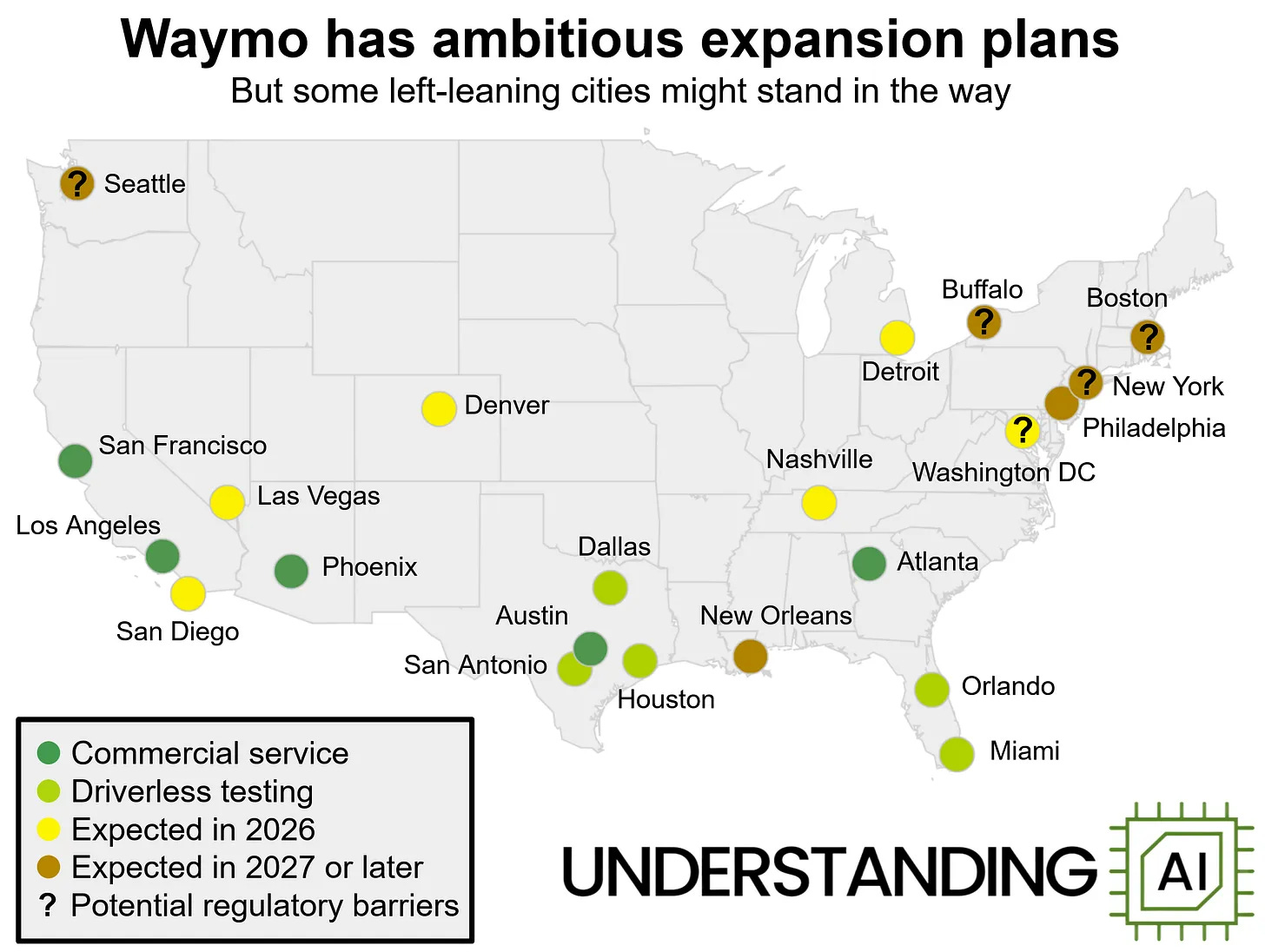
If a councilmember hasn’t thought about AVs, this might be a great opportunity for DC citizens and groups to influence their opinion early before the issue becomes polarized, or before the anti-AV interest groups reach them first. This actually seems really urgent in a way that hasn’t been covered as much, because even when the report is passed, the decision to legalize Waymo will be in the hands of these 13 councilmembers, and the only one who’s spoken about Waymo specifically has been negative. I think we should actually be somewhat pessimistic about how the council will vote. As noted in Understanding AI, Waymo has had a lot of success in Republican-dominated states where the regulatory environment is more favorable, and has hit barriers in more Democratic states. As a baseline, because DC skews very left, and this pattern of delay in more left of center places is becoming more consistent, we should expect a higher chance of bumping into more political opposition here.
One other note is that the two council votes running for Congress (Pinto and White) will be heavily influenced by how organized labor (a vital constituency in a citywide/district-wide congressional primary) views the AV issue.
The mayoral race
I really don’t think people should vote for DC mayor based on how they think about AVs, but it’s also important to understand that the two main candidates for DC mayor seem to be on opposite sides of the AV debate and it’s likely that this election will be extremely consequential for the future of self driving cars in the city.
The mayoral race in DC is basically decided by the Democratic primary on June 16 2026. Because DC is overwhelmingly Democratic, whoever wins that primary will almost certainly be the next mayor, taking office in January.
The two leading candidates in the primary are Janeese Lewis George and Kenyan McDuffie. McDuffie was the most pro-AV member of the DC council, and Lewis George is the most anti-AV.
Here’s a prediction market for who will win:
Kenyan McDuffie
McDuffie is the former councilmember who introduced the Autonomous Vehicles Amendment Act of 2025 (B26-0323), the bill that would create DC’s complete AV operating framework. The bill was introduced on July 11, 2025 and referred to the Committee on Transportation and the Environment on July 14, 2025. It would allow fully autonomous vehicles to operate without a human driver; establish insurance and financial responsibility requirements; require companies to submit law enforcement interaction plans; create an on-demand AV network under existing for-hire transportation law, with human-driver-only provisions carved out; and designate DDOT as the sole agency implementing the act.
McDuffie was regularly described as one of the most “pro-business” councilmembers. If elected mayor, he would likely direct DDOT to finish the report on a hard deadline, possibly issue driverless testing permits independently, and use his relationship with Allen and other councilmembers to push for hearings.
Surprisingly, McDuffie hasn’t done or said anything else related to AVs that I can find.
Janeese Lewis George
I want to flag that I’m going to be pretty critical of Lewis George’s coalition’s attitude toward AVs here, but I’m otherwise unsure of who I’m going to vote for and friends I trust have wildly different takes on which candidate is preferable in general, though basically everyone I know agrees that we’d like Lewis George to change her mind on AVs. Among other things Lewis George got the endorsements of prominent housing groups in DC who I tend to agree with.
Lewis George is the councilmember who has been most publicly skeptical of AVs. She said in a podcast interview in February “I don’t think our city is ready for Waymo at this moment.” She’s framed her concern as primarily about safety, but she also spoke about worker displacement, saying “we’re gonna create a balanced approach” because “I want to make sure we are not displacing workers.”
Lewis George describes herself as a democratic socialist and has built her career around labor advocacy. In December she got early endorsements from five unions with significant local organizing presence: SEIU 32BJ (which represents property service workers including janitors, security officers, and airport workers), ATU Local 689 (transit workers), UFCW Local 400 (grocery, retail, and healthcare workers), and Unite Here Locals 23 and 25 (hospitality and food service workers). At that endorsement rally, she pledged that as mayor she would “take on companies” engaged in union-busting and protect workers from displacement fueled by artificial intelligence. The Working Families Party and Washington Teachers’ Union have also endorsed her.
Axios reported that “a prominent local labor union” endorsed Lewis George in part because of concerns about job losses from autonomous vehicles specifically. The Washington Informer identified this union as SEIU 32BJ (property service workers), whose executive vice president Jaime Contreras said they endorsed Lewis George because "She's anti-Waymo, which is something that we oppose coming to the city because it's going to displace working-class people who do Uber or Lyft or DoorDash…for extra income.” This mirrors the pattern in other cities where organized labor has emerged as the primary opposition force to Waymo’s expansion.
Lewis George hasn’t called for banning Waymo or said autonomous vehicles should never operate in DC. Her stated position is that the city isn’t ready “at this moment” and that she wants to ensure workers aren’t displaced. This sounds reasonable, but is actually quite extreme as a reaction to new vehicles. Any rule that says we can’t introduce a new transit technology if it threatens to cause rideshare drivers to lose their jobs is an abysmal way to think about transit policy. Among other things, if buses didn’t exist, this same rule would ban buses. This same rule would have also banned rideshare apps in the first place, because they mostly destroyed the (better regulated, better paid, easier to organize) taxi industry in DC1. I have more on that argument here.
Lewis George’s position on Waymo closely matches the positions of leaders in cities that have stalled or effectively banned it:
In Boston, the city council’s proposed ordinance uses identical framing: study the impact on jobs first, require a human safety operator in every vehicle, and don’t allow commercial operations until an advisory board gives the green light. That advisory board would be required to include representatives from the App Drivers Union (a rare example of unionized rideshare drivers), the Greater Boston Labor Council, the Teamsters, and the UFCW. Eight city councilors collaborated on the ordinance. The Teamsters organized a coalition called “Labor United Against Waymo” which was the first mass-mobilization effort outside California to push back against AV expansion. Waymo’s spokesperson called the proposal the “first major city in the world to ban fully autonomous vehicles based entirely on vibes.”
In New York, Governor Hochul withdrew her robotaxi legalization proposal in February after failing to secure legislative support. Her spokesperson said “Based on conversations with stakeholders, including in the legislature, it was clear that the support was not there to advance this proposal” which in practice meant that organized labor made the political cost too high in an election year. The proposal would have allowed limited robotaxi deployment upstate while leaving New York City decisions to the mayor and city council. It died anyway. Waymo has testing permits for a handful of vehicles in Manhattan, but can’t charge passengers or operate commercially without new legislation that now doesn’t exist.
In Minnesota, SEIU chapters started organizing against AV legislation before Waymo even announced plans to expand to the Twin Cities. By the time Waymo began testing, there was already organized opposition pushing for legislation that would require human drivers in every vehicle. Multiple Minneapolis city councilmembers have signaled interest in passing a citywide ordinance with the same requirement.
In Washington state, law allows testing but requires a human safety operator in all vehicles and doesn't offer a clear path to commercialization. Seattle has its own additional testing permit program on top of the state requirements.
The same pattern shows up again and again where politicians express openness to AVs in principle, insist on studying job impacts first, and structure the study process so that it can never actually conclude that it’s okay to proceed. The “study jobs first” framing often functions as a ban.
Lewis George hasn’t gone as far as Boston’s councilors, who proposed requiring a human in every vehicle. But her framing seems to track the same playbook, her coalition includes the same types of unions driving opposition in those other cities, and the political incentives point in the same direction. The Teamsters’ national position is a permanent human-operator requirement for all autonomous vehicles. ATU Local 689, which endorsed Lewis George, has lobbied against AVs alongside its national chapter.
That said, Lewis George does have room to eventually support AV deployment. She could condition it on workforce transition programs, labor protections, or union consultation requirements. There’s a version of AV legalization that includes strong worker provisions and that she could plausibly support without reversing her position. The question is whether she’d actually pursue that as mayor, or whether the political incentives from her labor coalition would push her toward indefinite delay.
This doesn’t mean AVs would never happen under Lewis George. She hasn’t called for a permanent ban, and external pressure would keep building: Waymo would be operating in 15+ other cities, Baltimore might have the service 40 miles away, federal legislation could change the landscape. But nothing in her current positioning suggests she’d prioritize this, and the most likely outcome is that legalization gets pushed back by multiple years.
The mayoral race makes the DDOT timeline much more important, and vice versa
The mayoral race matters for AVs, but how much it matters depends almost entirely on whether the DDOT report comes out before the new mayor takes office in January 2027.
If the report comes out before January 2027, the mayoral race becomes potentially less decisive. Allen’s stated precondition would be removed. The McDuffie bill already exists. Allen could hold hearings in the fall. The council could potentially vote before the end of the year. If legislation passes before January, the new mayor inherits a legal framework, and unwinding legislation the council has already passed is much harder and more politically costly than just preventing it from ever being introduced.
Bowser could also use the report as cover to issue driverless testing permits in her final months. If DDOT hands her a finished product, the political calculus changes. She could claim credit for moving the city forward on her way out.
If the report still isn’t finished by January 2027, the mayoral election becomes the single most important variable in whether Waymo is legalized in DC anytime soon. The next mayor controls DDOT, and the report’s absence is what keeps everything frozen. Under Lewis George, the stall could extend for years, especially if she adds requirements to look into effects on jobs and halts legalization until there are guarantees that rideshare drivers won’t lose work.
Under McDuffie, things would likely move faster, though he’d need to navigate the council’s labor concerns.
This is why pushing for the DDOT report to come out before the election is the single most important thing AV advocates can do. Every month of delay past this summer makes the mayoral outcome matter more.
The federal government
Congress has direct authority over DC. While the local political dynamics I’ve described above are the most important near-term variables, federal action could eventually change the landscape, though right now there are no especially promising bills. Two bills that would in part pre-empt DC’s decision making on AVs are the SELF DRIVE Act of 2026 and the Autonomous Vehicle Acceleration Act of 2025 (S.1798), but both look very unlikely to become law. The SELF DRIVE Act is being talked about as maybe possibly being folded into the Surface Transportation Reauthorization, which would make it more likely to pass, but this is all pretty speculative. Technically the federal government could eventually pre-empt DC law if they passively disallow or actively ban Waymos, though I wouldn’t count on it anytime soon.
How to legalize Waymo in DC
The most promising levers to pull
I don’t know a lot about the specifics of influencing city government, so take these with a grain of salt. I’ll update them as I get feedback. The three main things to do right now seem to be:
Apply public pressure to DDOT to finish the report on time, and then to create the separate necessary testing permit framework. This could be through public writing or writing to representatives.
Make a plan for how to sway the councilmembers who haven’t expressed any opinions on AVs to support a legal framework for AVs in the city once the DDOT report is finished. It’s likely that like other cities that are pushing back against Waymo, interest groups will be eager to reach undecided councilmembers as well. They’re probably already trying to.
Push for “shall issue” permits in any AV legislation. This might be the most important detail to get right, and I haven’t seen it discussed publicly. The 2020 law gives DDOT discretionary authority over testing permits. DDOT decides whether to make the application available, how to evaluate it, and when to approve it. There’s no requirement to actually issue a permit once criteria are met. This is exactly how we got here: the law says DDOT can create a permit program, DDOT chose not to, and nothing can force them.
If the council passes AV legislation and keeps this discretionary structure, the same thing happens again at the deployment stage. A hostile administration sets up a permitting process that technically exists but moves at whatever pace it wants. Applications sit in review. Additional information gets requested in endless rounds. The framework exists on paper while no permits are issued. DDOT’s own AV program manager said in a 2025 MIT panel that “the industry is changing a lot faster than our rulemaking structure is allowing us to keep pace” and that’s without a mayor who’s actively trying to slow things down.
The solution would be that once an applicant meets clearly defined conditions (safety benchmarks, insurance, data reporting, law enforcement plan), DDOT must issue the permit within a defined timeframe. No discretion on qualified applicants. No sitting on applications.
Under McDuffie this probably doesn’t matter much. Under Lewis George it’s the difference between a framework that works and one that becomes another tool for delay. Someone with more knowledge of DC government than me pointed out that this might be the most important thing the council could do besides passing the legislation itself. I think they’re right. If the legislation gives the executive branch unlimited discretion over whether to actually issue permits, we end up right back where we are: a legal framework that exists in theory and doesn’t work in practice.
These seem less promising:
Convincing Charles Allen to change his mind on using DDOT as a prerequisite for any policy. Allen seems to have made up his mind on this, I’m skeptical that he can be swayed with the admittedly limited number of AV advocates in DC, and I also personally just have no way to judge how reasonable his decision is. It does make sense to me that councilmembers ought to rely on government agency expertise. A lot of what he’s shared on DC looks silly and overly critical of the cars compared to most other vehicles though, and the standards he’s using to judge them (jobs and safety) would imply every other type of vehicle in the city shouldn’t be legalized. On that maybe we can make some progress.
Relying on Mayor Bowser to take action. She doesn’t seem interested in prioritizing AVs and I’m not sure how much this could change.
Can we change Lewis George’s mind?
A strategy I’m unsure of is convincing Lewis George to change her mind on her current stance on AVs. She says she wants to ensure rideshare workers aren’t displaced, but this same rule would also ban buses or bikes. Her union endorsement coming in part because of her stance on AVs makes it seem difficult to change her mind. That said, Lewis George describes herself as a democratic socialist, and there are arguments for AVs that map onto things democratic socialists care about:
Fewer traffic deaths. DC sees about 40 traffic fatalities a year, disproportionately in lower-income wards with fewer protected pedestrian crossings.
Every Waymo is electric. DC has climate goals and environmental justice commitments. Waymo’s fleet is entirely electric, while a significant share of Uber and Lyft drivers in DC drive gas-powered cars. Replacing gas-powered ride-hail trips with electric AV trips is a direct emissions reduction, concentrated in the neighborhoods with the worst air quality. For someone who cares about environmental justice, this should matter. It won’t be decisive on its own, but it makes the “let’s wait” position slightly more costly in environmental terms every month it continues.
Ride-share jobs aren’t union jobs and probably never will be. This is the argument I find most interesting, though I’m least sure it would land politically. The jobs Lewis George is protecting (Uber and Lyft driving) are difficult-to-unionize gig work. They’re not the kind of jobs that democratic socialists typically celebrate. To my knowledge, DC does not have any rideshare unions. These are rare in general but do appear in cities where labor is especially powerful, like Boston and Seattle. It’s likely that the unions pushing against Waymo are actually worried about future automation of buses, trains, or trucks, and see automated rideshares as the beginning of a wave of automation that will eventually come for them too.
Constituencies who otherwise have trouble getting around the city might benefit from AVs. Elderly people among others.
I want to be honest that I don’t know if any of these arguments would actually move Lewis George. Politicians rarely reverse positions that are tied to endorsement relationships, especially during a campaign. The more realistic hope might not be changing her mind before the election, but rather creating enough cross-pressure from interest groups, environmental advocates, and safety organizations that, if she wins, she feels politically constrained from actively blocking AVs indefinitely.
The reason this matters is that if Lewis George’s position is immovable, then whether AVs are legalized in DC hinges almost entirely on the June primary. Any progress on softening her stance would reduce the stakes of the election and make the path to legalization less dependent on a single vote.
Lessons from other cities
Every city that has Waymo got it because at least one of three conditions was met:
A state-level framework that preempted local objections (California, Texas, Arizona)
An executive who personally championed the technology (Phoenix, Atlanta, Denver)
A regulatory process that moved on a defined timeline (California’s phased CPUC system)
Unfortunately, DC currently has none of these.
Here are some case studies:
California
San Francisco’s city government was deeply skeptical of Waymo. Its transportation agencies formally protested expansion, and the city actually sued the California Public Utilities Commission to try to block it. The CPUC approved Waymo’s commercial deployment in August 2023 over San Francisco’s explicit objections, and a state appeals court upheld the decision.
Public opinion in San Francisco shifted dramatically once the service was actually available. In mid-2023, net favorability for robotaxis was negative 7%. By mid-2025, it had swung to positive 38%, with 67% of residents supporting continued operations. People tend to like AVs once they can actually try them.
Texas and Arizona
Both states created permissive frameworks before Waymo arrived. Arizona’s governor issued an executive order welcoming AV testing in 2015. Texas passed legislation in 2017. When Waymo was ready to launch, the legal framework was already there. DC’s 2020 law was supposed to be that proactive step. DDOT’s failure to follow through is why DC is now years behind.
Boston: The closest parallel to DC
Boston is the most instructive comparison. The Teamsters organized “Labor United Against Waymo,” the first mass-mobilization effort outside California to push back against AV expansion. Eight city councilors collaborated on an ordinance that would require every AV to have a human safety operator (effectively banning the whole thing) and commission a study before any commercial operations could begin. The advisory board overseeing the study would be required to include reps from the App Drivers Union, Greater Boston Labor Council, Teamsters, and UFCW.
The Boston situation is still unresolved. Competing state-level bills are being debated. One allows driverless vehicles, the other requires human operators in all vehicles. Waymo has returned to Boston for further testing but faces serious organized opposition.
This Boston city council meeting drove me completely crazy to listen to, and might be a hint of the bad dynamics at play in coming debates about AVs in DC.
Minnesota
In Minnesota, SEIU chapters started organizing against AV legislation before Waymo even announced expansion plans. By the time testing started, there was already an organized opposition pushing for human-operator requirements. This is almost certainly already happening in DC.
Maryland
Governor Wes Moore is publicly enthusiastic about Waymo. The Maryland legislature is actively considering bills to allow fully autonomous vehicles, and hearings have gotten surprisingly little pushback from lawmakers. Waymo already has cars in Baltimore being driven by professional drivers to map the city. If Maryland passes its legislation, DC residents will be able to see the technology operating 40 miles away while they can’t use it at home. Maybe this will have some impact?
Atlanta and Austin
In both cities, Waymo launched partly through a partnership with Uber, making rides available through the existing Uber app. This partially neutralized the “Waymo vs. rideshare drivers” framing by positioning Waymo as an option within the existing ecosystem rather than a replacement for it. Whether this model could help politically in DC is unclear, but the narrative doesn’t have to be adversarial.
The national labor strategy
The Teamsters have called nationally for a regulatory standard requiring a human operator in all autonomous vehicles, with that operator subject to commercial driver’s license requirements. Teamsters president Sean O’Brien testified before Congress that “allowing the unfettered and unregulated operation of autonomous vehicles, ultimately seeking to replace human drivers with robots, is unequivocally a threat to safety on our roadways and the existence of good jobs in the trucking industry.” The labor impacts framing is part of a coordinated national strategy.
Federal momentum is actually moving in the opposite direction from the labor strategy. The SELF DRIVE Act passed the House Energy and Commerce subcommittee on a narrow 12-11 vote and could be folded into this year's Surface Transportation Reauthorization. Congress seems more receptive to AVs than blue-city local governments are. There’s no serious national ban proposal on the table. But labor opposition is likely to grow.
DC matters in the federal picture for a specific under-discussed reason: it’s where members of Congress, their staffers, federal regulators, and lobbyists live and commute. If Waymo operates in DC and these people experience it working well in their daily lives, it might normalize the technology among the people who write federal policy. If it’s anything like the other cities where Waymo’s operating, we can expect the public perception of AVs among policymakers to meaningfully improve.
In 2013, DC residents took about 20 million taxi trips. The DFHV 2025 Annual Report doesn’t directly state total taxi trips, but reports that 286,823 e-hail taxi trips represented 16% of all taxi trips that year, which implies about 1.8 million total. Roughly a 90% decline.
How does the metro area being spread across jurisdictions affect Waymo's rollout in DC? Is approval from DDOT / DC Govt really all that Waymo needs, or are VA/MD state govts also playing a significant role? What about smaller surrounding authorities like Arlington, Alexandria, Montgomery County, PG County, etc.?
Generally, I'm not super in the loop on how AV approvals work, but my impression is that it's much easier in cities like Austin because of the jurisdiction issue. In Austin, I imagine Waymo can more easily stay within a defined zone within one municipality. But in DC I feel like it's borderline impossible to drive without ever crossing city/state lines. Even if DDOT approves, there's no point of having a version of Waymo that can't even take you to Reagan airport. Is that shaping up to be a realistic possibility and problem?
One header says “On the depot/workforce concern (supports your source’s claim about wariness):” but I don’t know what the parenthetical is supposed to refer to. Was this copy/pasted from an email or chatbot?