

Contents
Responses to this piece from the authors of the studies Jordan cites
There’s a lot of social permission to treat data centers as boogeymen right now
Intro
There is a fast-spreading new idea that data centers cause a unique harm: “infrasound.” Environmentalists may remember this as a pseudoscientific idea promoted by some fossil fuel interests to scare people about wind turbines in the 2010s. Infrasound is now the topic of what looks like the single most popular piece of media made about data centers in 2026 so far: the video Datacenters Behaving Like Accoustic Weapons by the popular YouTuber Benn Jordan. Jordan’s previous video on infrasound is one of the first things Gemini recommends when you search it. These two videos are each a complete moment-to-moment disaster, and have received no meaningful pushback, so I will be the first. Even if you have no interest in either data centers or infrasound, I think this is an amazing sociological example of how highbrow misinformation is developed and rapidly spread. I found the experience of unpacking it jaw-dropping. After writing this Jordan accused me of being a paid shill, but you don’t actually have to trust anything I’m saying. All you have to do is trust the authors of the studies Jordan himself is citing everywhere.
This threatens to become yet another bizarre folk theory about data centers that educated people believe and give you funny looks if you say it’s fake, like that they heat the areas around them by huge amounts, they use a whole bottle of water per prompt, they seriously harm water supplies, or they have an outsized effect on national electricity prices.
I’ll argue here that all our best current evidence about the harms of inaudible infrasound implies that they’re fake, including recent popular claims about data centers. To be clear, data center noise pollution issues are very real. But “infrasound” is something very different, and is being smuggled into the real noise issues by pseudoscience enthusiasts to attribute almost mystical powers to data centers: inaudible sounds they give off that you can’t even hear can physically harm you and make you sick and mentally unwell.
Jordan’s video is a perfect case study of highbrow misinformation. The host is cool. He opens with the nuance that his video is hosted in a data center, and then immediately jumps into a pretty extreme claim:
1:28 - To put it simply, regardless of where your ethical, environmental, political, or economic interests are, if a data center is being built nearby your home, you’re generally kind of f*****.
Some wild claims have already been smuggled in, but by adding some points about how he’s also using a data center to host the video, they also seem like well-considered takes by a guy who’s willing to acknowledge trade-offs and nuance.
The video looks rigorous and technical, and is presented with the professionalism and chill vibes of the kind of explainer you might see from Hank Green and other trustworthy sources. He surrounds himself with equipment and images that look scientific. He talks to people who have been harmed by regular noise pollution, and shares their stories. A lot of legit-seeming studies are flashed on the screen. A big powerful bad guy is being taken down by a chill local dude. Why think about the individual claims too much?
Despite all this, the video is actually promoting a completely unfounded conspiracy theory, and every single study he uses to justify his conclusions either explicitly says the opposite of what he claims or has such terrible methodology that it’s useless. This is effectively a high-status Alex Jones video, it’s really uniquely terrible, but it’s also flying under the radar of most educated people because it looks and feels reasonable.
I'll show thoroughly and conclusively that the video’s wrong. Before I do that, I need to explain what infrasound is and the state of the science.
What is infrasound?
Sound is vibrating air particles. A sound’s frequency is how frequently the air particles move back and forth. A frequency of 3 Hertz (Hz) means the air particles move back and forth 3 times per second. The particles in this gif complete 1/2 of a full back-and-forth oscillation per second, so their frequency is 0.5 Hz.
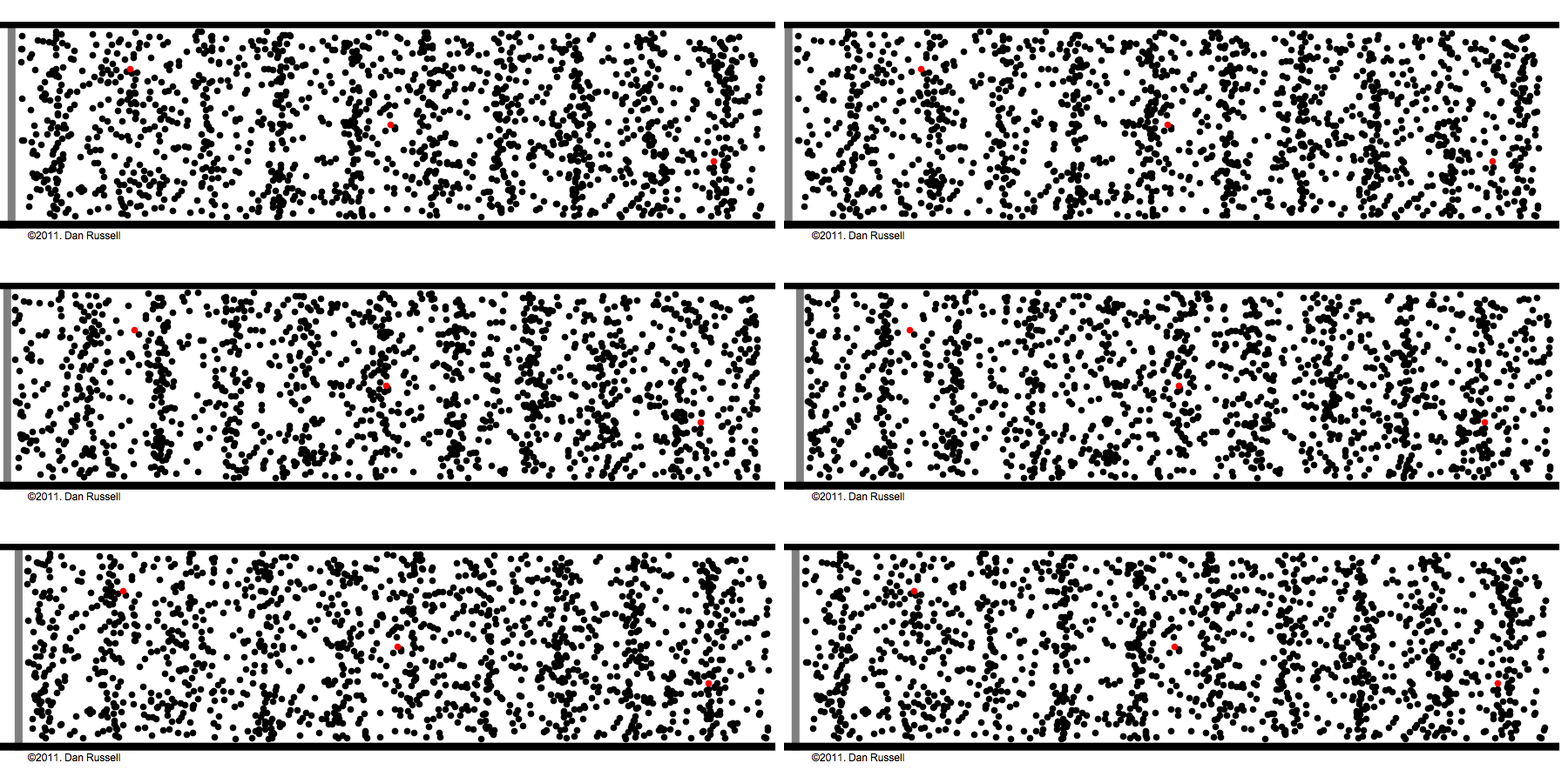
The higher the frequency of a sound wave, the shorter its wavelength. We hear higher frequency sounds as higher-pitched. For more on the basic physics of waves you can watch my old physics videos.
Frequency alone doesn’t tell you how much energy a sound wave carries. The energy of sound in air, which we experience as volume, depends mainly on the pressure amplitude of the sound wave. Pressure amplitude is like the physical height of a wave in the ocean. If you were standing in the ocean, waves hitting you very frequently could cause you to tip over, but they would have less impact if each were small, and way more if they were really large, so their height matters a lot too. Sound works similarly: frequency and amplitude are different variables, and the volume we hear is determined by the combination of the two.
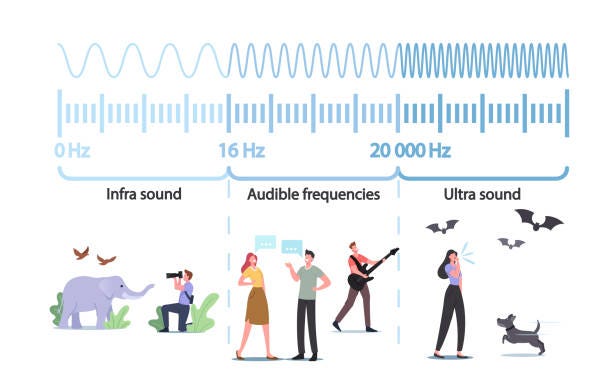
Infrasound is sound at very low frequency, below about 20 Hz. Human hearing sensitivity drops sharply in that range, so very low-frequency sounds usually have to be very loud before we can hear or otherwise perceive them. Infrasound is not all sound that isn’t loud enough to regularly hear. There are also sounds with frequencies too high for us to hear: ultrasounds. The prefix infra means “below” (“infrastructure” is structure metaphorically or literally below society) and ultra means “beyond” or “above.” This is loosely like the light spectrum: infrared light is below the lowest frequencies we can see (red), and ultraviolet light is above the highest (violet).
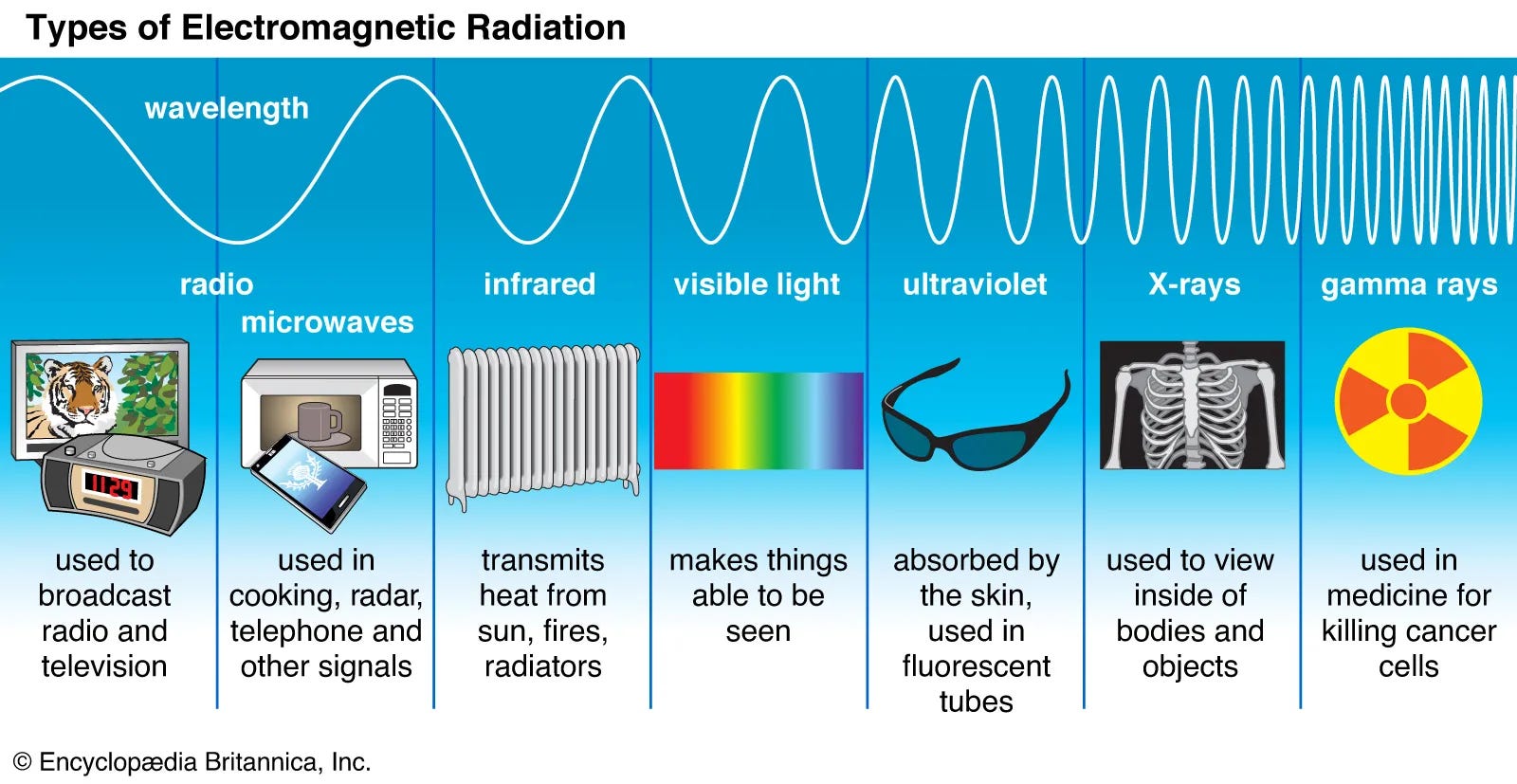
Ultraviolet light is dangerous because it carries more energy than visible light, high enough for electrons in atoms in our DNA to absorb and get knocked loose, which is why UV from the sun can cause cancer.
Infrared light carries less energy per photon than visible light, not enough to eject electrons from our DNA the way UV can. But infrared light can still transfer heat. The warmth you feel standing near a fire is from infrared light, and too much can burn you.
Infrasound (and low frequency sound in general) can move through material more easily than higher-frequency sound, and diffract around barriers easier as well. This makes it harder to block, and means that when something’s far away from a sound source, most of the sound they’ll receive will be lower frequency.
At high enough intensity, we can physically feel the presence of infrasound. It can create pressure or “fullness” in the ears. There isn’t an exact moment where it suddenly becomes detectable. The boundaries are fuzzy. The lower the frequency, the louder the infrasound needs to be before we can detect it.
For ordinary environmental infrasound, current evidence does not support major direct health effects below where we can hear and perceive it.
Sound pressure levels are measured in decibels, or dB, which is a logarithmic scale. Every 10 dB increase represents a 10x increase in sound intensity, every 20 dB increase is a 100x increase, a 60 dB increase is a million, and so on. The gap between 50 dB and 60 dB is a factor of ten in intensity. The gap between 50 dB and 100 dB is a factor of a hundred thousand.
Sound is measured this way because the range of real-world sound intensities is so huge that a linear scale wouldn’t work. A jet engine at takeoff is a trillion times more intense than the quietest sound a human can detect. To avoid having to write huge numbers out every time we want to measure sound, we just use a log scale. This is important for understanding infrasound because differences in dB can seem small, but actually represent huge orders of magnitudes in difference. The difference between a loud data center and enough infrasound to physical hear (maybe 60 dB vs 110 dB) may not seem like that much. On the scale it’s just a doubling. But in reality every 10 additional dB multiplies the power required to produce the sound by 10. So a difference of 50 multiplies the power required by 10x10x10x10x10, = 100,000 times as much power. People sometimes try to imply that infrasound could be dangerous if it just got a little higher on the decibel scale, ignoring that this would require it to get at least thousands of times as much power from its source.
Infrasound at 20 Hz needs to be at roughly 79 dB for us to detect it, about the level of a vacuum cleaner running a few feet away. A frequency of 10 Hz needs to be at about 97 dB, like a motorcycle at close range or a subway passing on the platform. A frequency of 5 Hz needs to be at about 107 dB, like a chainsaw at arm’s length.
Given the logarithmic scale, these thresholds are nearly three orders of magnitude apart. 5 Hz sound needs about 600 times as much power as 20 Hz sound to become audible to us.
It’s important to not confuse the effects of infrasound with ultrasound. Sometimes people talk as if the harms of all inaudible sound are interchangeable, but this blurs two opposite ends of the audible spectrum. It’s as confused as mixing up infrared light with ultraviolet light. The first can heat you up near a fire, the second can knock out atoms from DNA and give you cancer.
What are the ways infrasound could plausibly harm us? There are at least three:
Direct mechanical damage at very high intensities. Extremely intense low-frequency sound can cause discomfort, and injury at high enough levels. A sense of pressure in the middle ear starts showing up at roughly 127 dB of infrasound, like a jackhammer at arm’s length. Chest wall vibration, a gagging sensation, and visual field vibration occur at 145 dB, approaching the sound of a shotgun fired a few feet from your head. Abdominal wall vibration happens at 150 dB, which is the sound of a jet taking off at 25 meters away. This is loud enough to rupture an eardrum. These are not levels that occur in any normal residential environment. And infrasound is not “invisible” at these extremes. In any study, participants can tell when infrasound at this volume is turned on and off. They can either hear it, or feel these physical effects in the pressure of the air around them and know that something’s wrong.
Low-frequency rumbles that we can physically feel causing annoyance and sleep disruption. When infrasound is loud enough to detect, or when the thing producing it is also producing audible sound, it can affect us in the same way ordinary noise pollution affects us. It can mess with our sleep and stress response. In this case, infrasound is not really “invisible” anymore.
Vestibular or chochlear detection The inner ear contains structures involved in hearing, motion, and orientation. Research suggests that while inner hair cells don’t respond to infrasound, outer hair cells of the cochlea can respond to very low-frequency sound at levels below what we consciously detect, and some studies have reported cochlear or brain responses under near-threshold or below-threshold conditions. But no one has shown this mechanism produces the long list of real-world symptoms people often blame on environmental infrasound.
One last thing to note is that many things in our lives generate infrasound, and infrasound can travel so far that our environment contains sound created by things far away. Things like refrigerators or HVAC systems or highway traffic or wind blowing past a building or ocean waves or washing machines can generate them. Cities are constantly full of low-frequency sound energy. But the levels vary enormously by source, distance, frequency, and how you measure them. Nature contains a lot of infrasound as well. It would be a little strange if we evolved to feel bad when infrasound is present, because the Earth has always had a lot of it, in the same way Earth has a lot of sources of infrared light.
What the science says about infrasound harms
The history of infrasound science
People have been interested in infrasound for a very long time, but the first really rigorous work by modern scientific standards came out of NASA and the Air Force in the 60s. They were trying to simulate rocket launch conditions, and exposed volunteers to very loud infrasound at around 140 dB. At this extreme volume, the participants experienced ear pain, headaches, and nausea.
Geoff Leventhall is one of the most-cited researchers in the field. He’s spent a lot of time correcting public misunderstandings. A big complaint of his is people often read the NASA-style high-exposure studies as if they applied to ordinary environmental levels of infrasound, but in reality the bad symptoms from this study only show up at extreme volumes around 140 dB. The level of infrasound in people’s homes, even in pretty loud areas, is about a million times less powerful than the rocket launch levels these studies measured.
There’s a huge literature of good studies and reviews on infrasound since then, continuing into the present.
Marshall et al. 2023 is one of the most important. They took 37 noise-sensitive adults and had them spend three 72-hour periods in a sleep lab set up like a studio apartment. They were exposed to simulated infrasound, fake infrasound, or audible traffic noise. The researchers then monitored them while they slept, observing their brain activity, breathing, heart rate, muscle movement, and a lot of psychological, cognitive, cardiovascular, and self-report health measures. Infrasound did not seem to affect these, while traffic noise in comparison disrupted sleep.
Researchers have separately tested whether people’s expectation of experiencing symptoms from infrasound could be causing the symptoms (the “nocebo effect”). In one study, scientists showed one group of people a video implying there are real harms from wind-turbine infrasound, and they showed a second group a neutral or reassuring video instead. Then they exposed participants to both real and fake infrasound. The high-expectancy group reported larger symptom increases, including during sham exposure. The lower-expectancy group reported fewer changes. Most studies on this seem to imply that infrasound effects are nocebos.
Lots of public health bodies have done their own reviews, including the Australian NHMRC, Health Canada, the Massachusetts Department of Public Health, the Netherlands’ RIVM, and others. All of these have decided there’s no real evidence for ordinary levels of infrasound causing health problems.
There was also one huge Health Canada study of 1,238 households living near roughly 400 wind turbines in southern Ontario and Prince Edward Island, which found no relationship between wind turbine noise exposure (including infrasound) and hypertension, migraines, tinnitus, sleep disorders, or chronic disease. People who could physically hear the turbines at audible levels were annoyed.
One influential mechanistic paper often cited by people who think infrasound causes harm is “Responses of the ear to low frequency sounds, infrasound and wind turbines.” The cochlea is the organ in your inner ear that detects sound. It has two types of hair cells: inner and outer. Inner hair cells detect most of what we hear, and they turn out to be pretty insensitive to infrasound. Outer hair cells have a more complicated job, mainly amplifying certain sounds. A review by Salt and Hullar argued that these outer cells can respond to infrasound at levels below where a person would consciously register the sound. So it looks like there’s a possible pathway for infrasound to influence us, but no one’s produced any convincing evidence that it actually causes physiological or psychological effects outside the nocebo effect.
One other key fact: a lot of the good scientific studies of infrasound were specifically designed to look at wind turbines. In the 2010s there was a panic about “Wind Turbine Syndrome,” a long list of symptoms purportedly caused by wind turbine noise, pushed by an unholy alliance of international cranks, local NIMBYs, and some fossil-fuel interests. The whole thing originated in a single incredibly stupid book, written and published by an anti-wind couple who among other things compared wind turbines to Jim Crow. A lot of scientists knew this was pseudoscience and wanted to formally debunk it. Simon Chapman is the great public debunker of Wind Turbine Syndrome, so I refer you to his free book if you’d like the full history.
The consensus
Contrary to Benn Jordan’s video, where he claims infrasound is “grossly understudied,” infrasound and low-frequency noise have been studied for decades by a ton of reputable scientists and major health organizations. Controlled studies and public health reviews haven’t found a real, distinct health condition caused by ordinary environmental infrasound at the levels we actually experience, even in noise polluted areas. When low-frequency sound becomes strong enough to be heard or otherwise felt, it can cause annoyance, discomfort, and sleep disruption like any other normal noise pollution. At extremely high levels, it can physically harm us in the way other sound can. We can always detect it when it’s at this level.
The reported symptoms of inaudible, undetectable infrasound appear to be a nocebo. If you tell people infrasound is going to harm them but don’t actually expose them to any, they develop symptoms. If you don’t tell them, and play infrasound without telling them, they don’t develop any measurable symptoms.
Benn Jordan’s infrasound videos are a complete disaster
Benn Jordan has made 3 videos on infrasound:

The top one is his most viewed video of all time. I’m going to skip this one, because its topic is a little different: audible low-frequency sounds (sometimes called “the hum”) that some people can hear and find disturbing in the way other unpleasant sounds are disturbing. That falls under traditional noise pollution. And while I seriously doubt these sounds cause “psychosis” or “death,” the effects of traditional noise pollution are outside the scope of this post.
I’ll first unpack his original video on infrasound that’s inaudible to everyone, and then talk about the data center video. I’ll use quotes and timestamps for both.
First video - Infrasound: What You Can’t Hear CAN Hurt You
I would recommend watching a bit of this video before we dive in. It’s very easy to watch without noticing anything wrong. It’s very well-produced, and I think if you have the experience of watching it before reading what follows, this post will be much more jarring in a fun way.
0:00-1:40 - Intro
The intro to this video is already silly. He records infrasound in his home and then compresses and speeds it up until he can hear it.
0:24 - Whoa. I’ve done a whole lot of investigating and I still have absolutely no idea what’s causing that sound and it’s still going on right now as I’m recording this.
Lots of things in our lives make infrasound. It’s easy to record any of it, compress it, speed it up until it’s audible, and it always sounds alien and weird when you do. You can do this with infrasound from a fridge or HVAC or distant traffic. If you compress a whole day of it into something that’s audible, you’re going to get eerie sounds from far away. This tells you nothing on its own.
There’s a lot of infrared light everywhere too. I could aim an infrared camera at a dog, and then say “Whoa… something’s wrong with my dog. He looks Evil”
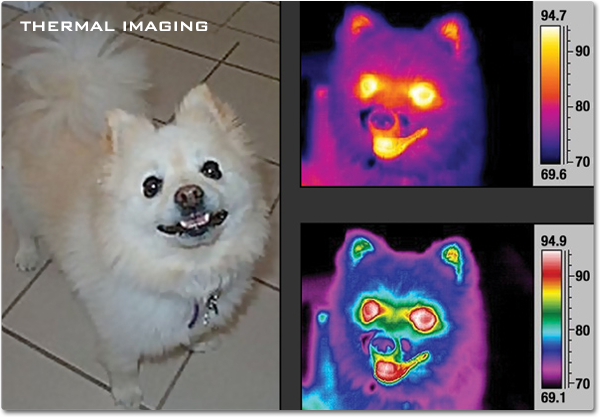
and this would tell us about as much as making infrasound audible.
0:32 - And if you’re in a city or suburb, chances are that similar sounds are emanating just below your hearing range.
Yes, most things we do and use create infrasound. This is like starting a video with a scary infrared image and then saying “And if you’re in a city or suburb, chances are that similar light is emanating just below the range you can see it.”

0:39 - And I have some bad news for you. A meta-analysis suggests that it can actually be pretty harmful to your health.
He flashes three papers on the screen here. He doesn’t link any of them in the video description. None of them support what he’s saying at all, they all go completely against it. None of these are a meta-analysis showing infrasound is harmful.
The first is an occupational measurement paper that implies infrasound is safe at levels hundreds of thousands of times more intense than anything people regularly experience in their homes, even in loud places. The second is part of a 3-part research project where the final report is called “Infrasound Does Not Explain Symptoms Related to Wind Turbines.” The third is a NIOSH workplace report that explicitly concludes the sound levels it measured are not known to cause negative health effects.
The first paper paper is “Exposure to infrasonic noise in agriculture.”
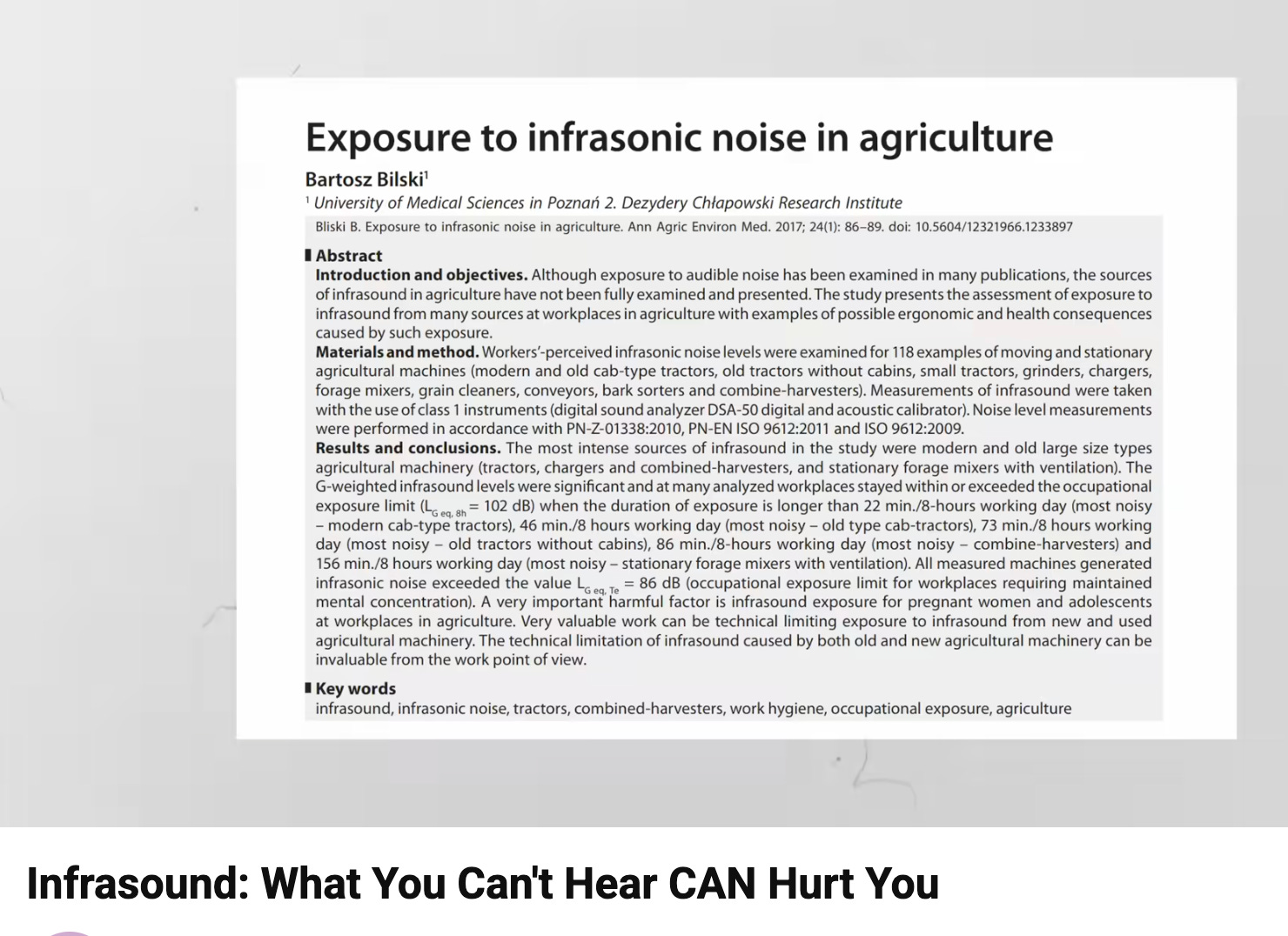
It’s an occupational exposure assessment for Polish farm workers. The author took a sound meter to 118 pieces of farm machinery in Poland and measured the infrasound levels they produce. And that’s all.
It’s not a meta-analysis. The abstract has some speculative language about infrasound having “possible ergonomic and health consequences,” and this is probably what Jordan is pointing at when he flashes the cover. The paper also asserts that “a very important harmful factor is infrasound exposure for pregnant women and adolescents at workplaces in agriculture.” That claim cites older Eastern European occupational health literature that’s never been replicated in modern studies. That older literature comes up over and over in infrasound harm claims. It’s almost all small studies with bad controls, often decades old, that don’t replicate. Most of the serious studies done on infrasound, (as well as meta-surveys of the literature) consistently find that it doesn’t produce noticeable effects.
Geoff Leventhall has flagged this pattern in his reviews of the infrasound literature. Governments set a regulatory threshold for infrasound exposure based on cautious extrapolation from very limited data, and then new papers cite that threshold as if it were evidence of harm at that level. Later papers cite those papers. The chain of legit-seeming papers starts with original evidence that either doesn’t exist or doesn’t replicate. This paper is part of that pattern.
The paper measures infrasound an operator would receive directly on a tractor or combine, with the engine and mechanical systems inches away. The measured infrasound levels here are really high. This doesn’t tell us anything about what everyday people experience in their homes. No source of infrasound (just like no source of regular sound) is nearly as loud as sitting on a tractor.
Worse for Jordan’s later video, the paper compares its measurements to the existing Polish occupational exposure limit of 102 dBG for an 8-hour workday. Data center and wind turbine infrasound at residential distances is typically in the 50 to 75 dBG range. That might sound like a small gap, but remember that decibels are logarithmic. Every 10 dB increase represents a 10x increase in sound intensity, and every 20 dB increase represents a 100x increase.
So this is telling us that even the loudest data centers near people’s homes are several hundred to over a hundred thousand times quieter than what the occupational standard the Bilski paper is using considers safe for a full 8-hour workday of direct exposure. The paper Jordan is flashing as evidence of infrasound harm is, if you actually read it, implying that our regular daily infrasound exposure could be multiplied by 1000 and still be totally safe.
The second paper is “Symptoms intuitively associated with wind turbine infrasound” published in Environmental Research.
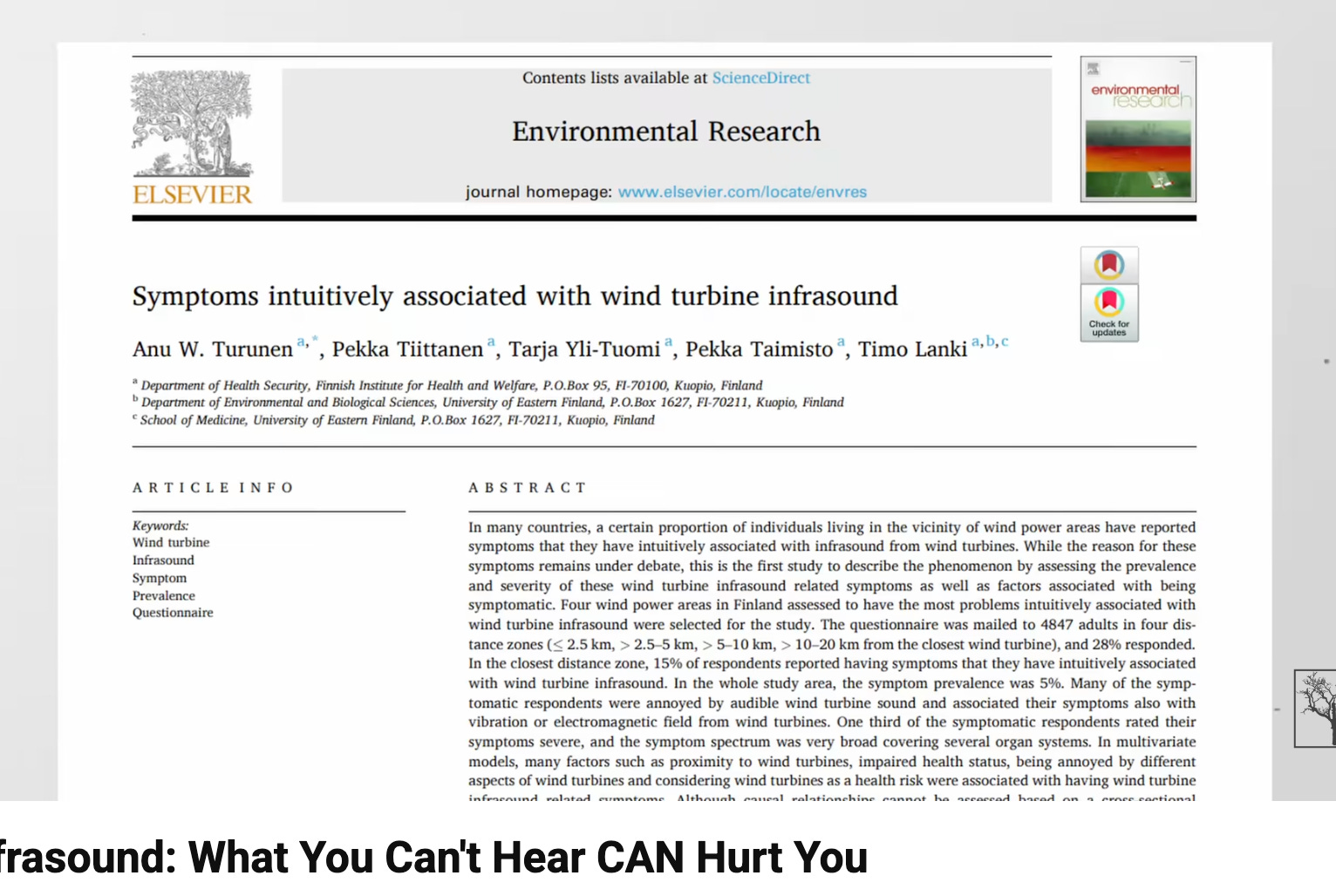
The paper concludes that infrasound had no detectable effect.
The paper is one of the main outputs of a single research project commissioned by the Finnish Government and conducted by the Technical Research Centre of Finland (VTT), the Finnish Institute of Occupational Health, the University of Helsinki, and the Finnish Institute for Health and Welfare from 2018 to 2020. Its goal was to figure out if wind turbine infrasound actually causes the symptoms some residents attribute to it.
The three outputs of the project are:
The paper that Jordan shows. This is only the questionnaire study. Within 2.5 km of a wind turbine, 15% of Finnish respondents said they associated various symptoms with wind turbine infrasound, and the symptoms spanned multiple organ systems. The paper documents what people report and what they believe is causing harm, not whether infrasound actually harmed people.
“Annoyance, perception, and physiological effects of wind turbine infrasound.” Here participants were divided into two groups: people who reported the types of symptoms they attributed to wind turbine infrasound, and people who didn’t. Both groups were exposed to real wind turbine sound recordings, with and without the infrasonic components. Neither group could reliably detect when the infrasound was present. It had no effect on reported annoyance, or measurable effect on people’s nervous system responses. There were no differences between the symptomatic and non-symptomatic groups.
The full final report of the project, published by the Finnish Government under the title “Infrasound Does Not Explain Symptoms Related to Wind Turbines.” Jordan conveniently does not mention this title.
The project found exactly what every other serious investigation of this question has found. Some residents report symptoms, they intuitively attribute those symptoms to infrasound. When you actually expose them to infrasound in controlled conditions, they can’t detect it, it doesn’t produce the symptoms, and it doesn’t produce any measurable physiological response. Looks like a nocebo.
Jordan only shows the first paper where people claim that infrasound caused their symptoms, and never clarifies that the conclusion of this study was that infrasound wasn’t to blame for whatever was happening.
The third paper is “Evaluation of Low-Frequency Noise, Infrasound, and Health Symptoms at an Administrative Building and Men’s Shelter: A Case Study.”
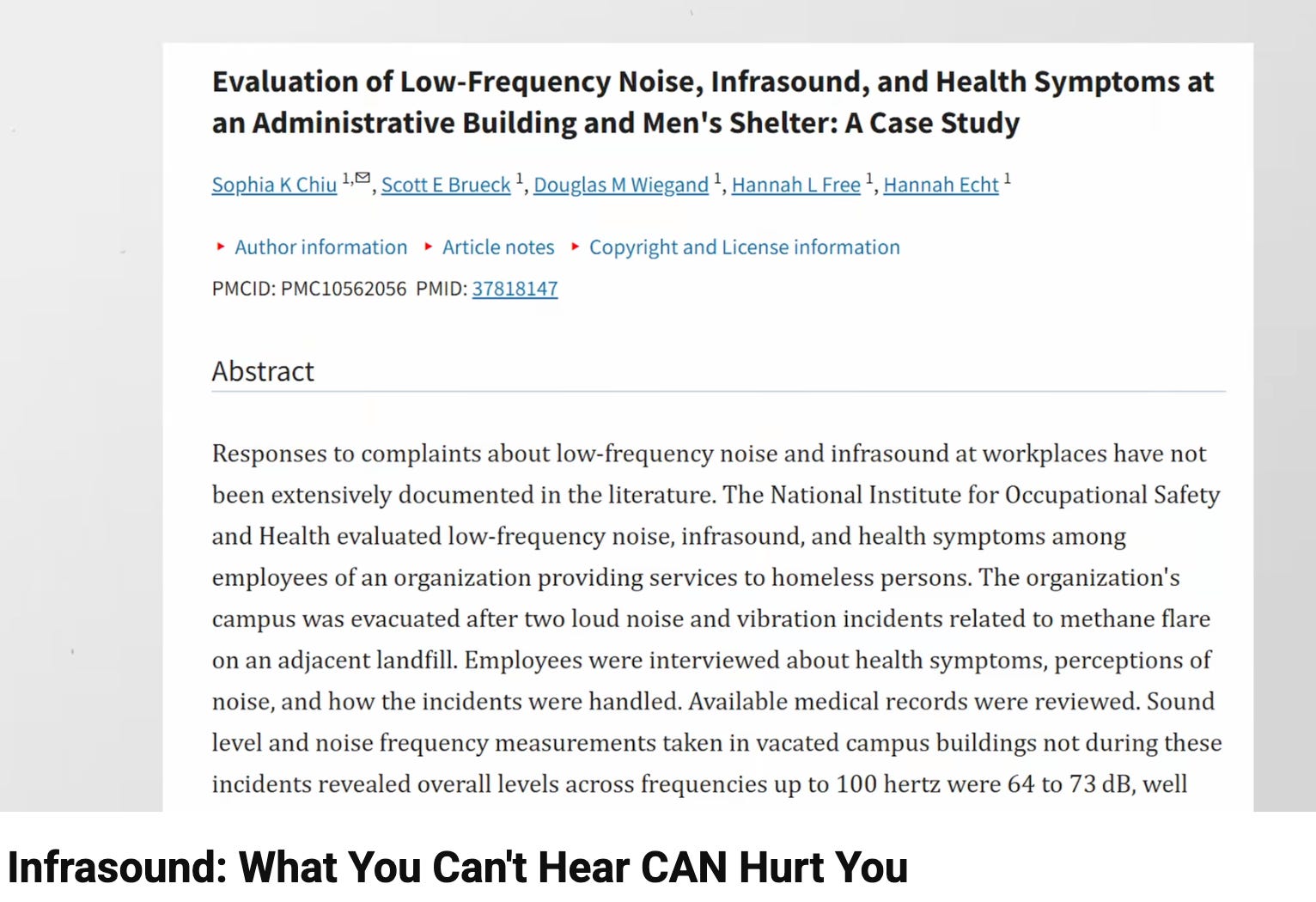
In 2019, a nonprofit serving homeless people had two incidents of loud noise and strong vibrations coming from an adjacent landfill. Employees reported feeling unwell during and after. The buildings were evacuated. NIOSH was called in to conduct a Health Hazard Evaluation. This is the paper documenting that investigation.
The paper is clear that HHEs are workplace investigations to help employers recognize and control hazards. They are not research studies. This one is a descriptive report published after the fact. Its findings don’t support what Jordan is implying at all.
NIOSH arrived four months after the incidents and took sound measurements during normal flare operation. The overall measured sound levels across frequencies up to 100 Hz were 64 to 73 dB. The American Conference of Governmental Industrial Hygienists threshold limit values for occupational exposure to infrasound and low-frequency noise are 145 dB at specific frequencies and 150 dB overall. The measured levels were roughly 77 to 86 dB below the threshold at which harm is known to occur, at least tens of millions of times less intense, and possibly hundreds of millions of times less intense at the quieter end.
The paper proposes explanations for the symptoms employees reported, and none of them involves infrasound damaging the body:
People audibly heard and felt two specific bad events and felt bad.
The normal sound at the site had what’s called an “unbalanced frequency profile”: more energy at low frequencies than at higher ones. This specific type of of imbalance is known to cause annoyance even when the overall volume is low.
A lot of the symptoms people reported (headaches, fatigue, trouble sleeping) are common and nonspecific. When NIOSH looked into the health records of the employees, a significant number had plausible looking alternative explanations for their symptoms.
Employees felt the organization and the county had mishandled the incidents. The paper describes this as a breach of “psychological contract,” meaning the sense that your workplace has become untrustworthy or broken a pact. The paper says this breakdown is affecting how employees experienced their symptoms and why they’re not willing to come back to the building.
The paper’s Limitations section acknowledges that no definitive conclusions about the cause of the symptoms can be drawn.
And in a final twist, the main wind turbine study this paper cites is Michaud et al. 2016, the Health Canada study, and summarizes its conclusion: the study authors did not find a relationship between wind turbine noise and reported health effects such as headaches, dizziness, sleep problems, and stress.
So just to wrap, Jordan’s third piece of evidence here is a paper that:
Measured sound levels well below any known harm threshold.
Explicitly states those levels are not known to cause adverse health effects.
Attributes the reported symptoms to annoyance and a breach of psychological contract rather than direct infrasound harm.
Explicitly refuses to draw causal conclusions.
Cites Health Canada to say wind turbine noise doesn’t cause the symptoms people attribute to it.
The actual meta-analyses and review papers on infrasound are overwhelmingly consistent: there are no health effects unless the sound is loud enough to be perceived, and at that point it behaves like regular noise pollution. There’s no serious meta-analysis that reaches the conclusion Jordan’s implying.
Why did he just flash three papers that obviously don’t conclude what he says? It’s such a bizarre move that my trust in him as a narrator cratered.
0:46 - Have you ever been to a particular place or maybe walked into a building and immediately felt like something was wrong? Like a rather noticeable and intense feeling of discomfort or maybe even fear despite there not being anything notably wrong with the environment. And then the moment you leave that place, you start feeling better.
Your bullshit detectors should be going off. This is a very common part of the human experience. A lot of places just look ominous, and a lot of people have anxiety.
Look at the images he chooses as examples here:

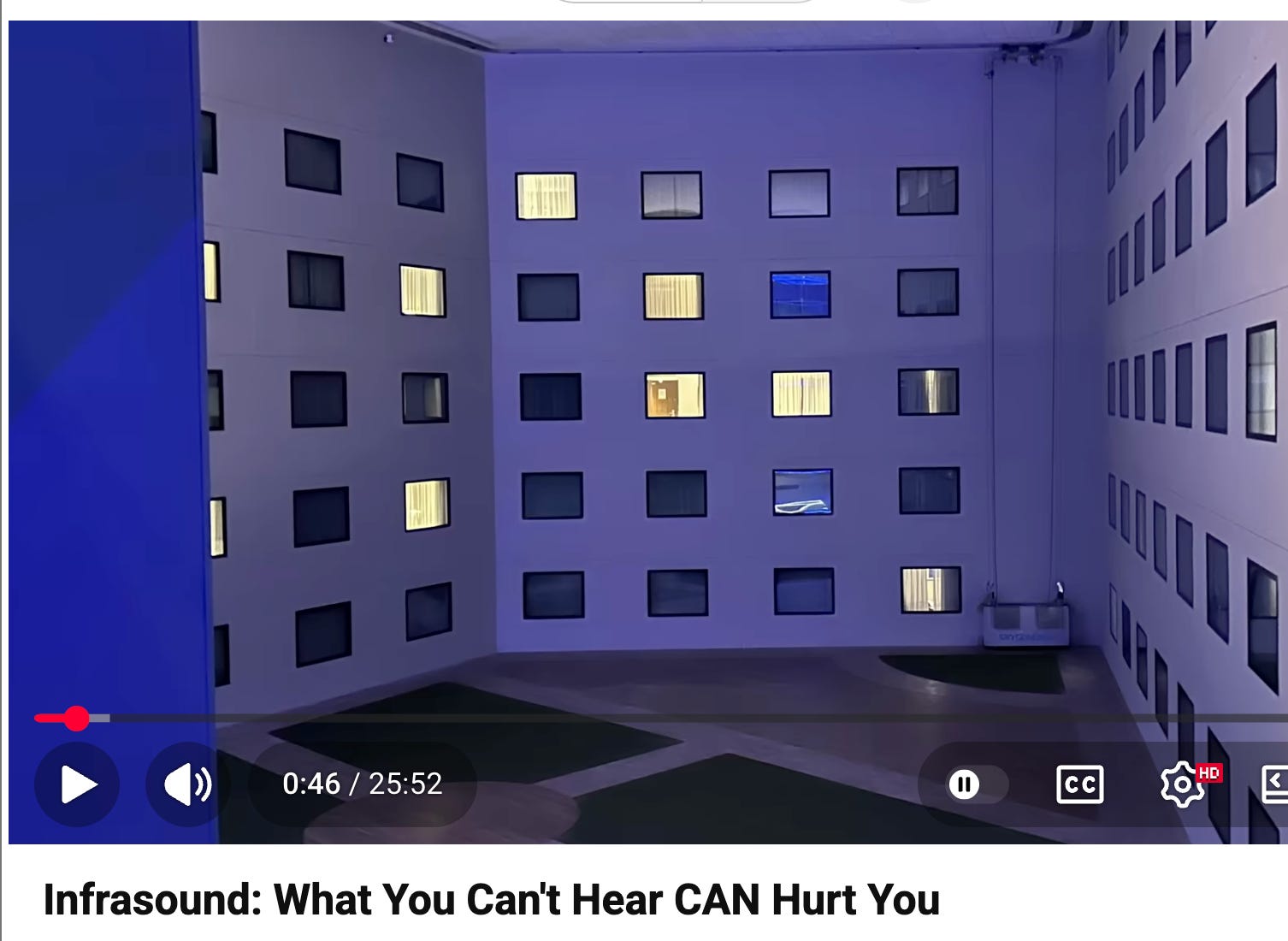
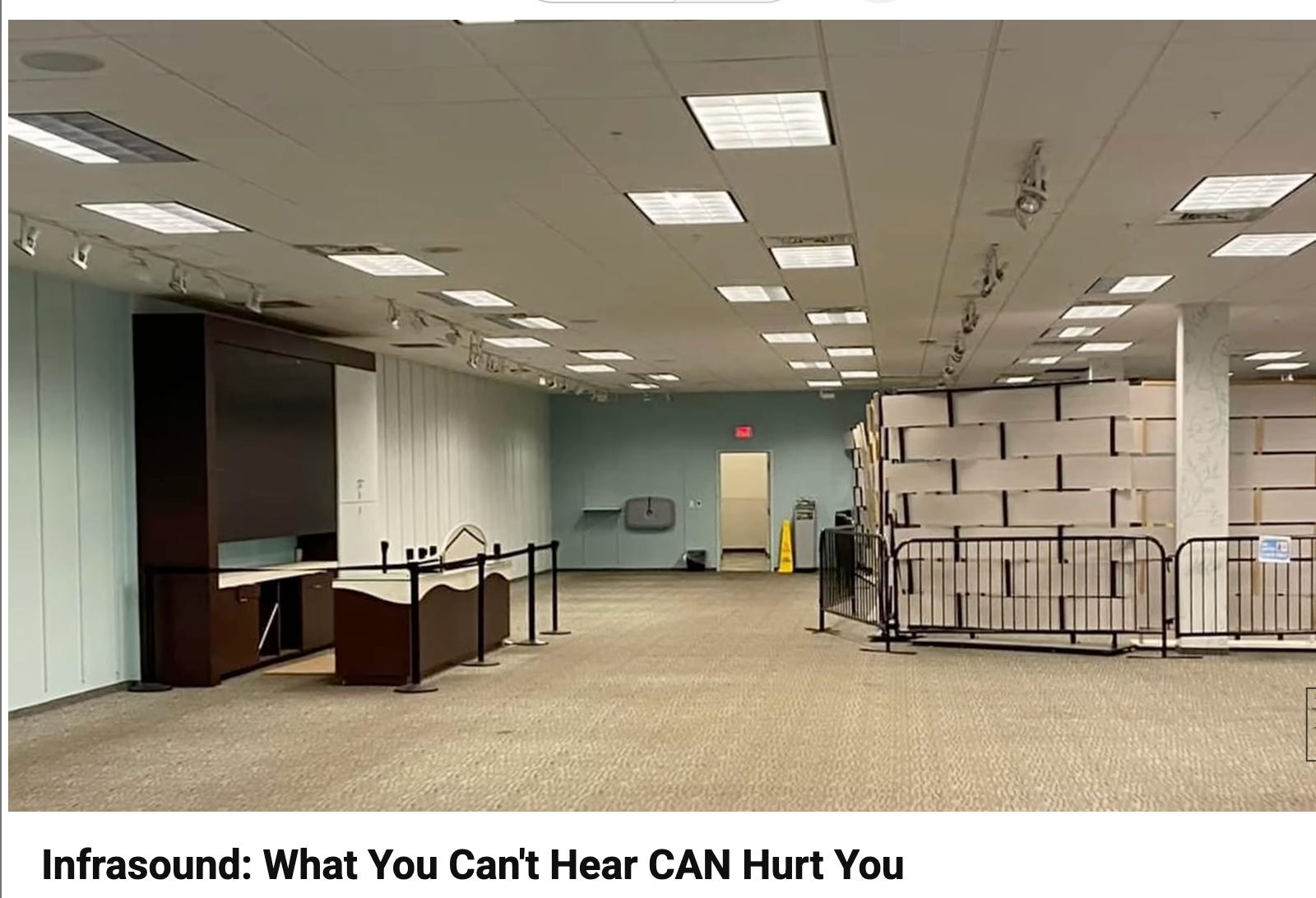

It’s obvious that these are just generally ominous places! The second is a famous image from /r/liminalspaces, which collects pictures of places that feel impermanent, and where you feel transient and possibly uneasy.
0:59 - Well, it turns out that there’s a chance that it wasn’t all in your imagination or anything paranormal. It could have just been infrasound.
All the thorough research that’s been done strongly implies that infrasound doesn’t cause this at all.
1:25 - We’re going to take a close look at the infrasonic research and see how how some types of these sounds can make people enjoy music less or feel incredibly ill.
He flashes this on the screen as he says this:

This is Chapter 11 of the WHO’s “Compendium of WHO and other UN guidance on health and environment” with the WHO, UN Environment, and UNICEF logos displayed. Flashing this implies WHO-endorsed evidence that infrasound makes people enjoy music less or get incredibly ill.
The document says nothing like this.
This is a policy guidance document compiling recommendations across environmental health topics. Chapter 11 is on guidance for environmental noise, listing recommended levels for road, rail, aircraft, wind-turbine, and leisure noise. It doesn’t discuss infrasound as a distinct health harm.
There is no overlap at all between what Jordan is narrating and what the document on the screen actually contains. He’s just showing a completely unrelated government document with health agencies his viewers trust, while saying completely different false stuff about what the infrasound research implies.
1:31 - And according to one famous study, even see ghostly figures near them who aren’t actually there.
He’s referring to Vic Tandy’s “The Ghost in the Machine” article, which he’ll discuss more later. He shows images from various press articles summarizing Tandy’s work, which tend to describe it as more legitimate than it was.
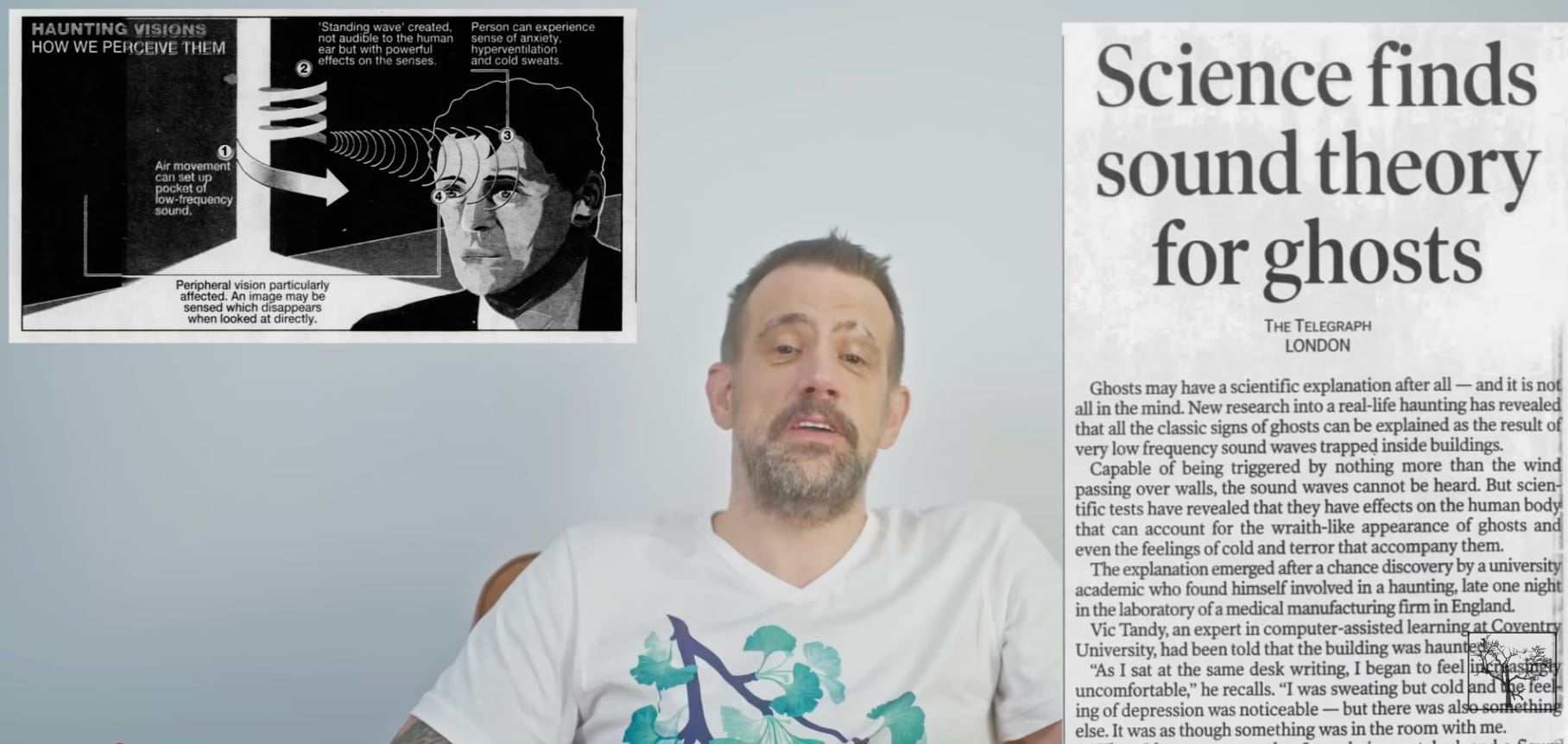
I’ll save the full overview of this article for when he goes into more detail, but for now just be aware that this “famous study” is not a study at all. It’s a personal anecdote from a single guy who felt uneasy after being told the place he was working was haunted, took a single measurement, decided infrasound was the cause, and published the story in a parapsychology journal founded to investigate ghosts. The study never replicated, and was specifically tested and failed when a proper experiment was finally run. Jordan has once again misrepresented his source.
1:40–3:48 - Philosophy of time
This section has nothing to do with infrasound. It’s about Greek concepts of time, water clocks, and objective versus subjective perception.
I normally give YouTube essayists slack here. They’re making videos for people with short attention spans, and tangents are fine. But this video’s already been so deceptive that I can’t help thinking this section exists to prop up the others. It makes Jordan look worldly and well-rounded, and lends credibility to everything else he’s saying. Showing himself making a DIY sun clock is neat, but I’m worried this is a move to look scientific, like a more hip internet-intellectual way of wearing a lab coat in the video.
There’s another really bad move he’s making here. He’s implying our capitalist western culture has trained us to focus on easy-to-measure effects and to ignore our felt subjective sense of what’s going on. He seems to be using this to open the door to wild claims about things that are invisible to our daily experience but can still harm us. The things he’s about to talk about aren’t actually invisible to the measurement tools of science, just to our senses. His next move is to use this setup for a wild connection between two different invisible things: UV light and infrasound.
3:48–4:34 - UV and infrasound
4:02 - Only when the wavelength of light enters the human visible spectrum do we call it a color. We can’t observe higher wavelengths like ultraviolet, but we can observe the effects of it when it burns our skin or causes cancer. And if you keep cranking up the frequency of invisible light to X-ray and gamma, even lower levels of light can eject electrons from atoms... And for you or I, that means death. A lot of death. It goes without saying that when waves of pressure happen between 20 and 20,000 times per second and become audible to us, do we call it a sound. And while pressure waves above our range of hearing can give us headaches and hearing damage, it fortunately doesn’t do anything as dramatic as rearranging atoms. But medical research is starting to trickle out data about the sounds that are happening below our range of hearing. And things are looking quite a bit more sinister.
As a former physics teacher, this section was torture.
He’s setting up this framing about how things that are invisible to us can still harm us, and then very quickly moves from ‘ultraviolet light can obviously kill us’ to ‘and there’s new disturbing evidence that infrasound can harm us’ without acknowledging the obvious problem that infrared light does not really harm us at all unless it’s so powerful that it heats up our bodies in the way other normal heat sources do. This is the correct analogy to infrasound, not UV light. Just like infrared light can only harm us if it’s powerful enough that we physically feel it in the way we do other heat sources, infrasound can only harm us if it’s so powerful that it causes us to physically feel its presence in the way we do other very loud sources of sound. He’s not so subtly reaching way across this spectrum to say that because something that’s so high energy that we can’t see it can cause damage, maybe something that’s so low energy that we can’t hear it can cause damage too.
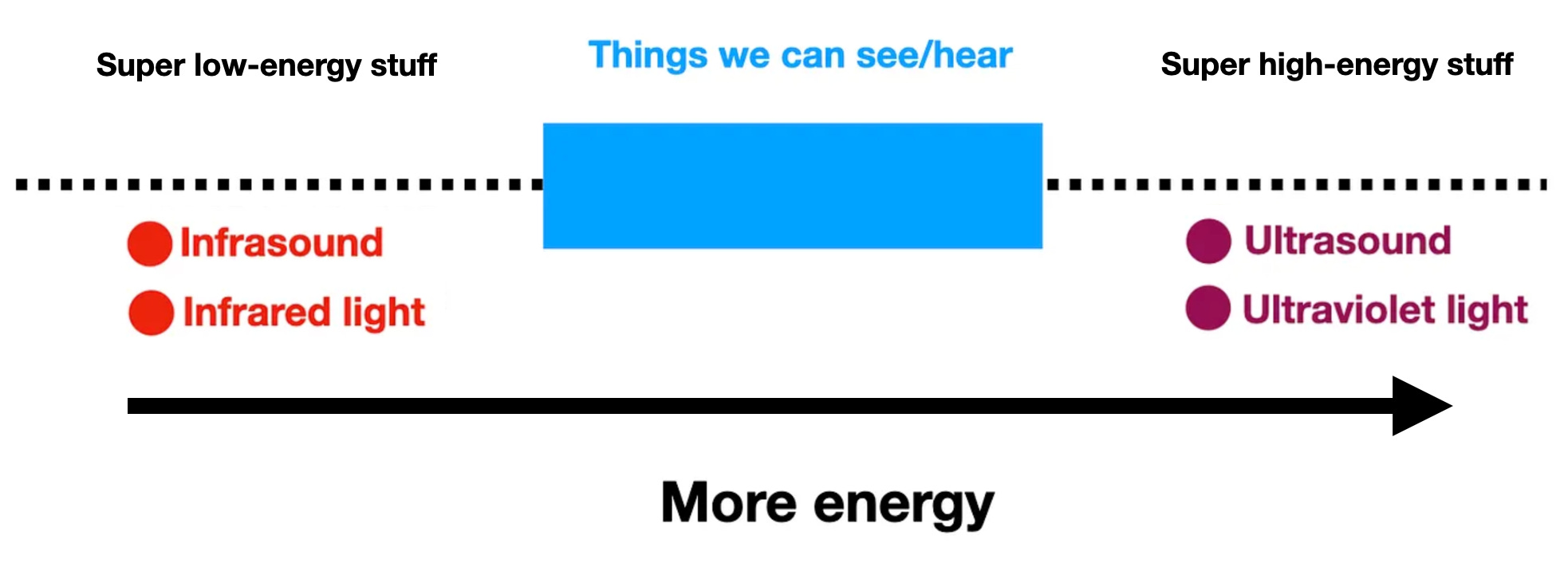
In your everyday life you probably don’t spend much time thinking about prices measured in fractions of a cent, or in tens of millions of dollars. Both amounts are “invisible” to your daily experience, but for opposite reasons. What Jordan’s doing is kind of like saying “Because you never think about tens of millions of dollars, other money amounts you don’t think about might also damage your wallet if you spend them, and there’s new evidence that fractions of a cent can harm your wallet too.”
“Things are looking quite a bit more sinister” is doing a lot of work. The medical research is not “trickling out” and is not at all sinister. As covered above, we’ve had decades of solid research, and the conclusion of all serious scientific work on this is incredibly consistent.
4:50–5:21 - The symptom list
4:50 - For example, research has strongly suggested that infrasound can cause headaches, fatigue, loss of concentration, mood changes, depression, sleeping disorders, panic disorders, nausea, dizziness.
The research he cites doesn’t say this at all, but first I need to note that a long list of basically anything and everything bad you might experience in your everyday life is a common signature of a nocebo. Think about how infrasound compares to any other exposure to something bad for us. Carbon monoxide or lead poisoning produces very specific symptoms. Even normal noise pollution has very specific symptoms like hearing loss and cardiovascular effects of chronic sleep disruption. They don’t have these incredibly general long lists of symptoms.
What are the studies he’s flashing on the screen here to support this?
Well, first he puts this map of infrasound science up on the screen:
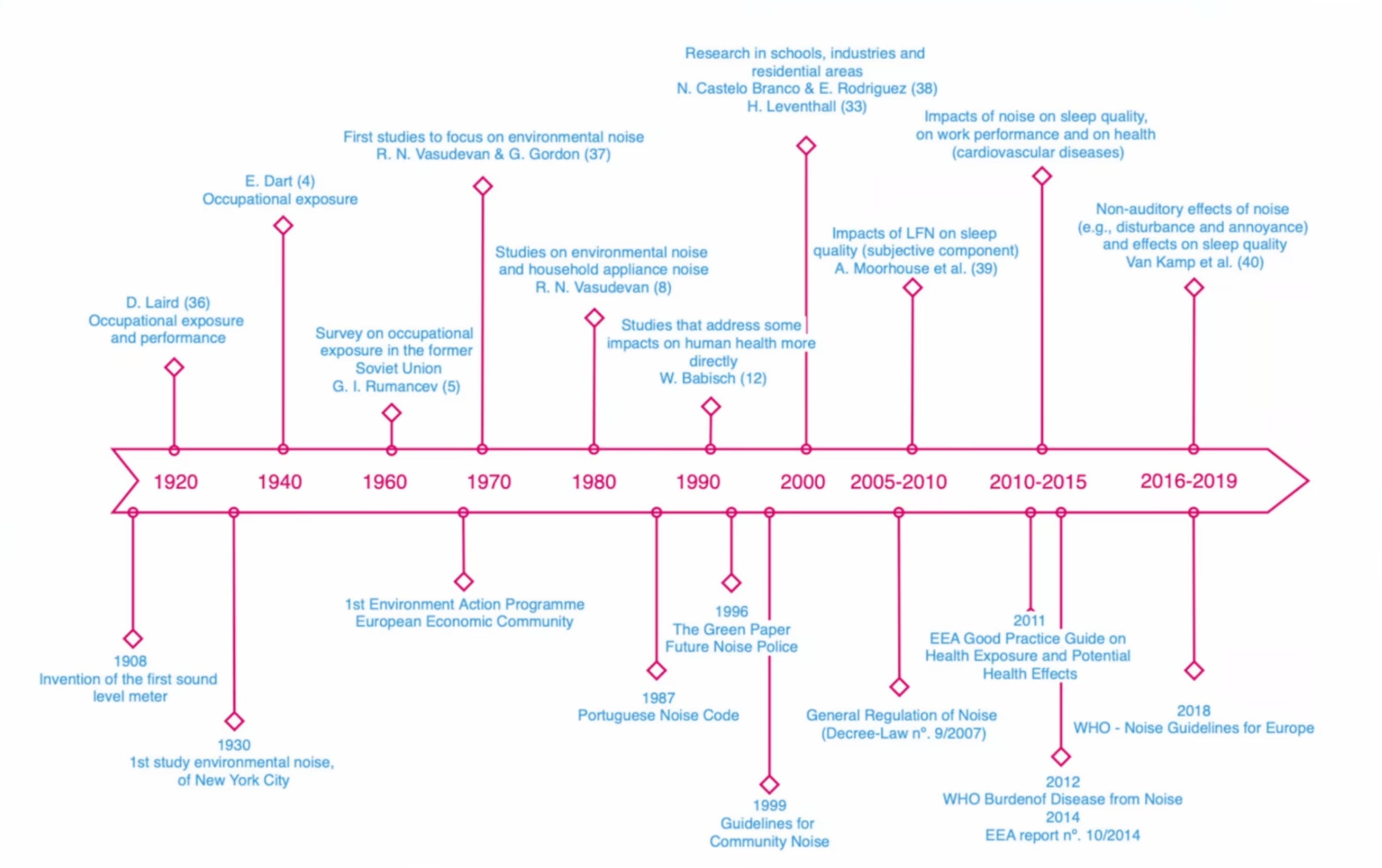
This looks authoritative and implies a century-long scientific history of studying the harms he’s discussing.
The image is from the 2020 paper “Low-Frequency Noise and Its Main Effects on Human Health — A Review of the Literature between 2016 and 2019,” published in Applied Sciences by four researchers at the University of Minho in Portugal. The timeline is a history of the general low-frequency-noise research field.
But he’s tricked his viewers again. The paper is about low-frequency noise, not infrasound. Those are not the same thing here. Low-frequency noise typically refers to the audible range roughly between 20 and 200 Hz, infrasound is below about 20 Hz and is generally inaudible. The paper uses “low-frequency noise” throughout and only occasionally touches infrasound specifically. So the timeline isn’t even a history of the field Jordan is claiming support from.
The paper doesn’t conclude what he’s implying at all. It’s mainly analyzing audible noise, not infrasound. He’s confusing audible lower frequency noise (roughly 20-200 Hz, which you can hear) with inaudible infrasound (below about 20 Hz, which you mostly can’t). The paper finds a lot of health effects from regular audible noise pollution, like annoyance and sleep disorders. The paper explicitly excludes inaudible infrasound. In the methodology, “low-frequency sound/infrasound” is listed as one of nine categories in the 142-paper database, but it’s deliberately not among the three categories selected for the 39-paper in-depth review. The paper doesn’t comment on whether infrasound is harmful or not.
The next section is even worse. He flashes and says a ton of individual symptoms described by the paper:
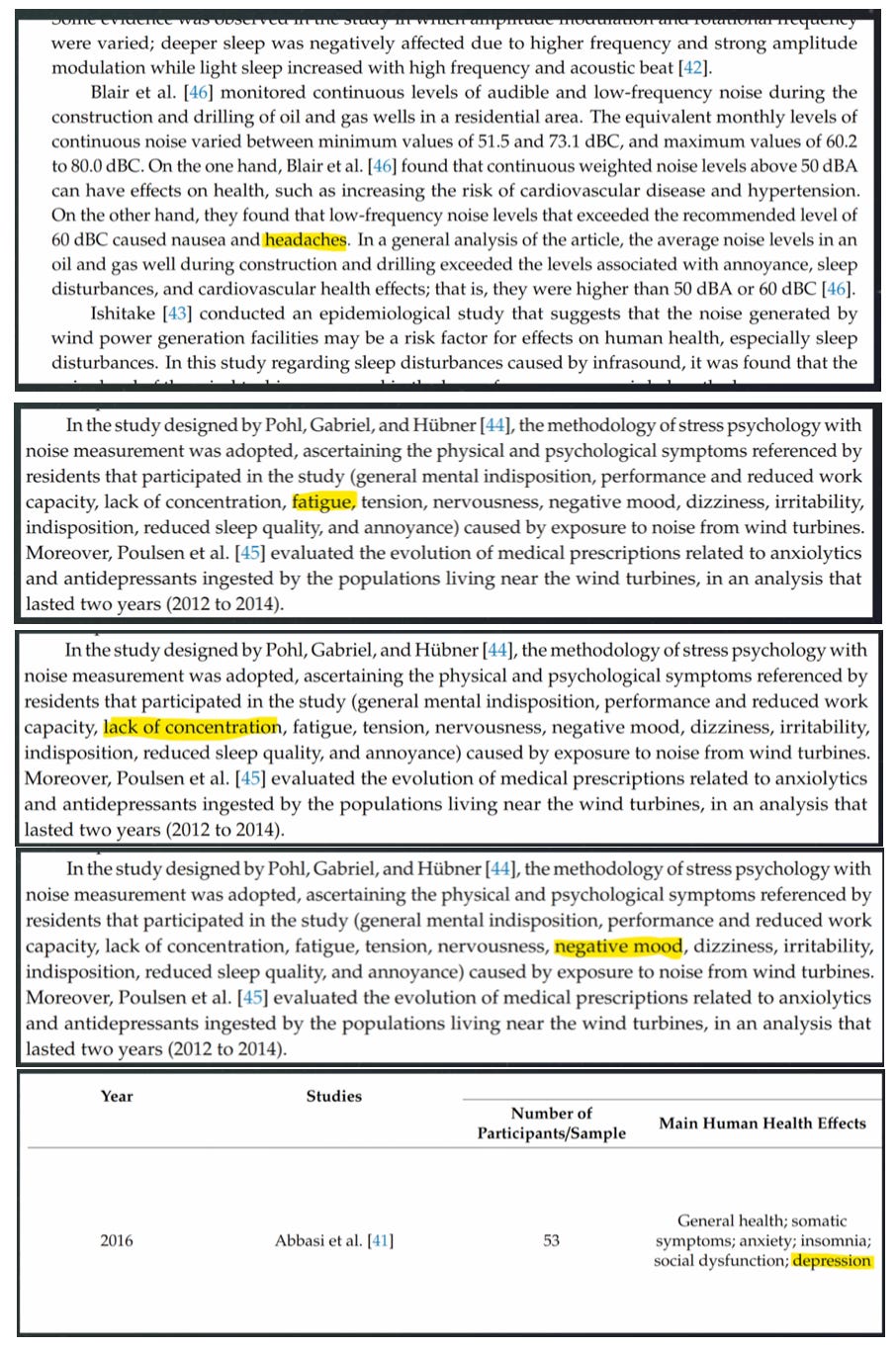
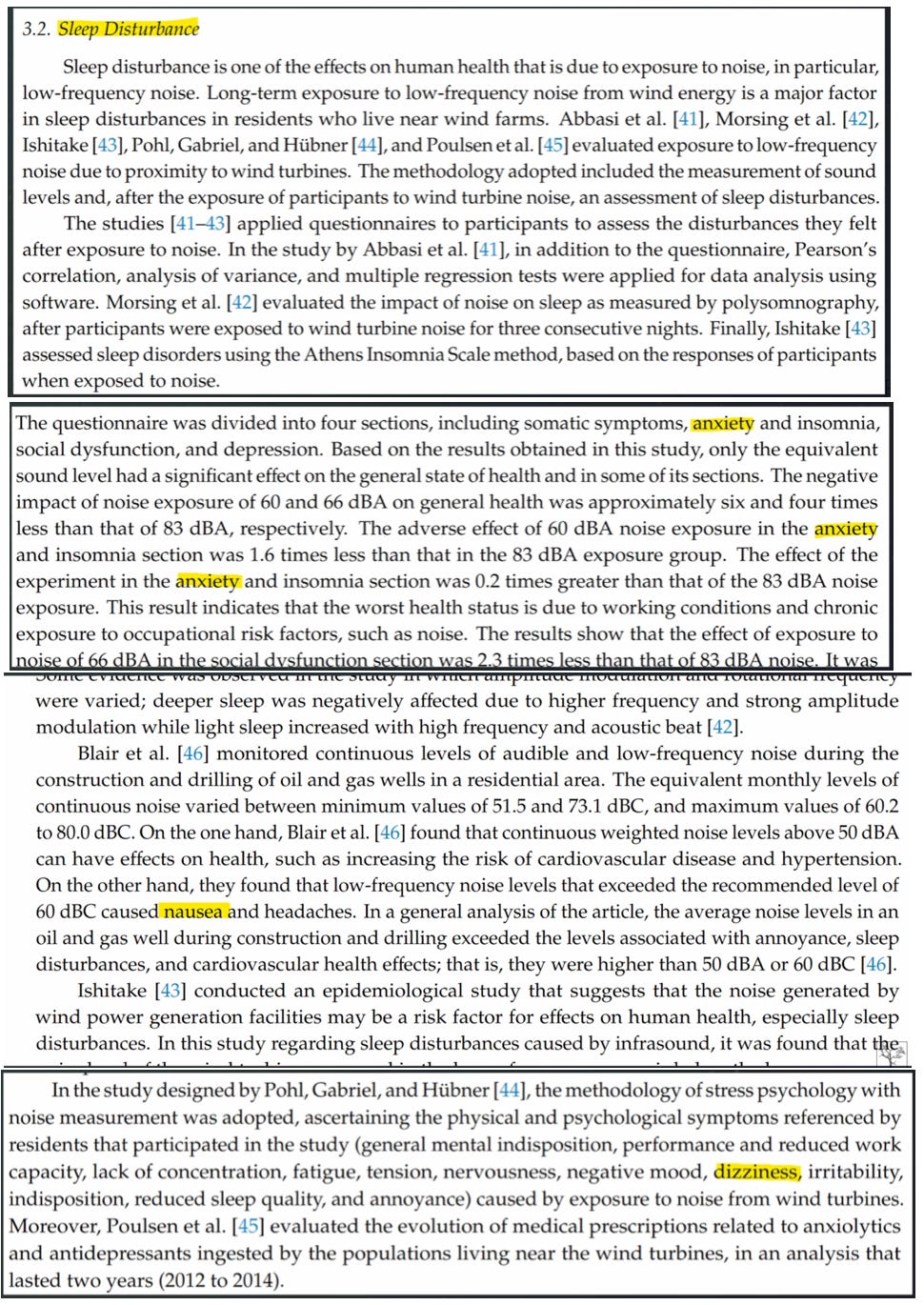
Not one of them is attributed to infrasound by the paper he’s citing, they are literally all caused by audible noise:
Headaches and nausea come from Blair’s study of oil and gas well construction and drilling in a residential area. The paper is explicit that this was from continuous noise measured at 51.5 to 80.0 dBC, with headaches and nausea reported when levels exceeded 60 dBC. The “C” in dBC refers to C-weighting, a measurement scale for audible sound that captures low-frequency components. 60 dBC is roughly the loudness of normal conversation. The study wasn’t measuring inaudible infrasound, it was measuring the audible din of heavy industrial drilling next to people’s homes.
Fatigue, lack of concentration, negative mood, and dizziness all come from the same sentence in the Pohl, Gabriel, and Hübner wind turbine study. And here Jordan is doing something more deceptive. These aren’t the results of a study, they’re options from a survey checklist, the list of 12 symptoms the researchers asked residents about. Quoting the paper: “ascertaining the physical and psychological symptoms referenced by residents that participated in the study (general mental indisposition, performance and reduced work capacity, lack of concentration, fatigue, tension, nervousness, negative mood, dizziness, irritability, indisposition, reduced sleep quality, and annoyance).” This is just the questionnaire the surveyors handed out.
And what did the study actually find when residents were asked? The exact opposite of the picture Jordan is painting. Pohl concluded “the annoyance experienced was very low.” Only 8.5% of residents in 2012 reported any feelings of pressure related to the wind farm, dropping to 6.8% by 2014. Only 6.1% reported felt vibrations in their body, dropping to 3.8%. Symptoms of dizziness, one of the words Jordan highlighted, “were not observed in this study.”Anxiety and depression come from Abbasi’s study of wind turbine maintenance workers, who stand on and close to them. The study’s exposure levels were 60, 66, and 83 dBA. This is clearly audible, occupational noise. The paper’s own summary of the findings emphasizes that “the worst health status is due to working conditions and chronic exposure to occupational risk factors, such as noise” and that the harmful effects were concentrated in the maintenance team who were “in the vicinity of wind turbines, due to the reception of very intense noise.” In other words, the study’s own framing is that these effects track with exposure to loud audible noise, not infrasound.
Sleep disturbance is discussed across several studies the paper reviews, and again the attribution is to audible noise. The paper says directly: “Long-term exposure to low-frequency noise from wind energy is a major factor in sleep disturbances in residents who live near wind farms.” Note the framing: low-frequency noise, not infrasound.
When the study did look into infrasound, it observed “the noise level of the wind turbine measured in the lower frequency range is below the human sensory threshold” and the paper seems to treat this as evidence that it’s not causing harm. The paper does not argue that inaudible infrasound causes the sleep disturbances. It blames them on audible low-frequency components.
Jordan has now completely misrepresented all 11 studies he’s mentioned in the first five minutes of the video. 7 imply the exact opposite of what he’s claiming they do, 3 are completely unrelated to what he’s saying, and the only one that agrees with him isn’t a study at all, it’s a one-off anecdote written in a publication that mainly studies ghosts. From what I can tell his follow-up to this video is the most popular new piece of media made about data centers so far this year.
5:04 - I am very aware of the placebo effect and of course disclude my personal experiences with generated infrasound here in my lab when making this video. But I can tell you subjectively that it very much sucked. And even after turning the infrasound off, it took a while for things like intense nausea and dizziness to subside.
He’s confusing the placebo with nocebo effect here, but either way this is silly. He put himself in a position to experience the nocebo effect, and then he experienced it, and said “but it very much sucked.” I’d like a little acknowledgement that literally all good science points to this being a nocebo.
5:21–5:51 - The heart-contraction study
5:21 - A few years ago, a large published and peer-reviewed medical study showed that 100 dB of infrasound, primarily around 10 hertz, caused a very negative effect on the heart’s ability to contract with a 9% decrease in contraction force for every 10 dB above that. Your heart, an organ that some people would argue is necessary for survival, has to work quite a bit harder when you’re exposed to high levels of infrasound. And this is on top of quite a bit of animal research suggesting negative effects on heart, liver, nervous system, and lungs.
Jordan flashes “Negative Effect of High-Level Infrasound on Human Myocardial Contractility: In-Vitro Controlled Experiment” as he’s saying this.
You might be surprised to learn the full context of this paper implies something different.
Researchers at the University Hospital of Mainz took small samples of heart muscle tissue from patients having cardiac surgery, mounted them on tweezers in a laboratory apparatus, stimulated them electrically to contract, and exposed them to infrasound at 100 to 120 dB at 16 Hz for an hour. They measured a decrease in contraction force. That’s it! The whole study’s just that.
Jordan gets the decibels a little wrong. He says “100 dB.” The experiment actually tested 100, 110, and 120 dB. The dramatic effect mostly happens at 120 dB. In the same journal, two peer-reviewed critical responses of this paper were published and linked directly from the top of the PubMed Central page he’s screenshotting. They completely demolish the original paper. Did he notice this?
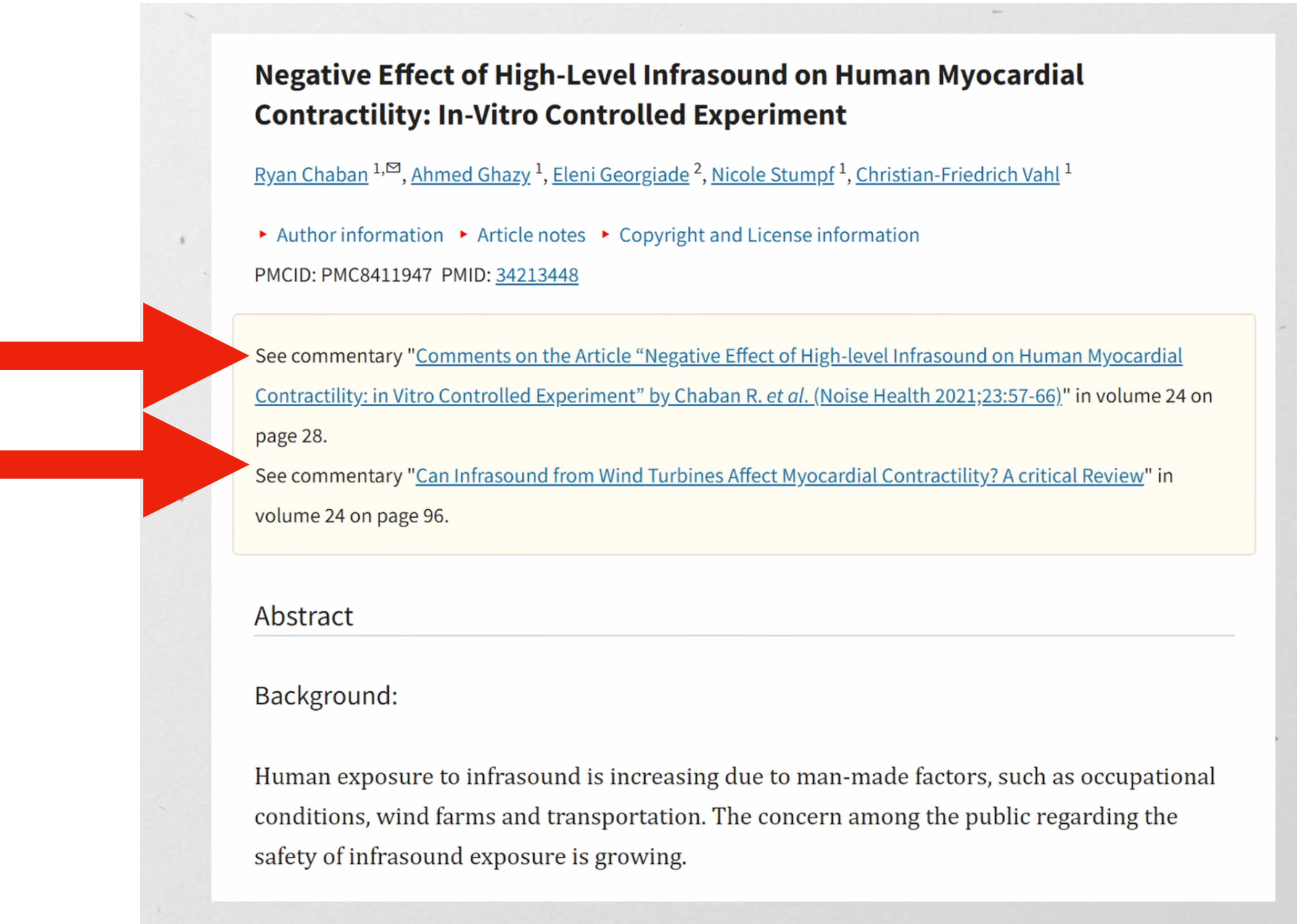
Here are the links:
Three big fatal problems with this paper:
The critical reviewers found that Chaban’s apparatus produced excessive air movement, which caused the tips of the tweezers holding the muscle samples to vibrate. The muscle samples weren’t behaving differently due to the infrasound. They were being mechanically shaken by vibrating tweezer tips in the near field of the sound source. The critical review concluded: “The results of the paper of Chaban et al. are invalidated by a physically inappropriate setup that produces excessive air movement, not present in a regular sound wave of the same sound pressure in the far field.” Their overall conclusion: “Chaban et al. identified an artificial problem that doesn’t exist in reality.”
The reviewers pointed out that the total acoustic dose, the amount of pressure energy delivered over time, that caused an 18% decrease in contraction force in Chaban’s experiment (one hour at 120 dB) is matched by a single cycle of a swimmer doing the breaststroke. Every time a swimmer pushes their arms forward and back, the pressure their chest experiences from pushing through water equals or exceeds the total acoustic energy Chaban’s lab spent an hour blasting at dead tissue samples. If Chaban’s finding mapped onto anything biologically real, competitive swimming would be incredibly dangerous.
Infrasound never reaches anywhere near Chaban’s experimental volume in people’s homes. Wind turbine infrasound at typical residential distance from large modern turbines is about 65 dB, measured in high wind conditions at 200 m distance. Data center infrasound at residential distances is in a similar range. That’s 55 to 65 dB below what Chaban tested, a factor of hundreds of thousands in acoustic intensity.
I’m starting to think Jordan isn’t the most reliable narrator.
He pairs this paper with a vague appeal to “quite a bit of animal research suggesting negative effects on heart, liver, nervous system, and lungs.” He does not name the research. What he is gesturing at is the body of work around “vibroacoustic disease” or VAD, a hypothetical condition developed in Portugal starting in the late 1980s by a surgical pathologist named Nuno Castelo Branco and an engineer named Mariana Alves-Pereira.
Their big claim is that long-term exposure to low-frequency noise causes a “whole-body systemic pathology.” This includes thickening of heart tissue, respiratory damage, cognitive decline, epilepsy, increased rates of tumors, depression, and eventually death. It’s a lot of responsibility for a single environmental mechanism! And this is the basic source of every claim about animal research and infrasound damaging organs.
VAD has never been accepted by any mainstream medical body or independently replicated in the 40 years since it was proposed. The UK Health Protection Agency reviewed the evidence in 2010 and concluded that the disease “has not gained clinical recognition” and that there is no evidence infrasound at levels normally encountered in the environment causes it. A 2013 meta-analysis of VAD found that the entire “field” is mainly two authors citing themselves to build up the appearance of a larger body of evidence. Leventhall, reviewing the evidence we have, quoted Henning von Gierke, former chief of the USAF biodynamics laboratory, calling VAD “an unproven theory belonging to a small group of authors.”
Their animal studies done use volumes of sound way above anything that would happen in people’s homes. They’re at the volume you’d only get standing next to a jet engine. None of those studies have been replicated by independent researchers outside this specific Portuguese group.
Jordan’s description of “animal research shows effects on heart, liver, nervous system, and lungs” is referring to this goofy individual research group mostly self-citing that hasn’t gained any broader legitimacy in 4 decades.
5:51–6:37 - ‘It’s hard to study’
5:51 - Another pretty scary thing is that this list is likely very incomplete due to the difficulty and lack of research on infrasound. It turns out that not many people want to volunteer to feel super uncomfortable while their organs may get damaged for some reason.
“We just don’t have enough research” is a pretty common move in pseudoscience. It gives you permission to dismiss the actual negative findings in the literature. But the literature on infrasound is not thin, and its findings are not ambiguous. Infrasound has been studied a lot! There are now decades of papers, trials, and large studies, and literature reviews from multiple countries, and they imply he’s wrong. He’s misrepresenting the state of the research here.
6:07 - If you look into this, a lot of the research that goes into the health effects of infrasound is overwhelmingly concentrated on infrasound caused by wind turbines. And yes, wind farms do generate infrasonic noise pollution. And it turns out that a lot of this research is either partially or completely funded by the fossil fuel industry to try and find something nefarious or wrong with wind energy.
This is an incredibly weird way to frame the actual research. Most of the infrasound research has been done in response to fossil fuel industry claims that wind farms cause harm, and the good studies have all shown they don’t. What Jordan is not-so-subtly implying is that the infrasound research is invalid because fossil fuel money touched it. In reality, basically every good study on infrasound cuts against the fossil fuel industry’s claims.
He does to his credit at least flash the Wind Turbine Syndrome Wikipedia page, which is a good debunking.
6:31 - And this situation is a major problem in science and research. I did a video covering some of this here
You might think that this video explains how the fossil fuel industry has messed with infrasound research.
I watched the video he flashed on the screen. In it, he’s growing wheatgrass and chia seeds in his home. He plays a 4,000 Hz tone at 72 dB at his plants for twelve days, observes that the plants that got the sounds grew about 28% more biomass, and speculates about why. The video has some reflections on Gödel’s incompleteness theorems, the replication crisis, and his own decision not to go to college.
In this video Jordan also completely inverts what the replication crisis is:
The replication crisis is more about researchers not being funded to reproduce their own or other studies and some of that is probably because of capitalism.
This is not what the replication crisis is. The replication crisis has been the rolling discovery that when researchers do try to reproduce published studies, a huge proportion of them fail. Recently it was found that of 100 psychology studies, only 36 replicated. In a similar study of cancer biology, only 40% replicated. A lot of similar levels of replication have shown up in other fields. The replication crisis is about the validity of the studies themselves, not the funding for replicating them like Jordan seems to think.
This matters because the whole video arguing that institutional science is corrupted by capitalist and credentialist, so not to be trusted. Jordan explicitly tells viewers “there’s a major war on truth and objectivity happening right now” (I definitely agree with him that in the exact moment I’m watching this video, a major war on truth and objectivity is occurring!) and that the replication crisis has been used “to discredit the effectiveness of research and scientific method.”
This is what Jordan tells viewers he’s “covered some of” in that link at 6:37. You’d expect that the video would cover the fossil fuel industry affecting infrasound research. It’s actually a goofy argument based on a complete misunderstanding of the replication crisis, and it implies you should trust independent YouTubers doing their own experiments instead. He seems to be preemptively dismissing a lot of scientific literature on infrasound, because it’s “capitalist” or whatever.
His own n=1 wheatgrass experiment is actually a pretty obvious example the kind of unreplicated finding the whole replication crisis is about.
6:37 - So, yes, wind farms do cause infrasonic noise pollution, while fracking in Texas, Oklahoma, British Columbia is literally causing record-breaking earthquakes. And how does the infrasound from all this fracking affect people? We don’t really know ‘cause we haven’t studied it nearly as much as wind farms.
The fracking point is wrong. The research on infrasound from other sources also applies to fracking. We don’t need a specific study on infrasound from fracking. This idea that we need a new study on every individual industrial source of infrasound before we can make conclusions is a way of creating permanent uncertainty. We don’t need to do a study on the audible sound from every industry either. He seems to be trying to separate himself from the main way infrasound pseudoscience has been badly used in the past: by attacking wind turbines. I don’t think he gets to have it both ways here. If infrasound is actually harmful, we should expect to see a lot of harm from wind farms very close to people’s homes, and Jordan would have to at least acknowledge the trade-off.
Also, on the earthquake point, felt earthquakes directly caused by hydraulic fracturing are extremely rare, and the big rise in places like Oklahoma is primarily tied to wastewater disposal.
6:52–8:10 - The Vic Tandy ghost story
6:52 - In the late 1990s, Vic Tandy, a respected lecturer and engineer, was working in a laboratory in Warwick, England that had a long reputation of being haunted. He felt a cold sweat and an intense feeling of depression. And out of the corner of his eye, he saw a blurry gray figure.
Yes, in the late 1990s, Vic Tandy was a lecturer working in a medical equipment lab. The lab had a local reputation for being haunted. People working there had reported feeling uneasy, seeing things out of the corners of their eyes, etc. Tandy himself had an experience like this. He suddenly felt cold and anxious and saw a blurry gray figure in his peripheral vision that vanished when he turned to look at it.
The next day, Tandy was clamping a fencing foil in a vice when he noticed the blade vibrating on its own. He realized a large fan in the lab was producing low-frequency infrasound around 18.9 Hz, and he hypothesized that this infrasound might be what was making people in the lab feel uneasy and see peripheral figures. He published this idea as a short article titled “The Ghost in the Machine” in the Journal of the Society for Psychical Research, a parapsychology journal, in 1998. This wasn’t “a study” the way Jordan describes it. It was a short article speculating about a possible mechanism. Just one guy’s anecdote, no experiment, no controls, nothing.
When someone eventually did try to test Tandy’s hypothesis rigorously (the Goldsmiths Haunt Project, which will be discussed more below when Jordan brings it up) the infrasound had no effect on reported experiences. Participants’ prior suggestibility was the sole thing that predicted whether they felt uneasy. This paper reinforced the idea that infrasound effects are a nocebo.
In both cases, Tandy visited places with strong local reputations for being haunted, where the people he interviewed had already been primed by each other to feel uneasy. It’s very likely this was a nocebo.
7:33 - A large fan was causing infrasonic vibrations around 18.9 hertz. You know what else resonates around 18 hertz? The human eye.
The eyeball resonance thing sounds scientific but isn’t at all. The original NASA study this comes from is about very high energy vibrations in the body. It wasn’t looking at normal levels of infrasound. This is kind of the same as seeing the frequency it takes to push a kid on a swing to get them to go higher and higher, and then concluding that little taps on their back at the same frequency would also make them move higher and higher. The large fan couldn’t have been having the kind of effect the NASA study observed.
7:49 - This would later be published in a rather famous paper titled The Ghost in the Machine.
This is famous in pop-science and paranormal-adjacent writing. It’s not respected in the medical literature. Serious infrasound researchers seem to ignore it. It’s never been replicated under controlled conditions.
7:54 - Soon after this Vic visited another famously haunted place, a cellar in Coventry.
A few years later, Tandy wrote another article called “Something in the Cellar” in the same parapsychology journal. He visited a 14th-century cellar in Coventry visitors had said they felt uneasy in. He recorded with a microphone in the room for 20 seconds, found a 19 Hz peak in the ambient sound, and declared this confirmed his earlier hypothesis. The measured sound level was 38 dB at 19 Hz, which Tandy acknowledges is 50 dB below what humans can hear for that frequency. He suggests the reason this very low sound might still cause people to become uneasy is that some people are hypersensitive to it, and then he cites a New Scientist article about hypothetical military infrasound weapons. So this also wasn’t a “study,” it was a guy going around with anecdotes and random hypotheses. This is not science.
The anecdotes themselves are also pretty bad evidence. He’s in a purportedly haunted cellar! Of course people feel uneasy! Two of the “witnesses” Tandy relies on were self-identified witches who visited the cellar specifically to commune with the spirit world. A third witch was “frightened to death” and left.
Another obvious problem is low-frequency resonances are a feature of almost every partially enclosed space. A cellar’s shape can produce standing infrasound waves.
So the “Cellar in Coventry” paper is a ghost-hunter-reviewed anecdote-plus-ambient-sound-measurement, at sound levels the author admits are below any established threshold for perception, reported in a parapsychology journal, using informants who included self-described witches, in a cellar already known as haunted, and detected normal infrasound levels for cellars. And when it was tested rigorously later, it failed. This is the second piece of Tandy’s case, and it is, if anything, weaker than the first.
8:00 - It’s not the most conclusive study in the world, but pretty damn interesting
This is definitely the pattern yes.
8:10–10:09: Backyard recording
This section frames it as mysterious and maybe significant that he can’t identify the source of the infrasound he’s recording outside. This is silly. There’s a continuous soup of infrasound from a lot of sources outside. Distant traffic or HVAC or wind or the ocean. Thunderstorms hundreds of miles away. He does at least clarify at the end of this section that infrasound can travel far.
The fact that he can’t identify specific sources for specific rumbles is because infrasound propagates extremely well over long distances (which he acknowledges later) and that there are innumerable sources creating it constantly.
When he says “Wow, I am not jealous of the people who live nearby” he’s blurring the line between commenting on noise pollution vs. infrasound harms. The first one’s real, second one’s fake.
He throws in a wind turbine and makes what I think is a pretty obvious point that the wind turbine isn’t as loud as a train starting up at close range or the world’s busiest airport. He’s doing this in part to distance himself from the anti-wind activists on his side of the infrasound debate. I don’t think he should get to have it both ways here. If he thinks infrasound is a problem, he needs to acknowledge that wind farms create it, and that living near a wind farm exposes you to new levels of infrasound. He can say “that’s bad, but worth it to have the wind farm” or agree with me instead and say “that’s fake, build the wind farm, don’t listen to the cranks” but he shouldn’t get to imply that wind farm infrasound is fine because it’s not as bad as a train at close range. Throughout the rest of the video he’s implied over and over that similar levels of infrasound as wind turbines create are bad for you.
10:25–12:00 - The South Dakota detour
10:25 - But I really wanted to hear clear infrasound far away from any form of human infrastructure. And to do that, we had to drive over 1,500 miles to a particular spot south of Badlands National Park in South Dakota on the Oglala reservation.
10:55 - From where I’m recording, the nearest paved road and infrastructure of any type is about 11 miles away, and it looks like this. So not exactly a teeming metropolis. The sound up here is remarkably quiet.
Okay so yes the only way you can get away from infrasound is basically in the middle of nowhere. This seems to cut against the idea that it’s harming us. If all of society is producing it, why are data centers in the next video a unique harm? He hasn’t actually done anything to prove that infrasound is harmful yet. Everything he’s flashed before this has been pretty useless and left the viewer misinformed.
11:38 - But this does not mean that nature is infrasonically quiet. The earth can produce infrasound that humans can’t even begin to compete with. This distant thunderstorm, for example, made a symphony of various rumbles.
This is a pretty important part of the debate that complicates his broader argument. Lots of things in nature like thunderstorms and earthquakes and the ocean create infrasound louder than a lot of what humans have built. It doesn’t seem to make sense from an evolutionary perspective that these sounds would be harmful to us. If ambient infrasound at ordinary levels caused the broad symptom list Jordan describes, everyone living by the ocean would be chronically ill.
12:00 - And there’s some early research and testing on the accuracy of infrasound to detect and predict tornadoes.
This part is actually real, phew! Infrasound can be used to detect and predict tornadoes.
12:08–14:49 - The Yellowstone segment
He drives to Yellowstone to record infrasound coming from geysers, hot springs, and volcanos. This section is pretty. There’s nothing wrong with it scientifically.
14:49–18:00 - The physics detour and SpaceX launch
Jordan explains the physics of why low-frequency sound travels farther. He then uses seismograph data to track a SpaceX launch, showing that it can be detected up to 140 miles away.
The physics here is correct! Low-frequency sound does travel way farther than high-frequency sound. This is why you can hear thunder from very far away. It’s similar to electromagnetic radio waves, which have a way lower frequency than visible light, and can travel way farther.
But we still have zero evidence to think that this very low volume of infrasound traveling very far is actually harmful.
17:18–18:00 - Helmholtz resonance
17:18 - it’s worth pointing out that in many cases, infrasound is actually louder indoors than outdoors, even if the source is coming from outdoors. And this is due to a phenomenon called Helmholtz resonance.
Helmholtz resonance is real, but he’s doing the same thing where he takes a really really loud source of infrasound and compares it to something quite. The idea that Helmholtz resonance in residential buildings makes infrasound loud enough to be harmful is, once again, not supported by any evidence.
18:00–18:56 - The Liverpool Cathedral study
18:00 - In 2003, a group of scientists from the UK National Physical Laboratory held a live musical performance at the Liverpool Metropolitan Cathedral and then took a survey from the audience on how they felt during the music. In some of those music performances, they had a gigantic 23 ft infrasonic cannon tuned to 17.5 hertz, a frequency that didn’t resonate the building in a way where it would shake things or create audible overtones. and they played that tone at 90 dB while some of the music was played to people who were completely oblivious to what was actually going on. It turns out that people were quite a bit more likely to have felt uncomfortable during the performance when the infrasonic tone was playing. And 22% of the audience said that they felt some type of strange or unexplainable effect such as sadness, chills, or even feelings of fear and anxiety.
This is the “Soundless Music” or “Infrasonic” experiment, a 2003 concert at London’s Purcell Room (not Liverpool Metropolitan Cathedral, Jordan has the wrong venue). There were about 700 people there. The experiment collected 522 questionnaires. This study is often misunderstood as implying that the infrasound caused 22% of people to experience something strange.
There are some core problems with this experiment that infrasound researchers have identified. There wasn’t ever a peer-reviewed paper published with the data, and there wasn’t a control group. The 22% number shows the baseline rate of people reporting something strange during evocative music in a dramatic theater. It’s not surprising that some people at a dramatic music concert report feeling strange. And the Goldsmiths Haunt Project (which will be covered next) tested the same hypothesis under controlled conditions and found that infrasound exposure didn’t predict reported experiences. It all depended on how suggestible people were.
18:56–20:16 - The Goldsmiths Haunt Project
18:56 - In yet another study from Goldsmith’s College, four researchers attempted to make a haunted room by filling it with various infrasonic frequencies and EMF or electromagnetic frequencies.
The researchers here built a “haunted room” at Goldsmiths College and had 79 participants stay in it. Each person sat alone in the room for 50 minutes. They were exposed to either infrasound or complex EM fields. People were randomly assigned to one of four conditions: infrasound only, EM only, both, or neither. Everyone was told the room might produce unusual sensations.
After, participants filled out a questionnaire about whether they had feelings of presence, unusual body sensations, dizziness, emotion, or anything else out of the ordinary. They also completed a psychological measure of suggestibility beforehand.
Jordan narrates the study setup accurately, but then he misrepresents what it found.
19:23 - Out of these groups, an average of 3.7 participants in the control group, those sitting in the empty room with nothing unusual happening, had some type of haunted experience. When infrasound was present, this number grew to an average of 5.2 people having a haunted experience.
Jordan seems to ignore the actual findings of this paper. They found that there was no statistic difference in symptoms between the groups exposed to different stuff! The authors very specifically say that the number of reports was unrelated to what the people were exposed to, and that a better explanation was just that some people were suggestible.
19:48 - Now, in my opinion, the study is fun, but not very well organized and definitely not conclusive.
He hedges on the study’s conclusiveness only after having cited its numbers in a way that implies the opposite of what it found. This seems to be timed so that the viewer leaves this segment with the 5.2 vs 3.8 number in their head, and the idea that the science “hasn’t been settled” but is “suggestive.” But the actual published conclusion was that infrasound did not explain the reports.
This is yet another massive misrepresentation of a scientific paper in the video! Jordan presents the paper as if it found the opposite of what it did.
20:16–End - The gear section
The final third of the video is a discussion of his microphone setups, the Raspberry Shake seismograph, accelerometers, and a mention of his “hum” video. This section doesn’t make any big new scientific claims about infrasound harming humans. I’m mainly worried this is yet another way to look more scientific and legitimate.
Conclusion
In a single 25-minute video about how infrasound is bad, Benn Jordan cited as evidence:
A survey of farm equipment that noted infrasound is safe at levels 100,000x what we experience even in noise polluted areas.
A WHO document about noise pollution that doesn’t mention infrasound.
A Finnish government project whose final report is titled Infrasound Does Not Explain Symptoms Related to Wind Turbines.
A NIOSH workplace report that explicitly says the sound levels it measured aren’t known to cause harm and attributes the workers’ symptoms to annoyance and a psychological contract breach.
A literature review exclusively about the bad effects of audible low-frequency noise.
A survey checklist of symptoms as if it were the symptoms subjects actually reported having.
A study of wind turbine maintenance workers at 60 to 83 dBA of audible occupational noise.
A study of people living near oil and gas drilling getting mad at the 80 dBC audible noise.
A heart-muscle paper demolished by two peer-reviewed responses linked from the top of the page he screenshotted, which found the results were caused by vibrating tweezers, that the acoustic dose was matched by a single breaststroke, and that the intensity used was hundreds of thousands of times above anything in a home.
“Animal research” that turns out to be vibroacoustic disease, a hypothetical condition published almost entirely by two authors citing each other for forty years and rejected by every mainstream medical body.
A parapsychology essay written as a personal anecdote by a guy primed by ghost stories, and its sequel, which mainly interviewed self-described witches in a cellar already advertised as haunted at sound levels 50 dB below the perception threshold, and found that they felt somewhat uneasy.
An experiment that found no effect, but Jordan presents it as having an effect.
A study that found 22% of people at a concert with evocative music had strange experiences.
NASA work on eyeball resonance frequencies without mentioning that these harms only appear when you are literally inside a rocket.
The running theme across every study that actually addresses it is that the symptoms people report are real but not caused by infrasound. They’re driven by expectation, annoyance, context, and suggestibility, which is the signature of a nocebo.
He implicitly analogized infrasound to UV light instead of the obviously more comparable infrared light. He used Helmholtz resonance to imply buildings amplify residential infrasound until its harmful without giving any actual evidence of harm. He called infrasound “grossly understudied” when it’s one of the most thoroughly studied topics in noise research. He implied the fossil fuel industry suppressed infrasound research when the fossil fuel industry is in fact the main funder of the pseudoscience he’s promoting. He claimed fracking infrasound needs its own dedicated research before we can conclude anything, despite fracking causing the same levels of infrasound as a ton of other sources.
He told viewers he had a separate video explaining the politics of all this. In that video he inverts the replication crisis, dismisses relying on credentialed scientists as “a really poor or weak scientific argument,” calls institutional gatekeeping a bigger threat to science than replication failures, and presents his own n=1 wheatgrass result as meaningful.
And this is, from what I can tell, the lead-in to what I think is the most popular piece of media made about data centers in 2026 so far.
Which brings us to the second video.
Second video - Datacenters Behaving Like Acoustic Weapons
Well now we can finally talk about data centers I guess.
I’m going to work through this in roughly the order of the video. There are three key ideas Jordan is blurring together here:
Audible noise pollution from data centers, which is real and harmful.
Ambient infrasound from data centers, which his own data shows is unremarkable. This is a fake problem.
The symptoms residents are reporting, which are real, but whose cause is the audible noise plus stress, not the infrasound.
The video’s central move is to associate 3 with 2, whereas in fact it’s all caused by 1
0:00–1:29 - Intro
0:00 - If you’re in the demographic of people who generally get recommended my videos, then chances are that you are not a fan of data centers.
As I said at the start of this post, he’s using this nuance as a credibility shield. It works on viewers because it reads as a signal that he’s willing to acknowledge nuance, but it’s really a way of pre-buying permission to make crazy uncharitable claims about an industry the audience already dislikes.
1:04 - Spoiler alert, the results are terrifying.
Spoiler alert, they reduce to random statistical noise in a terribly designed study by Jordan
1:36 - regardless of where your ethical, environmental, political, or economic interests are, if a data center is being built nearby your home, you’re generally kind of f*****.
Obviously I disagree. Data centers (with a few exceptions, like xAI, which comes up later in this video) mostly don’t seem to have harmed people. I don’t think the citizens of Loudoun County, one of the top 5 wealthiest counties in the country and home to the most data center capacity in the world, are “generally kind of fucked.”
1:56 - Last year I started hearing about some mysterious and troubling symptoms from people who live nearby newly constructed data centers
Jordan seems somewhat addicted to flashing completely unrelated studies on the screen.
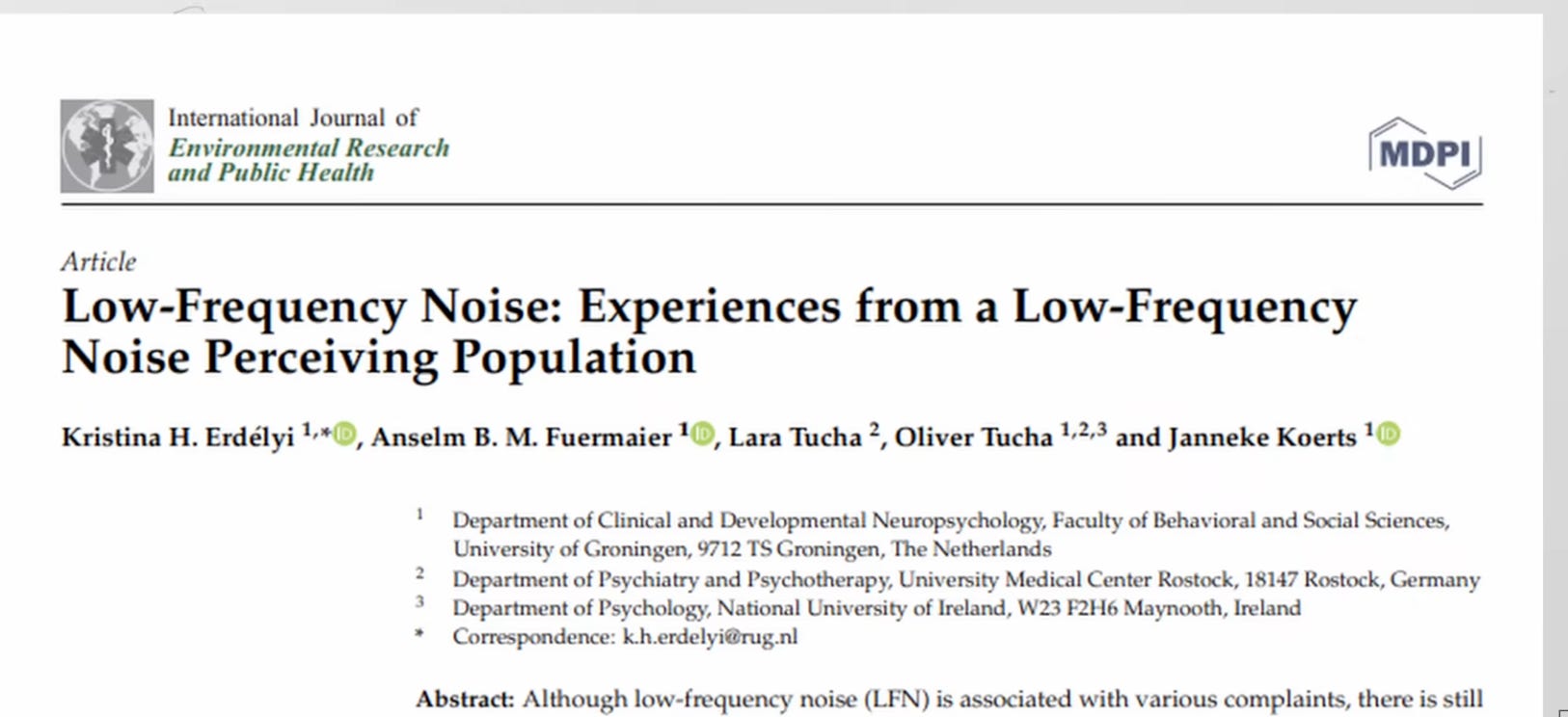
This time he flashes a Dutch survey of 190 people who self-identify as experiencing a perceptible low-frequency hum in their environment, compared to 371 people who don’t. The researchers didn’t measure any sound in anyone’s home. They didn’t establish that the complainants were even actually being exposed to what they thought they were perceiving. They didn’t test causation.
Most importantly, they didn’t mention data centers once.
What the paper does document is that the complainants are disproportionately older and introverted, which is the exact demographic signature of other “environmental sensitivity” syndromes where the attributed cause has repeatedly failed controlled testing. The paper’s own authors explicitly acknowledge that “non-acoustic factors including sociodemographic and individual characteristics or personality constitute substantial predictors for reactions to noise.” This is likely a nocebo, and Jordan once again takes a paper that documents self-reports and presents it as a paper that proves causation.
He then flashes the symptoms list on the screen as he says this. You would think that if someone is saying “symptoms from people who live nearby newly constructed data centers” and is flashing a list of symptoms on the screen, those people would live near data centers, or the study would focus on this in some way. But you’d be wrong!
2:07 - I started looking into seismograph readings from around the country, and there was enough correlation for me to dig pretty deep into an area of research I already had some experience in
Consider what that first video was like, this is the “experience” he’s referring to.
It’s true that data centers register on seismographs. So do rail lines, highways, hospitals, college campuses, shopping malls, factories, power stations, and large intersections. I suspect he’s going to draw some bad inferences.
2:24–3:22 - The symptom list, round two
2:24 - Being in the presence of elevated levels of infrasound has been shown to show spikes in cortisol levels... It can cause vestibular issues leading to loss of balance, vertigo and nausea. Then there’s something called vibroacoustic disease which suggests that infrasound can cause abnormal growth of extracellular matrices... It’s been shown to cause high frequency hearing loss, shortness of breath, anxiety, depression, and it even makes your heart have to work harder to pump blood.
He’s flashing the same study from last time that only measured audible low-frequency sound, not infrasound. Great! He’s doing the same trick of flashing a bunch of highlighted words without making it clear these are all about audible sounds. He seems more confident than last time. He also references the disproved heart study.
“Has been shown” is carrying most of the weight. Again, all of these claims are only true for audible sound, or come from the goofy VAD literature that no serious scientists accept, or just contradict what the actual studies he’s flashing on the screen say. Literally everything he cited last time either contradicted these claims, didn’t address them at all, or was published in a journal about ghosts.
In the last video Jordan didn’t explicitly mention VAD pseudoscience, he just vaguely referenced it as animal studies, so he’s escalated in mentioning it directly here. Again, VAD is the pet theory of a small Portuguese research group whose work has not been replicated and which the peer-reviewed acoustics literature has specifically assessed as unproven.
2:57 - So, it’s not like this anxiety-based or obsessive compulsive thing where an unpleasant feeling or an unusual situation makes you manifest symptoms. We know that infrasound can tangibly harm your health in a very real and measurable way.
As we saw in the last section, we don’t know this at all. Basically all the literature Jordan cited in the last video said the opposite of what he claims here. He just flashed all the same sources again that all show completely unrelated results to what he’s implying or aren’t respected in the broader literature at all and rely on circular citations.
Here he’s more directly rejecting the nocebo explanation, whereas in the last video he at least passively mentioned it. He’s now implying this is established science, and implying that anyone who doubts the infrasound stuff is basically accusing people who were harmed of making up the harm.
4:06–9:10 - xAI’s Colossus
xAI’s Colossus is a massive outlier among data centers, and there are a lot of real, widely-covered problems with it. The biggest is that it ran up to 35 unpermitted methane gas turbines for roughly a year as primary power generation, behaving like an unregulated mid-sized gas power plant in an already heavily polluted poor neighborhood. The methane turbines, the local air quality impacts on Boxtown, the nitrogen oxide emissions, and the permitting problems are all real, well-documented problems.
As a quick aside he also cites xAI using a lot of water, but doesn’t give a frame of reference for how much it is and just zooms up on a depleted water source. In reality, Memphis has some of the lowest water bills in the world, their water bills haven’t risen as a result of xAI, and Memphis isn’t considered a water stressed-area.
But none of the problems with xAI are about infrasound, and lies about infrasound cheapen the real harm people experienced.
7:46 – The lowest of rumbles is peeking out at like -28. And then if we go down to infrasound, the infrasound that you can’t hear is like 10 dB louder than that.
He’s reporting levels in what looks like digital audio reference (dBFS) rather than sound pressure level in the environment. We’re left without a way to convert this to an absolute sound level. He doesn’t show his method anywhere. He says “infrasound is 10 dB louder than” and then adds a rumble, but we don’t know what absolute level that represents in the environment. This tells us nothing.
Of course infrasound is louder than the audible component at distance. Low frequencies propagate better than high frequencies. The lower the frequency, the less it diminishes over distance and the better it passes through walls. The ratio of low-to-high energy always increases as you move away from any industrial source. He made this clear himself in the brief wave physics section of his last vide.
8:02 – This in particular is a great example of how higher frequency sounds are dampened by distance much more than lower frequency or infrasonic ones.
Yes, correct. But then he’s going to use this correct observation about physics to imply that infrasound is doing something special and harmful. All that this physics actually shows is that at a distance most of the sound you’ll get from a source will be low frequency, not that it’s harmful. He hasn’t actually demonstrated any harms from infrasounds. This this entire video will now just assume infrasounds are harmful, based on the terrible edifice he constructed in the last video.
8:26 – This rumbling is no good and would make your life utterly miserable. And then this rumble down here is happening at an amplitude that’s loud enough to shake the frame of your house.
If infrasound were actually shaking the frame of a house, that would be an extraordinary claim and easily falsifiable. It would also be perceived as a rumbling vibration by residents. He provides no measurements to support the “shake the frame” claim, and none of the residents interviewed mention their homes shaking. There has never been any accusation at all that Colossus shakes nearby houses.
8:44 – Okay. So, I’m going to delete everything above 20 hertz here. So, all audible frequencies. And now we’re only left with the infrasound. Now, I’m going to interpret the sample rate four times faster. And I’m going to make it even four times faster than that.
Same trick as the beginning of the first video. If you speed up infrasound and make it audible, it sound ominous. Just like if you look at the infrared light coming from your dog, your dog looks evil. It’s not evidence that the specific source he’s recording near is producing unusual infrasound. It’s evidence that infrasound exists, which no one disputes.
The xAI section is him listing a bunch of real harms, water, and then doing a bunch of fancy tricks with fancy but inaccessible sound terminology and equipment to support his unrelated baseless conspiracy theory.
9:10–15:18 - MARA / Granbury
Noise pollution from the Marathon Digital / MARA Bitcoin mine in Hood County has caused well-documented harm to nearby residents. Cheryl Shadden’s experience is definitely real, as are are the symptoms of the girl who had seizures and whose symptoms resolved after she moved away from near the data center. But these symptoms are clearly being caused by audible sound. Jordan’s going to imply it’s his conspiracy theory instead.
10:15 – While the noise pollution is described as a 70 to 90 decibel jet engine-like sound, a large number of reports site symptoms ranging from vertigo to pulmonary embolisms to heart palpitations.
70–90 dB sustained is awful. It’s above the level where WHO guidelines say it can cause cardiovascular disease, sleep disruption, and other stress-related outcomes. A family living across the street from a 70–90 dB jet-engine-like sound will absolutely experience a ton of terrible symptoms. This is a real case of terrible audible noise pollution from a data center.
10:39 – Sustained audible noise pollution can be a blight on any living thing nearby. But a lot of these symptoms don’t line up with the symptoms of just noise pollution exposure.
This is just completely wrong. The symptoms he lists are exactly the symptoms of chronic environmental noise exposure. There is a massive literature on this going back to the 1970s. Every major environmental health textbook describe this symptom cluster as the expected health consequence of chronic exposure to 70–90 dB environmental noise.
At 11:39 he starts playing more scary clips of sped up infrasound, with no evidence this is harming anyone, after leading in about how the residents told him about the real effects of noise pollution. What a dumb way to hide a baseless conspiracy theory behind people’s real suffering.
The residents of Granbury are suffering from real terrible noise pollution. Infrasound adds nothing to the explanation, and Jordan’s last video gave us not a single reason to believe it’s real in the 25 minutes it runs.
13:08 – Like, what physical symptoms have you felt just from your property being directly across the street from the data center? Motion sickness, dizziness, nausea, GI side effects. My ears ring and buzz. I’ve got permanent conduction hearing loss now. Um, nervous, anxious, worried.
Every symptom Cheryl describes is widely understood to be caused by chronic high-level noise pollution. Hearing loss in particular. There’s no good evidence that infrasound causes hearing loss. Jordan presents these symptoms as mysterious that infrasound can explain, but they’re not mysterious at all.
13:24 - Cheryl thought that I was just doing a story on the noise pollution as I was keeping my infrasound research close to my sleeve.
Okay, so this guy nods along to this person who was harmed by very real noise pollution, and lists classic symptoms of real noise pollution, and then adds “Oh by the way, I didn’t tell her that I’m actually just interviewing her to promote my bullshit unrelated conspiracy theory that I’ve never found a single good source to justify, and I’m just nodding along and am going to lie about her symptoms actually being caused by this other thing.” This is terrible! He lied to this real victim of noise pollution.
13:32 - Yet, every single one of these symptoms is commonly associated with excessive infrasound exposure.
This is silly. He’s saying that because the symptoms are similar to the infrasound horoscope-list, they must be caused by infrasound. But the symptoms match much more strongly with audible noise pollution. Notice that these symptoms have only appeared near a data center with a huge amount of audible noise. Why are they not appearing anywhere else?
14:03 – One family, their daughter was 6 years old. She started having seizures in the summer of 24... they basically walked away from their home here, took out a second mortgage, moved to Somerville County... If you know, has her symptoms kind of gotten better since she’s left? They went away.
The family has been severely harmed by this data enter. It’s terrible. But do we have any reason to think infrasound caused the seizures? Chronic sleep disruption from audible noise in a young child can trigger terrible neurological symptoms, including lowered seizure thresholds. Severe family stress can too, and this family’s experiencing a lot of stress from the noise! This all is entirely consistent with audible noise and stress being the cause. It provides no evidence for infrasound specifically. Jordan’s never produced any actually good evidence that infrasound causes seizures.
I think it’s gross to present this family as evidence of infrasound. It’s not justified scientifically and unhelpful to families in this situation. It directs the legal and regulatory conversation away from the actual scientifically provable cause.
I really don’t like that he flashed a quick out of context clip of this woman at the very beginning of the video to imply that infrasound caused her problems.
15:18–17:58 - The Permian Basin
17:32 - But while the infrasound levels were nowhere close to ideal, they still weren’t as bad as they were near the data centers in Memphis or Granbury.
I’m a little skeptical that a place with thousands of earthquakes every year, massive amounts of fracking, and lots of oil and gas infrastructure will produce less infrasound than two data centers.
17:39 - The infrasound levels at these two data centers were so much higher than the ambient values that it doesn’t even make practical sense to use a linear scale like 25,000% higher.
25,000% is about 48 dB. This means the data center is somehow way way above any residential or rural baseline of sound anywhere in the world, including airports or freeways or industrial sites. This doesn’t seem likely for ordinary data center cooling or power delivery (the main way they make sound). I think it’s more likely that his baseline is at or below the noise floor of his measurement equipment, while his site recordings are well above it. Dividing “real signal” by “noise floor” gives you any number you want.
17:58–23:15 - The experiment
This is the centerpiece of the video, and is a disastrously bad experiment. I’ll walk through the problems one at a time because each one independently invalidates the claimed findings.
Problem 1: The “haunted painting” priming
19:17 - I improvised a new story of why the owl painting was known to be haunted... I told them that the audio recording that they would be listening to was known to be haunted. I had them sit in this enclosed room while studying the painting and listening to the music for 3 minutes while paying attention to how they felt physically and emotionally.
So he’s priming all his participants to expect unusual experiences! This is nocebo-priming. It’s making it more likely that people will experience weird things. His rationale (that varying the story randomizes a bias variable) is wrong. Randomizing the specifics of the priming across groups does not eliminate the priming. I’m confused about why he’s doing this.
To do this correctly would require one group primed negatively and one group given neutral or no priming, the way Crichton and Petrie actually did it. His design has no unprimed group.
Problem 2: He isn’t blind
20:10 - And unless I saw water vibrating in a bottle or something, I often didn’t know if the infrasound was on or off myself.
That’s not good enough. If the experimenter can sometimes tell what’s up in a study, it’s possible that their own behavior will leak information (like facial expressions etc.). Jordan says he can tell via the vibrations when the sound’s on. This has the potential to mess with people’s reactions.
Problem 3: The stimulus itself
18:04 - I needed to figure out a way to reproduce the infrasound waves at 25 to 30% of the volume or amplitude near the data centers.
Here he’s playing infrasound through “a gigantic specialized subwoofer in the room.” These seem to produce a lot of evidence that they’re on beyond infrasound. It seems likely people might be able to tell it was on.
His own video gives this away:
20:23 - Just put my DJI gimbal on the ground here. And Jeez, it’s kind of scary.
This implies the room is shaking! This means people can detect when infrasound’s present!
Problem 4: The self-selection filter
21:33 - The experiment had over a 100 participants, but I disqualified anyone who missed a survey question or someone who seemed suspicious or said that they felt a vibration or where I was privy to whether the infrasound was on or off.
He dropped subjects who “seemed suspicious” or who reported feeling a vibration, based on his own after-the-fact judgment. I’m worried that “Seemed suspicious” is way too much of a subjective call by Jordan, who seems to have a bias in wanting the experiment to show results.
We also don’t know how many of the original 100+ were dropped, which groups they were in, or what the results look like with them included.
Problem 5: The effect sizes are tiny and the framing is misleading
Jordan does acknowledge this one:
23:58 - the 33% more likely to experience nausea metric, the viewer may imagine a room with 100 people in it and then 33 of them experiencing nausea, which is very much not the case. The average nausea feeling score from 0 to 10 that each user put in for infrasound is 1.2. For the control group, it’s 0.9.
This is “33% increase” from 0.9 to 1.2 on a 0-10 scale. This doesn’t look meaningful, it’s a difference of 0.3 of 74 people. It doesn’t try to correct for multiple comparisons across a dozen or more symptoms. And this is all happening in a room where people can possibly feel the floor vibrating or notice his reactions! This looks like statistical noise.
24:55 - the average score in the control group for discomfort was 1.2. The average score for discomfort in the infrasound group was 4.8.
A 1.2-to-4.8 shift on a 10-point scale is a large effect, if it’s real. But consider that people might be feeling the floor shake, subjects have been told the space is haunted, and where they’ve been told the audio’s spooky, and where the experimenter may subtly give away when the sound’s on with his facial expressions. All of these together look like better explanations to me than infrasound.
Problem 6: Multiple comparisons
He’s comparing about a dozen symptoms, and finds that some increased and some decreased. If you have 74 people in a study and measure 12 symptoms, some will increase or decrease by chance alone. There’s no attempt to correct for this.
What the experiment actually shows
If you prime a group of synthesizer-convention attendees by telling them a painting is haunted and some audio is spooky, then expose half of them to a subwoofer producing enough mechanical vibration to visibly shake objects in the room, the exposed group will report more discomfort and dizziness on a survey. This doesn’t tell us anything about data center infrasound. Jordan is just accidentally reproducing the nocebo literature.
25:13 - When reviewing that data, it’s hard for even the most skeptical person to come to any other conclusion than the presence of elevated levels of infrasound is likely to lower your quality of life.
Very very very very easy for the skeptical person, actually. The skeptical person concludes: priming produces reported discomfort, perceptible subwoofer vibration produces reported dizziness, and an unblinded single-operator study with post-hoc subject exclusion at a synthesizer convention is not a basis for policy claims about data center health effects.
25:43–end - The call to action
27:12 - Prior to this experiment, I feel like we have seen more than enough data to make infrasound monitoring and regulation just as important as air or water quality.
NOOOOOOOOOO!
Outdoor air pollution kills 4 million people every year. This sentence is elevating a fringe belief with zero evidence to the same level as one of the single largest killers on the planet. Crazy. After 40+ minutes of this guy misrepresenting studies and concepts almost by the second, this moment really made me lose it.
27:21 - Especially when you look at the studies pertaining to the cardiovascular effects, it’s a very real environmental hazard that has been poorly understood and grossly understudied.
Another repeat of his false claim that infrasound is “grossly understudied.” There are no good studies that imply cardiovascular effects. It’s fake.
28:21 - Now would be a great time to set up something like a Raspberry Shake and start storing a daily log of seismic and infrasonic activity. Because the vast majority of the responses to complaints and lawsuits is that there is no way of proving whether the infrasound wasn’t already present before construction.
If communities want to collect baseline acoustic data in advance of data center construction, fine, go ahead. I agree with critics of data centers that they often haven’t been careful about audible noise pollution, that this has caused real quality-of-life harm, and that communities should be able to monitor it.
But communities shouldn’t monitor infrasound for the same reason they shouldn’t monitor wifi signals over fears about wifi-intolerance or cancer. There’s no evidence for either. Monitoring would just waste everyday people’s time and leave them more confused and paranoid when they realized how much infrasound is around normally. It’s like hyping people up about the dangers of infrared light and sending them out to test it themselves. They’ll find a lot!
Conclusion
I found this second video to be way more objectionable than the first. Even though the first had nonstop lies about what every study flashed on the screen said, at least it didn’t have interviews with victims of real noise pollution Jordan was trying to use as evidence of his unrelated baseless conspiracy theory instead without even telling them. I found that pretty gross. I was also repulsed by his comparison of infrasound to outdoor air pollution, one of the great global killers right now.
My claim remains strong. Infrasound harms are fake, data centers or otherwise. People should focus on the real problems of noise pollution and not give an inch to baseless conspiracy theories promoted by chill-seeming guys using fancy-sounding technical terms and unrelated studies flashed on the screen to trick millions of viewers. Infrasounds have been used by all kinds of bad actors to oppose things we should all agree are good, like wind farms. Let’s not give the crazies more power here.
Some stray thoughts
If infrasound exposure near data centers caused this much harm, wouldn’t the absolute worst off people be people working in data centers themselves? They’re in the belly of the beast of data center infrasound, many have been working in data centers for way longer than the current buildout’s been happening, and it’s very easy to identify who works in data centers. They seem like the ideal people to look at for data center infrasound effects, but never get a mention.
Responses to this piece from the authors of the studies Jordan cites
Someone had suggested to me that since Jordan and I disagree about the content of these studies, why not just reach out to the authors themselves?
I reached out a few days ago. So far I’ve received one response from Swen Müller, who wrote the rebuttal to the heart study. Jordan cited the heart study but not the rebuttal, so this isn’t as good as having a direct quote from the authors themselves. Here’s Müller’s thoughts:
I’ll update this section as I get more replies.
Jordan’s response to this article was pretty goofy and reaffirmed that he can’t defend any of his misleading citations
Bluesky back-and-forth
Jordan responded to this post on Bluesky, and it went pretty badly. Opened with this
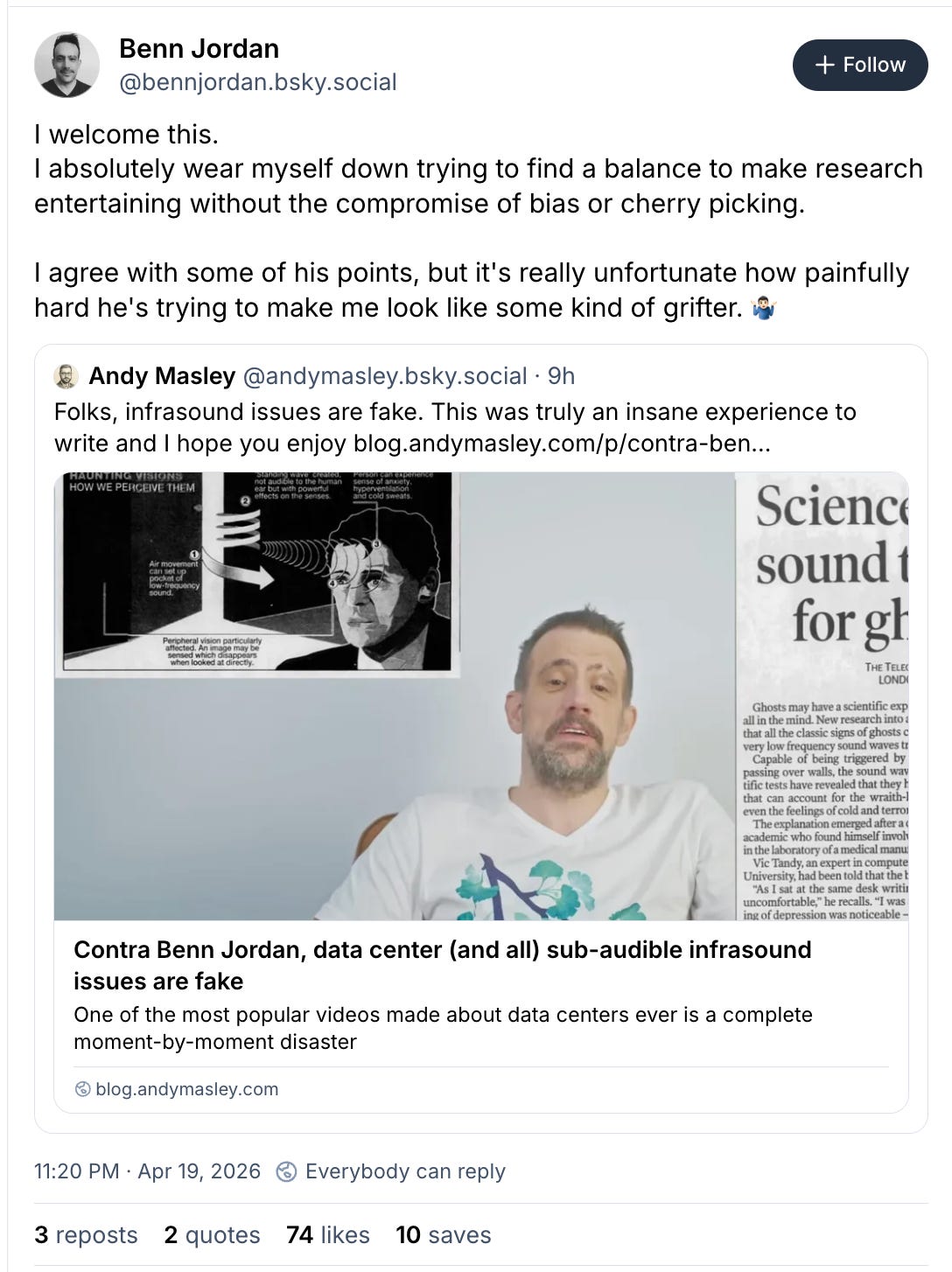
Then added this. Sure, I’d say people harmed by data center noise are vulnerable, but maybe that was too strong.
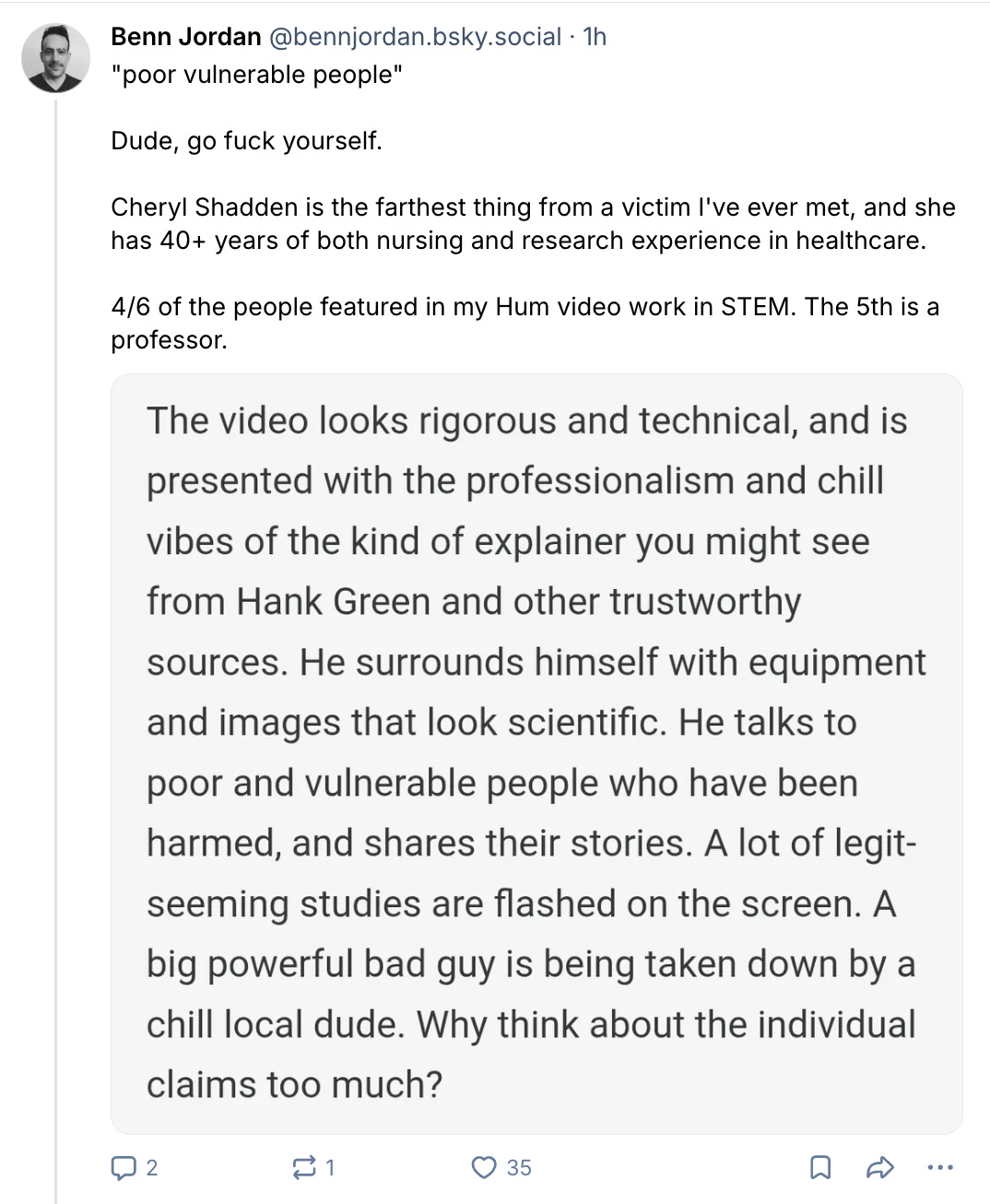
Here’s the next thing in the thread + my response, no reply from Jordan here.
He then accused me of hypocrisy here:
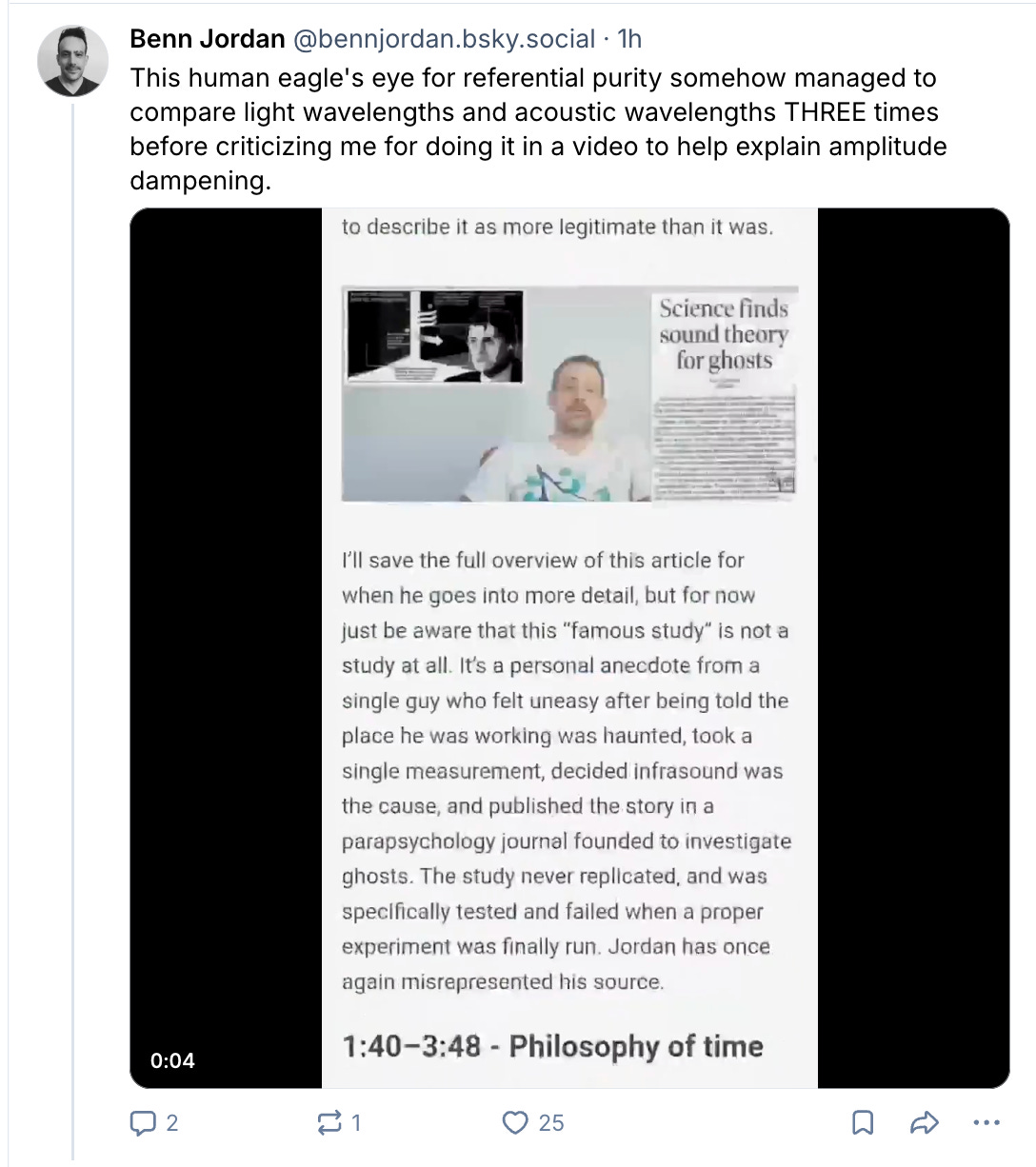
Which is a misreading of this post. I never said that it’s invalid to compare sound to light. Like he said, I do it over and over. I think it’s a useful comparison. What I specifically said was that it’s invalid to compare infrasound to the harm of ultraviolet light specifically, and I made that explicit here:
He’s setting up this framing about how things that are invisible to us can still harm us, and then very quickly moves from ‘ultraviolet light can obviously kill us’ to ‘and there’s new disturbing evidence that infrasound can harm us’ without acknowledging the obvious problem that infrared light does not really harm us at all unless it’s so powerful that it heats up our bodies in the way other normal heat sources do. This is the correct analogy to infrasound, not UV light. Just like infrared light can only harm us if it’s powerful enough that we physically feel it in the way we do other heat sources, infrasound can only harm us if it’s so powerful that it causes us to physically feel its presence in the way we do other very loud sources of sound. He’s not so subtly reaching way across this spectrum to say that because something that’s so high energy that we can’t see it can cause damage, maybe something that’s so low energy that we can’t hear it can cause damage too.
I replied making this point and didn’t get a reply. Jordan seems to have a pattern of misrepresenting articles.
I finally got a response here:
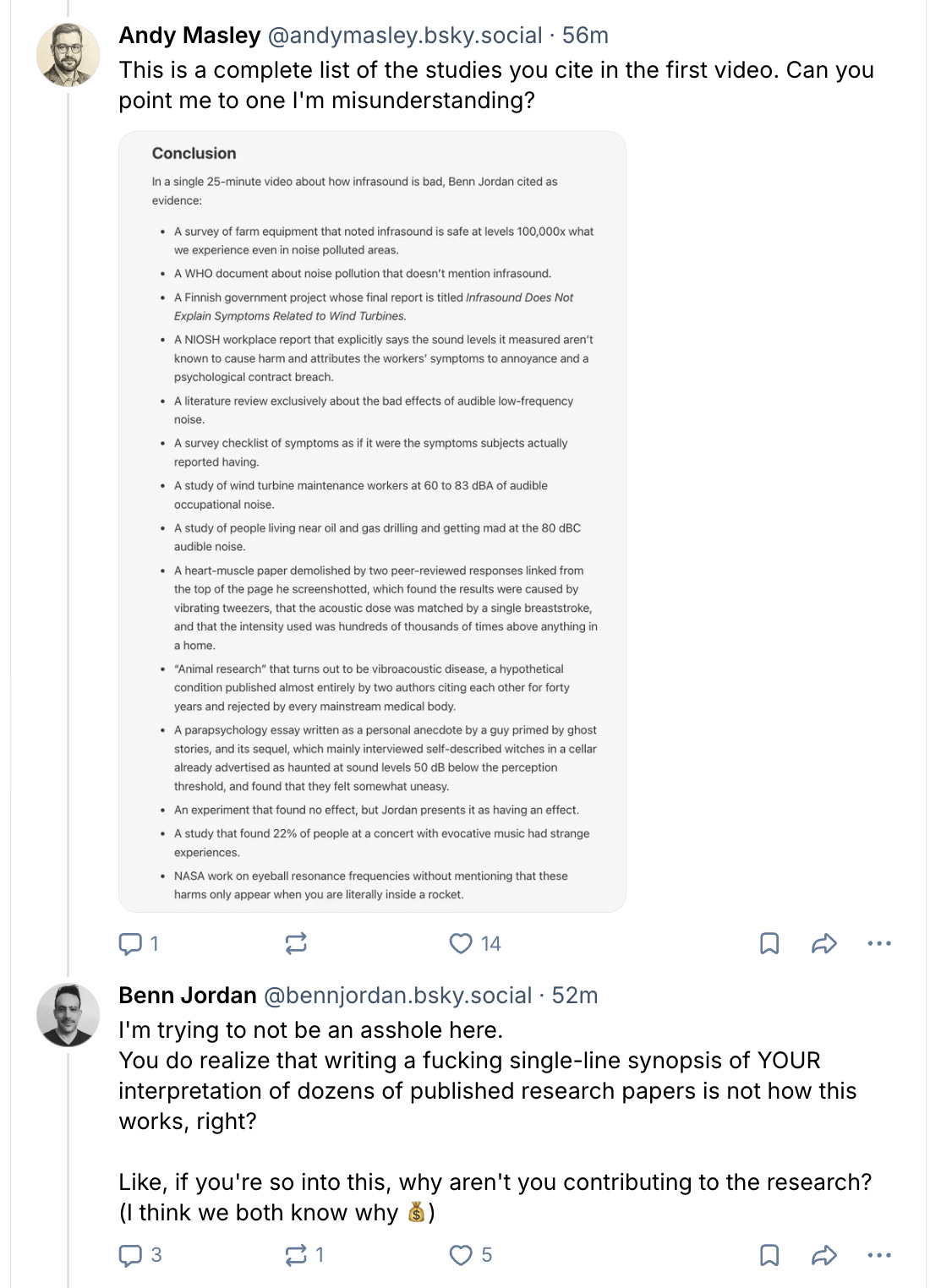
No response there so far…
There was one more thread where I got responses:
Instead of answer he just asked this:
We went back and forth for a little while and I asked him for a meta-analysis showing that infrasound was legitimate science. He sent the following links:

This is the same heart study I mentioned above. It’s an individual study, not a meta-analysis. “Cited 5 times” is a weird defense of the paper, it makes it look pretty bad. Two of those citations were the critical responses I posted above basically showing it was useless, and 3 other citations for a paper like this makes it seem like it hasn’t had any impact at all. I’ve been unable to find what those citations were. When I brought this all up he accused me of “moving the goalposts” but couldn’t actually explain why this study was useful beyond that it was a scientific study.

Importantly, he’s the one moving the goal-posts here, because I had specifically asked for a meta-analysis, not a random study.
The next link he sent was this one:
This one’s really weird. It’s not a meta-analysis or a study. It’s a single-author narrative review, basically a long op-ed.
The author is Michael Persinger, who’s known best for the “God Helmet.” This was a device he built, which he claimed could cause religious and paranormal experiences via magnetic fields. When an independent team ran a proper double-blind replication in 2005, they found nothing. Persinger said the scientists hadn’t done it right.
He separately written a lot about telepathy, precognition, “non-local” consciousness, and his theory that Earth’s magnetic field creates paranormal experiences. A substantial chunk of this guy’s career was pseudoscience.
Benn said “Their validity is supported by convergent quantitative biophysical solutions.” What that sentence actually means, once you trace the paper, is that Persinger’s claims about infrasound are supported by Persinger’s other work on biophysical mechanisms. There wasn’t any research done here.
Actual systematic reviews of infrasound (NHMRC 2015, Baliatsas 2016, van Kamp and van den Berg 2018, Marshall 2023) all converge on the conclusion that infrasound at the levels people are actually exposed to doesn’t produce the symptoms people attribute to it.
So when I asked for his best evidence, the second thing Jordan sent me was a 2014 narrative review, by the God Helmet guy, that vouches for its own conclusions by citing the author’s other papers.
Next was this one:

These are the paper’s results:
At 108 dB of noise exposure, adding the 30 Hz tone slightly increased cochlear damage compared to 108 dB alone.
At the 86 dB exposure, adding the 30 Hz tone did not increase damage at all.
The authors’ proposed mechanism is that the 108 dB exposure perforates a membrane in the cochlea called the reticular lamina, and the low-frequency fluid movements makes the existing damage worse by mixing cochlear fluids through the hole. The low-frequency exposure only contributes to damage after a separate, extremely loud audible exposure has already wrecked the structure.
So the subjects are not human, the “infrasound” is audible to humans, the exposure levels are not remotely close to what someone living near a data center could encounter, and the finding is that a 30 Hz tone only contributed to damage when a separate exposure had already caused the damage. Alone, it did nothing.
And finally this one (after a mislink of a paper on PTSD that didn’t mention infrasound):

This is a link to a 2016 undergrad paper by Ryan Littlefield that was self-published on Medium and never peer-reviewed or published in a scientific journal. Semantic Scholar indexes it, but it indexes student papers indiscriminately. A paper being on Semantic Scholar tells you nothing about how legit it is.
I pushed back on each. Jordan’s final comment to me was anger that I was calling “published papers pseudoscience.”

He said these were from PubMed, but they’re actually both from PMC (ignoring the Medium article and single-author narrative by the God Helmet Guy he sent). PMC is an entirely separate paper archive with a much lower bar for inclusion, and mixing them up is a very common way to justify pseudoscience.
PubMed is built on MEDLINE, whose journals have to pass a scientific quality review by the National Library of Medicine (NLM). PMC accepts material under looser criteria, and, importantly, it also hosts NIH-funded author manuscripts that get deposited automatically regardless of whether the journal they appeared in has ever been reviewed for quality by anyone at NLM. According to NLM’s own staff, these manuscripts may come from journals that have never undergone scientific review, are outside the library’s traditional scope, or have failed to meet even PMC’s standards. If a paper’s added to PMC, it’s searchable through PubMed, so this is technically “on PubMed.”
The Yale Medical Library flags this exact move is common enough that readers should watch out for it. A publisher can claim to be “in PubMed” when they’re really just searchable via PMC. It is a well-known laundering pathway for predatory and low-quality journals, and is popular among infrasound pseudoscience.
So yes, this all looks extremely pseudoscientific.
Jordan then blocked me and posted this:
After a lot of back and forth he wasn’t able to stand behind any of the studies he cited in his video. I rest my case that this video is full of fake information and pseudoscience, Jordan seems to know this, and is good at dodging this info and reframing any criticism as a “good guy vs bad guy” thing that will cause a lot of his audience to not look into it further. Jordan is knowingly promoting infrasound pseudoscience and is getting millions of views doing it.
Jordan’s blog post rebuttal of this post
Jordan then posted a blog post reply to this article, and it’s pretty bad. You can read the whole thing here. I’ll go down the list and respond to points from it.
But it seemed desperate and mean. I’m attacked for…creating a sundial and having “scientific looking microphones”.
Jordan is obviously knowledgeable enough about sound to be able to read and understand the incredibly simple language in the studies he’s flashing on the screen. I don’t know how it could be possible that he doesn’t know what they contain. I’m forced to conclude that he does know and is choosing to mislead the viewer with half an hour of wild intentional misinterpretations of very simple studies. So yeah, I think he adds scientific looking stuff to make himself seem more legit.
The author is constantly ping-ponging the people interviewed or featured in my videos as poor, stupid people, or people that are owed more empathy than I allotted. Something is just weird about this.
I don’t do this? I say he talks to poor vulnerable people who have been actually definitely harmed by real noise pollution. They’re not stupid at all. I do think people are owed not having their very real harms rebranded as the result of a pseudoscientific sham yes.
So after some sniffing around, I realize I’m being brigaded by someone deep in the Effective Altruism community.
Oh no how did he notice I was really trying to hide this one.
But please do browse his bibliography.
Andy lives in a parallel universe where datacenters don’t waste water, AI artwork is without victims, and using ChatGPT doesn’t harm the environment.
✅ Data centers don’t waste water.
✅ AI artwork is without victims.
✅ Using ChatGPT is not bad for the environment.
I love the idea that the only way you could possibly believe these is if you’re being paid to. Very intellectually walled-off from a lot of the world. I guess when you’re wrong, the correct people do live in a parallel universe.
This is one of the many takes that perfectly align with the board, contributors, and partners with Coefficient Giving
I only received a grant to write from Coefficient Giving a month ago. All the articles he cited above are from when I was just writing for fun.
Unlike most people with shadowy billionaire benefactors, mine and I are buddies on Bluesky. Here’s his input on my writing:


I spend a lot of time on Twitter interacting with people farther right than I am who think EA’s goal is to destroy all technological progress and stop AI, and people farther left than me on Bluesky who believe EA’s goals are to max out AI progress at the expense of everyone else. The truth is that most EAs think there’s a huge amount of both upside and downside to AI. If CG could, I think they’d slow the data center buildout significantly, but wouldn’t do it via spreading pseudoscience.
formally called Open Philanthropy, but changed after its close association with Sam Bankman-Fried was causing some well-earned skepticism.
This is not at all why Coefficient Giving changed its name. If they changed the name due to associations with SBF, why did it take them four years after FTX collapsed to do it? Open Philanthropy also never accepted any money from SBF.
The effective altruism movement, if we want to be gracious in calling it a “movement”, is a rabbit hole of reciprocal wealth.
Fair tbh
A lot of billionaires unload money into its related NPOs, and oddly enough, that money often goes into buying NVIDIA GPUs for an altruistic AI project, directly to Bill Gates to use philanthropically
Bill Gates isn’t involved really? I don’t know of any EA money that’s been used to buy GPUs or for altruistic AI projects?
or to grants for independent journalists and content creators to attack research that is being used to shift legislation away from things that the partners have interest in. Since it’s 2026, those things are data centers and AI.
I do wish I could get everyone telling me EAs are secretly paid to destroy AI and people who say EAs are secretly paid to max out AI progress in a room together to hash this out once and for all. The idea that EAs are paid to DEFEND AI is very funny. If you look up negative coverage of journalism funded in part by EAs, it usually focuses exclusively on how the journalism is more negative on AI than average.
But how did my infrasound content, of all things, end up as the target of a special interest group?
Well, as luck would have it, It turns out that I’m getting cited a whole lot in legislative meetings that are voting on datacenter zoning and moratoriums.
So while I’ll save my digging deep into the clusterfuck that is effective altruism for another time (I’m inspired now!), below is a quick graphic summarizing where this article came from and why it was written. Feel free to “do your own research”.
Jordan seems to have something of a fantasy of persecution. I didn’t receive any kind of command from above to write this. What happened was I was seeing more and more tweets about data center noise pollution, looked into it, thought “Wow this is terrible, this looks like a real problem” and then stumbled on Jordan’s videos. At first I only noticed a few problems, and was going to make infrasound a small end note of a post about the very real problems with noise pollution. But once I realized just how terrible Jordan was with his sources, and how popular this video was, I decided it needed its own post.
I’ve had a deep hatred of pseudoscience my whole life. In college I Turned Evil at a community meeting about the smart grid (essential for the green energy transition) where I got called a shill by crazies who had swarmed the meeting for not believing in WiFi intolerance. I decided these people absolutely could not be allowed to win anything ever. I respect real community concerns. I do not respect pseudoscience at all, anywhere. Now I get to debunk it it as my job.
The connection between EA and tech billionaires is not something I’m the first to document.
Yup, but the tech billionaires I’m associated with mostly oppose rapid AI progress and the rapid data center buildout.
Jordan shows a picture of local town meetings where he’s been brought up and says “That’s a lot of .gov action for a YouTuber who doesn’t understand science!” Well yeah, he successfully tricked people into believing his pseudoscience. Great.
I’m not going to go through Andy’s novel line-by-line because it’s a waste of everyone’s time. The entire framework of attacks like this are to “machine gun” information in a way that overwhelms the reader so they concede that the writer has an exhaustive understanding of the topic.
There was no way to document all the massive problems with Jordan’s two videos without making this post very long. A lot of people accuse me of either writing posts that are too long, or conveniently leaving things out. I suspect that if this post were shorter, Jordan would bring up every argument he made that I didn’t address. This is just a way of dodging all my very simple specific criticisms that he misrepresented every study he relied on.
1. On-screen graphics are not always citations, but sometimes may appear to be.
There’s a lot of time and tempo change between researching, writing, and editing. My infrasound videos have about 3TB of footage, sliced down into 2 videos running less than 30 minutes per piece. They may seem like elaborate deep dives, but you’re watching an entertaining overview of the actual deep dive. I spend an excruciating amount of time balancing the depth of research versus the probability that anyone will be interested in watching or learning about it. Some may disagree, but I think I’m doing a good job at this. More importantly, I’m always learning how to do it better with each video as I pay close attention to what makes viewers stick around.
My way of breezing through citations is using them as on-screen graphics. Unfortunately, not all graphics are consistent with what I’m talking about in a particular clip of the video. For example, an article making statement A may have a graphic or headline that fits better with statement B. It provides the viewer with continuity and visual confirmation, but if you comb through every on-screen article and compare it to the sentence coming out of my mouth, guess what? You’ll occasionally, if not seldomly, find that the 2 don’t perfectly line up.
But context is important. If a graphic isn’t confirming a point made in the video, that doesn’t mean the point in the video is a nefarious lie. It’s a truly wild stretch to assume that my videos are just factless voids of manipulation and Andy is the first person to catch on. Which brings me to the next segment.
This would be understandable if literally any of the articles he cited did what he claimed. It’s not that the timing was off, it’s that none of them backed up his claims at all and mostly contradicted them. This is an obvious simple dodge.
There is literally no way you can watch this section without believing that the paper he’s zooming in on that’s 100% perfectly timed with every single word he says is about infrasound, whereas in fact it’s entirely about audible sound, as explained here. This wasn’t sloppy editing, this was incredibly deliberate editing that showed a paper that didn’t at all say what he claimed in the moment. He’s just completely dodging these very obvious objections by claiming this was some cool editorial decision.
2. I fact-check. Always.
With the amount I complain about legal expenses, it’s probably not a secret that I often run my entire scripts past attorneys. And they catch a lot, sometimes transforming the video significantly, and in at least two cases, resulting in a video project being shelved. This isn’t always because of poor research, but because perfect is the enemy of good. And I need to be perfect sometimes for all the wrong reasons.
For example, I cannot drive up to a datacenter owned by the wealthiest person in history (who also happens to be a litigious asshole), pull out some equipment, measure infrasound, and make up readings or make claims about their health effects without a really good list of citations. If I make a single mistake in activities like this and when reporting on them, I’ll lose everything I have, including my channel. I do not receive any benefits of doubts when it comes to potential libel.
For months, I’ve had private investigators hired to park in front of my property. Are we to assume the company hiring them hasn’t found out about lawsuits yet?
So the idea that I’m intentionally misleading millions of people and legislators is not something I’m insulted by because in the context of my daily stressors, it’s comedy.
Well the fact-checkers clearly failed here, drastically, and Jordan hasn’t given us any counter evidence of that so far.
Throughout Jordan has what I think is a somewhat self-centered view that I’m just writing this to “stress him out” whereas in fact I would like him to stop promoting the same pseudoscience used to block wind farms. Throughout this exchange, he’s always speaking in “us vs them” language and is trying to identify me as being on a bad team instead of just looking at the facts directly. I think he knows what will happen if he does, so he’s somewhat desperate to just smear me as a tech billionaire stooge.
3. Categorical Dismissal vs. Scientific Uncertainty
Andy’s central thesis that sub-audible infrasound issues are “fake” is a definitive and hyperbolic claim that is impossible to sustain scientifically. In research, there is an infinite distance between “not yet proven without a doubt” and “fake”.
Anesthesia, consciousness, contagious yawning, and a whole library of things we experience are not completely understood. That doesn’t mean they don’t exist.
One thing that irks me is how heavily Andy relies on the “nocebo effect” (the idea that symptoms are caused by negative expectations).
Of course nocebo effect is a real confounding variable, but using it as a "catch all" to dismiss physical data ignores the actual physiological mechanisms routinely observed.
All of this happens within the confines of a world where Andy seemingly doesn’t have the ability to fact-check himself.
Recent research into mechanotransduction suggests that humans can "feel" sound through non-auditory pathways. Low-frequency noise can modulate pressure-sensitive ion channels (like PIEZO1), potentially causing neuroinflammatory responses or cellular stress even if the sound is below the threshold of "hearing" [Armand & Bikaran, 2025; MDPI, 2026].
This is just one of many examples of where infrasound is observed to be related to physiological responses that have absolutely nothing to do with one’s conscious perception or bias. “
Note: Due to IP restrictions, not all papers can be linked, only referenced.But here is a more recent study pertaining to PIEZO1 and TRP4 channels.
It’s true that infrasound harms could technically exist, but because we haven’t found any after a half-century of serious studies looking for them all over, I’m forced to conclude that infrasound is as fake as other things in this category. Could be real, maybe? But no one (especially Jordan) has produced any evidence so far.
I’m using the nocebo as an explanation after I’ve already separately showed that all studies that hint at infrasound harms seem to be pretty quickly invalidated.
He links one MDPI paper by Dastan et al., and references a second “[Armand & Bikaran, 2025]” citation he says can’t be linked “due to IP restrictions.” Peer-reviewed science doesn’t have IP restrictions that prevent citing them, you just paste the DOI. I can’t find any paper by Armand & Bikaran 2025 on infrasound, PIEZO1, or anything like it. If anyone reading this can find it, let me know, but as it stands I’m going to treat it as made up until proven otherwise.
The MDPI paper he did link is a narrative review in Applied Sciences. Again it’s not a study or meta-analysis, and it doesn’t even find that infrasound is harmful. It’s the same type of article as the Persinger paper Jordan sent me over Bluesky.
This is a quote from the abstract: “Short-term studies in humans at moderate intensities have reported minimal physiological changes, with psychological and contextual factors influencing symptom perception.”
That last line is just perfectly describing my view of infrasound! Moderate infrasound (the kind people experience in their homes) doesn’t have an effect. and people’s experience of it is mostly determined by their psychology. It’s also saying that the cellular mechanisms people get excited about only produce damaging effects at high intensities over long durations in animals, which everyone has agreed on since the 1960s NASA work. Again, Jordan has linked a study that agrees with me, not him.
4. Comparing Light to Sound is Stupid (Except when Andy does it)
As much as I detest surveillance cameras indoors, I kind of wish I had one so I could see the look on my face as Andy repeatedly tried to cross-explain sound and light waves. His article does this 3 times before using the comparison of sound and light waves as a source to discredit my video.
In reality, there’s a lot of false equivalence that needs to be addressed when throwing shade on ultraviolet light comparisons. Light interacts with human tissue at a quantum/chemical level. Sound interacts with human tissue via mechanical resonance. UV light is blocked by skin while infrasound passes through solid structures with ease. This means that every human has their own resonant frequencies for their bones and organs that can be mechanically stimulated by external sources of mechanical pressure regardless of if the source is audible or not.
I already addressed this in the Bluesky section above (and had replied to Jordan on Bluesky saying exactly that, but he either didn’t read it or didn’t care). My complaint isn’t that he’s comparing light to sound, it’s that he’s comparing UV to infrasound when the obvious comparison is infrared to infrasound.
This ”every human has their own resonant frequencies for their bones and organs that can be mechanically stimulated by external sources of mechanical pressure regardless of if the source is audible or not” thing is just a restatement of VAD pseudoscience. The only way to get resonance frequencies to actually harm you is to apply enough power, and there’s just not enough power in infrasound in homes near data centers. Again, a kid on a swing has a resonance frequency for pushing them to get them higher, but if you don’t also push with enough force they won’t move back and forth at all. Same goes for your cells.
5. Wind-Turbines and Oversimplification
While not recently, infrasound research has been poisoned by special interest groups backed by energy companies trying to create arguments against wind turbines. I caught on to this very quickly years ago and had to be especially careful to avoid research papers primarily focused on wind energy.
But it’s also not difficult to do this for some very important reasons unrelated to politics or lobbying:
I’ve spent a gross amount of time playing Othello on my phone while sitting next to a device measuring wind farms and datacenters. Datacenters and cryptocurrency mines have a drastically different acoustic signature than wind turbines. Datacenters utilize high-velocity cooling fans and, in many cases, massive diesel generators in a 24/7, high-density configuration. They’re also typically much closer to residential zones. This is easily enough of a difference to segregate to 2 areas of study.
I think wind farms should be allowed to be built closer to residential zones, to the point that the infrasound from them would be louder than infrasound from data centers, because infrasound harms are fake. Would Jordan be okay with building them this close? He doesn’t give us a way to know. He’s trying to have it both ways here, but pseudoscience is like a biological weapon. You can’t use it to target hyper specific industries you don’t like and spare others. It messes with everything.
But it is tricking out, and we have very new research that directly studies datacenters. A 2026 report by the Environmental and Energy Study Institute [Communities Are Raising Noise Pollution Concerns About Data Centers] points to specific health clusters (vertigo, nausea, hypertension) in Virginia and Texas specifically linked to these industrial cooling arrays, noting that standard decibel meters (A-weighted) fail to capture the low-frequency energy that residents report that is literally “vibrating their homes”.
This article he mentions is good on real noise pollution. It’s a problem. I’ve recently been speaking to some city planner friends and have been kind of shocked at how difficult it is to regulate noise. I’ve upped noise pollution in my worries about the real issues with data centers quite a bit.
But again, this article is about audible low-frequency noise. It is not evidence of inaudible infrasound causing health effects. The Ontario environmental review board found this exact thing about wind turbines in 2011: dB(A) understates how annoying low-frequency audible noise is, which is why the EU moved to including C-weighted measurements. This article also does not support Jordan’s theory about inaudible infrasound. He seems kind of pathologically obsessed with linking articles that don’t show what he claims.
Now before we move on, it’s important to note that this “confusing concept of vibration and infrasound being related” was cited in “Health implications of the rapid rise of data centers in Virginia”, which was published the same week my datacenter video released. It also mentions datacenter water use, so I’m sure Andy has his work cut out for him in reaching to discredit it in the name of altruism.
This is one of the goated papers on data centers. It’s a reasonable mini-review that organizes a lot of the known real concerns about data centers, including air pollution from diesel generators, water stress, and audible noise pollution.
But Jordan is lying about what it says again. I’m coming away from this thinking he’s a pathological liar about research papers specifically.
The paper cites the JLARC report that Virginia data center noise is “between 40 and 59 decibels” and says this “approaches or exceeds” EPA’s 55 dBA day-night outdoor noise guideline. The health harms it then links to this noise exposure are the standard, boring, very real harms of chronic audible noise pollution: heart disease, tinnitus, hypertension, sleep disruption, cognitive and mental health effects. All of these are well-documented consequences of chronic exposure to environmental noise, and this is why I’ve said repeatedly throughout this post that data center audible noise pollution is a real problem.
The paper does not mention “infrasound” a single time, as far as I can tell. It does not mention “ground-borne vibration.” etc.
Jordan’s correct that I mostly disagree with the paper’s assessment of water issues. It basically just says that blowdown from data centers might be an issue and that they use a lot of water in the area. Both are technically true but don’t paint a good picture of the relative harm of either, which I think is pretty small, as explained at length elsewhere.
6. Infrasound and ground-borne vibration are often the same thing.
Andy seems to think that I’ve “confused” infrasound with ground-borne vibration, as if these 2 things aren’t a constant catalyst for one another. I’m actually perplexed that a former physics teacher would even argue this at the risk of discrediting themselves to anyone capable of using common sense.
I have no clue what he’s talking about here? Is this where I said that xAI probably isn’t shaking people’s homes? I have to throw my hands up and await more info.
For any 7 year olds reading, I’ll explain...
For the rest of us, as I explained in the video, it’s really hard to accurately measure the full spectrum of infrasound because [long explanation of microphone diaphragm shelves, vibration sensor weak spots, and Fourier harmonics].
Yeah it’s hard to measure, cosign.
7. The decibel problem.
I’ve already explained how challenging it is to get a quality infrasound measurement… Solving this problem is what I immediately turned my attention to when finishing my last infrasound-related video. I believe that there may be a way to accurately capture the full spectrum of pressure waves via infrared optical sensors and a collimated light source inside a self-contained portable unit. It’s something I’m actively working on. But to be clear…
This is a logistical problem, not evidence of pseudoscience.
This is a non-response to what I said.
Building a new portable infrasound sensor is completely fine. My problem is his experimental design was bad. It included priming the test subjects, a subwoofer that made the room physically vibrate, and he knew when the infrasound was playing and could potentially give it away with subtle mannerisms. This isn’t about the quality of the microphone.
So when Andy read the words “low-quality data” in the World Health Organization’s analysis of infrasound exposure research, he didn’t seem to realize that the “low quality” was in the consistency of measuring the infrasound, not analysing physiological effects.
??? I didn’t quote any WHO “low-quality data” language in my post, and he didn’t link where he thinks I did. I think he might mean 2018 WHO Environmental Noise Guidelines. Here, the WHO did say the evidence base for health effects at the frequency range they considered was low-quality in the “grade” sense, which is a technical term referring to overall confidence in effect estimates.
His move is to frame every negative finding in the field as a measurement problem and every positive finding as real.
8. This “hit-piece” is good news.
The fact that someone is paid to spend an enormous amount of time pedantically combing through hours of video, reaching in every possible direction to discredit and insult me, my viewers, the cited researchers, and the people whose lives have been devastated by what appears to be infrasound means that our message has reached enough of the general public and their legislators to justify a low blow.
Classic conspiracy theorist move here. “They’re only criticizing me because the cabal doesn’t want me to win.” This is Alex Jones but higher status.
Coefficient Giving didn’t call me one day and say “take this guy out.” I’ve been posting about AI and the environment for a year and a half and now have a no strings attached grant from them to write more. I decide what I want to write about, and I despise pseudoscience and hate when people use stupid tricks like this to push it. I want it gone from the public debate.
Nobody is bringing a tablet to city council meetings and playing my videos. The presented information inspires them to roll up their sleeves, pick and choose what is reputable and relevant to their communities, and then present it formally to legislators.
Inshallah they actually read what the studies say.
Why doesn’t this organization just spend this money on researching and mitigating these things?
Like, wouldn’t actually lowering the water use of a datacenter help legislation pass in their favor?
Wouldn’t actually researching infrasound sources and reducing it where there’s growing evidence of harm make this all go away?
Lowering the water use of a data center often means increasing energy used in cooling, which means more air pollution and greenhouses gases. Don’t do it!
Again with the plea to take his dumb pseudoscience that he knows is fake seriously.
I’ve measured sound sources in hundreds of places, designed low-cost measurement devices, and interviewed hundreds of people suffering from something that I believe to be 100% real. And I’ve done it all on a shoestring budget provided by my videos and viewers under the umbrella of a nonprofit of which I do not claim a salary.
Popular YouTuber funds his own pseudoscience investigations. Hero!
What angers me the most about Andy’s post is that I could have spent this afternoon working on that optical microphone, but instead I’m feeling pressured to defend research that already holds its own ground.
One of the ways tactics like this are effective is by providing a distraction from the research.
I think Jordan should feel some pressure to not abjectly lie to his big audience yes. I’m the one defending the research from his crazy constant misrepresentations.
Response to “Andy Masley doesn’t understand how sound works”
Jordan also shared a blog from someone else claiming that this post misrepresents this science. The post was pretty bad and I wasn’t going to respond to it until Jordan shared it, but since he did I felt like I should put something together. Here’s my complete response (in another post):
To be clear, I do understand how sound works

This post is kind of inside baseball for the ongoing drama around my last post on Benn Jordan’s infrasound videos. It might not be interesting to regular readers, but if you’d like to see me use my physics background to defend my good name, read on.
There’s a lot of social permission to treat data centers as boogeymen right now
Misinformation is not always easy to identify based on the speaker. If someone looks and acts like Alex Jones, my alarm bells go off, but if someone presents themselves as a well-rounded everyday person who just wants to criticize giant powerful corporations and does it in a chill way, it’s much easier to nod along and not be as alert to ways they might be wrong. More importantly, a lot of people don’t seem to think it’s even worth worrying about the specifics of how they might be wrong if they’re targeting bad people. Who cares about the specific ways data center critics are getting things wrong? Data centers are evil. Jordan is clearly taking full advantage of this and knows that this will get him lots of views.
I think wind farm misinformation is obviously way way worse than data center misinformation. I’d much rather build a wind farm than a data center. But there are two key points here:
Promoting pseudoscience is like releasing a biological weapon. It’s going to have broad unexpected effects on everything, including things you might like and support. I do not want more infrasound pseudoscience in the world. It will make a lot of people a little more dumb and neurotic and unable to consider real trade-offs well, and cause them to oppose a lot of things I want to see built out, especially wind turbines.
Decisions about the environment are incredibly complicated, and involve a huge amount of trade-offs. If a pharmaceutical plant or a car factory is proposed near you, it’s important seriously weigh both the real upsides and downsides of both. There are places where building either could help a local community, and places where it can harm it, and getting the real benefits and avoiding the real harms involves understanding very nuanced details of where specifically the harms and benefits are. Throwing pseudoscience into the conversation just incapacitates people from making good decisions. I don’t want people to think of data centers like wind turbines, but I do want them to think of them like they do pharma plants or car factories: things with upsides and downsides that might in specific places be good or bad for local communities.
I want to ask Jordan and his audience “Why do you feel the need to be a goofy goober about this? There’s plenty of trade-offs to worry about with data centers and AI. xAI’s Colossus is a great example of a way a data center harmed people with air pollution, a real and terrible general problem. Why not just make a video about that? Why flatly make things up? Don’t you want to empower your side to know where the actual problems are? Don’t you want to treat your audience like friends and adults, who you wouldn’t lie to and want to empower to think seriously about the world?”
I’d like more people to think of pseudoscience and misrepresenting studies the way Batman thinks about guns.

As data centers become boogeymen for more people, who start to see them as encapsulations of everything wrong in society more broadly, there’s going to be more and more incentive to add on more fake issues, and I think this is mostly just going to incapacitate people from thinking more seriously about the downsides and upsides of the largest industrial buildout of my lifetime and maybe the most consequential new technology.
I think you should make a YouTube video about this, or work with someone who will. Takedown videos do pretty well because people like drama, and it would get many orders of magnitude more views that this post
I preferred it when Benn Jordan was making videos about music production. Admittedly I am now worried about the validity of those videos too 😬