

A few weeks ago I shared my axis of which data center concerns I think are most real and fake:
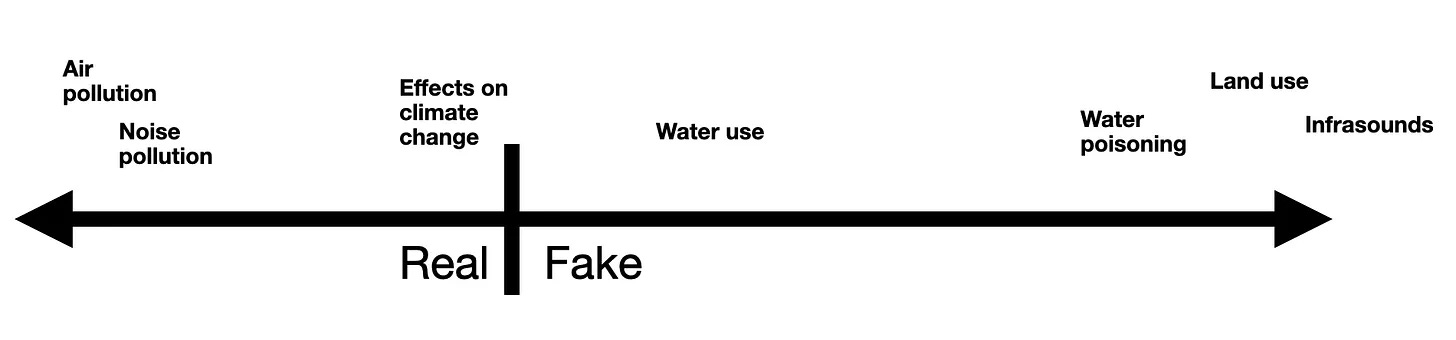
I’ve already covered water use, water poisoning, and infrasounds. There’s one fake issue left to address: land use.
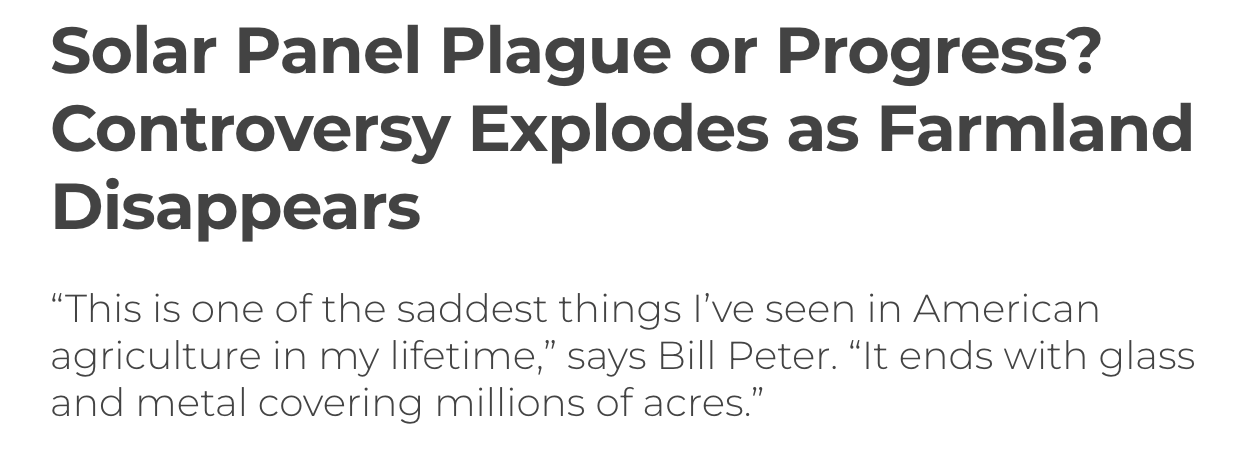
Like biographies use their subject as a prism for the world around them, I use data centers as a prism for much larger but invisible environmental problems, hidden by our tendencies toward populism and localism that data centers offend. This post focuses on the ridiculous ways we use land in America, which (like most of our water issues) is downstream of farmers being shielded from popular criticism by political alliances and folk intuitions about the honest toil of growing food. By the end, I hope you’ll be much more skeptical of headlines like this:
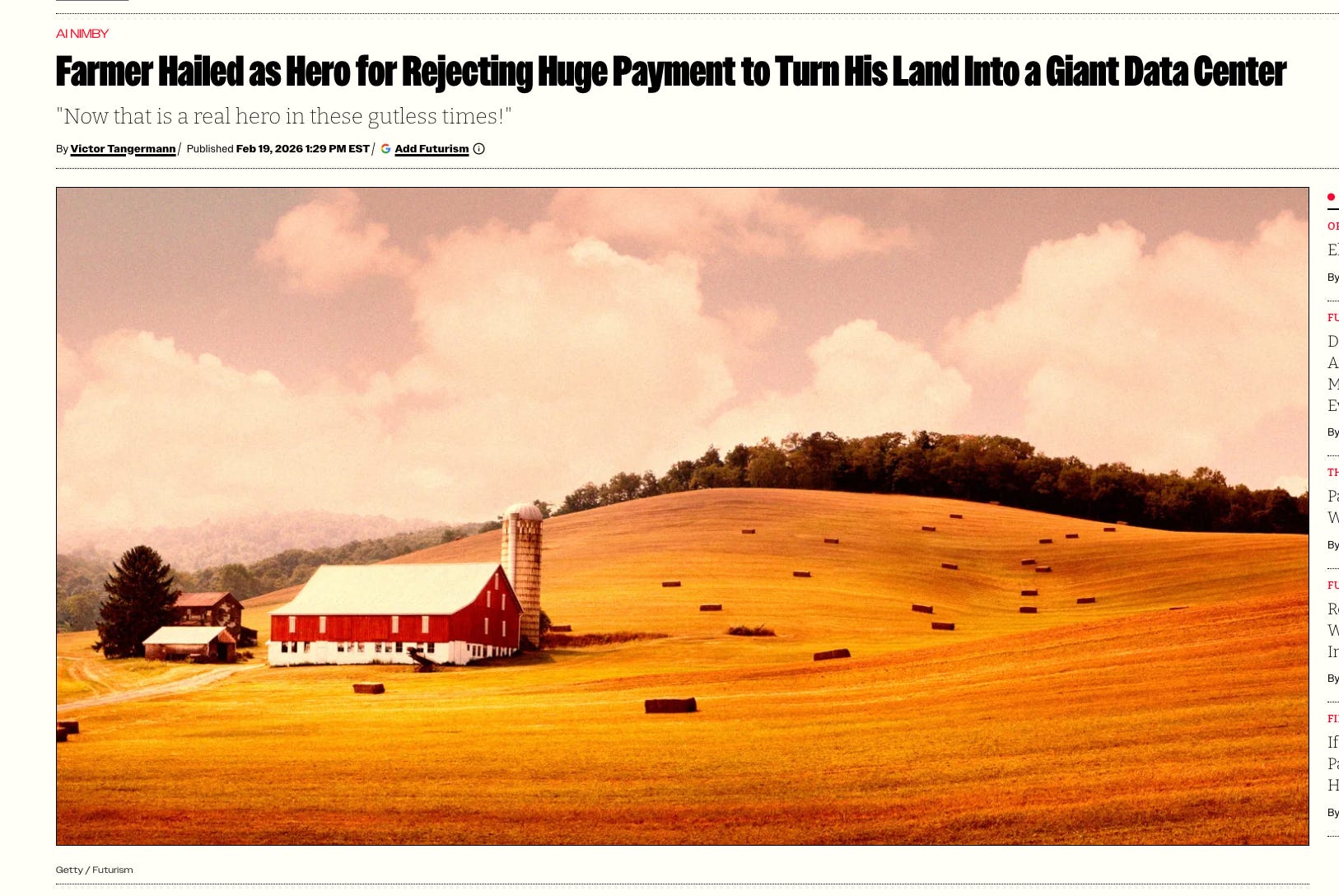
and of the idea that data centers purchasing farmland is a unique evil.
I’m not claiming data centers should be built anywhere and everywhere. There are lots of places where they’ve been built too close to people’s homes. This post is about whether data centers waste the land they’re on relative to what they compete with, and my claim is that they mostly don’t compete with things we need more of (housing) and mostly compete with things we need less of (farmland).
Contents
Data centers are the absolute most optimized use of land physically possible
The fact that data centers don’t create many jobs makes their land use way smaller
What about the land use of new power and transmission capacity data centers will require?
Data centers are the most optimized use of land physically possible
No other large buildings are crammed this full of objects optimized down to the atom for maximum performance. The most advanced supply chains in the world work together to push the servers inside data centers as close to the physical limits of manufacturing as anything we make.
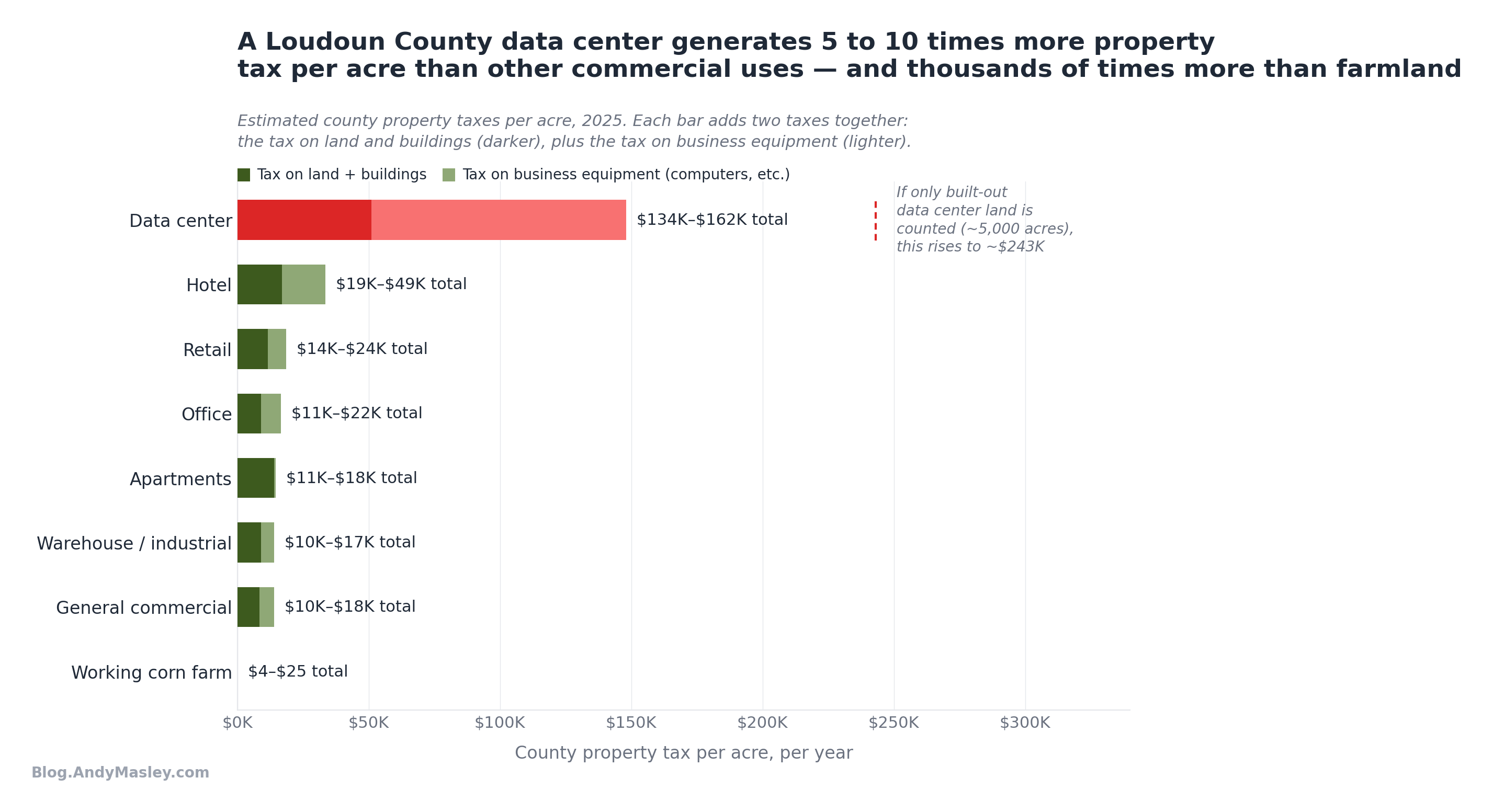
Northern Virginia has 13% of all global data center capacity, and Loudoun County has by far the largest concentration. But data centers only take up 3% of Loudoun’s land, and they generate 38% of all county general fund revenue. Using county tax info, I roughly estimated combined real- and personal-property tax revenue per unit land area (including land around the buildings data center companies own) for data centers vs. other major Loudoun revenue sources. Comparisons like this get a little ridiculous.
America isn’t lacking in land
By 2028, all data centers in America will occupy roughly 1,400 square miles. This is about 0.3% as much as America’s prime farmland. The vast majority of this will be land around the data center, the buildings themselves will collectively take up about 25 square miles, 0.005% of America’s prime farmland.1
Here’s a chart of how America currently uses land:
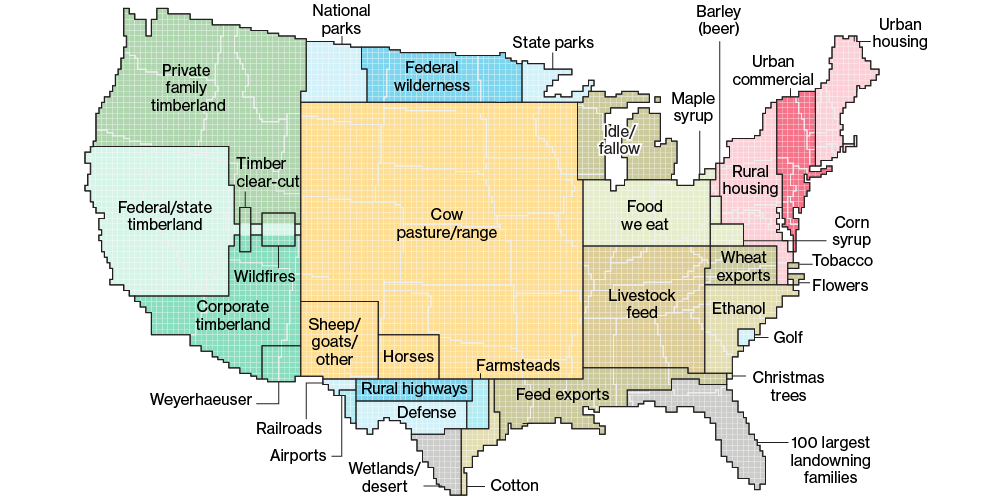
1,400 square miles is about 3.5 squares here, 3.5x as much as the land we currently dedicate to Christmas trees:
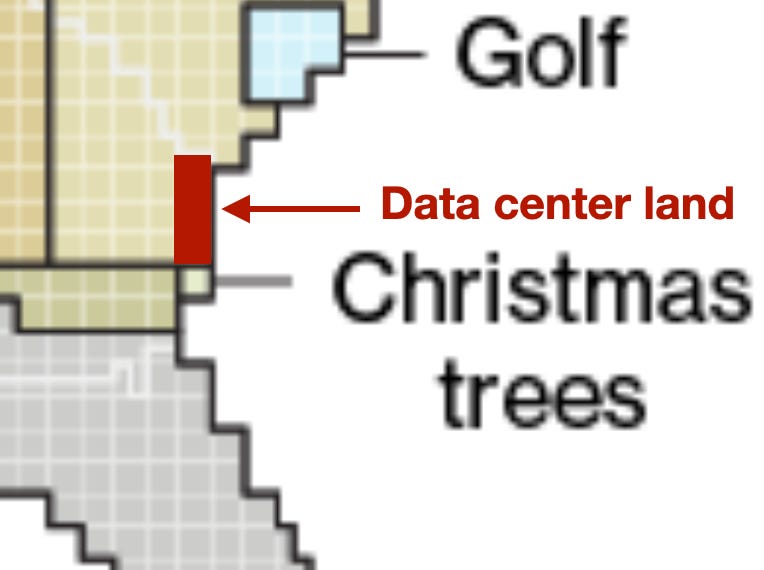
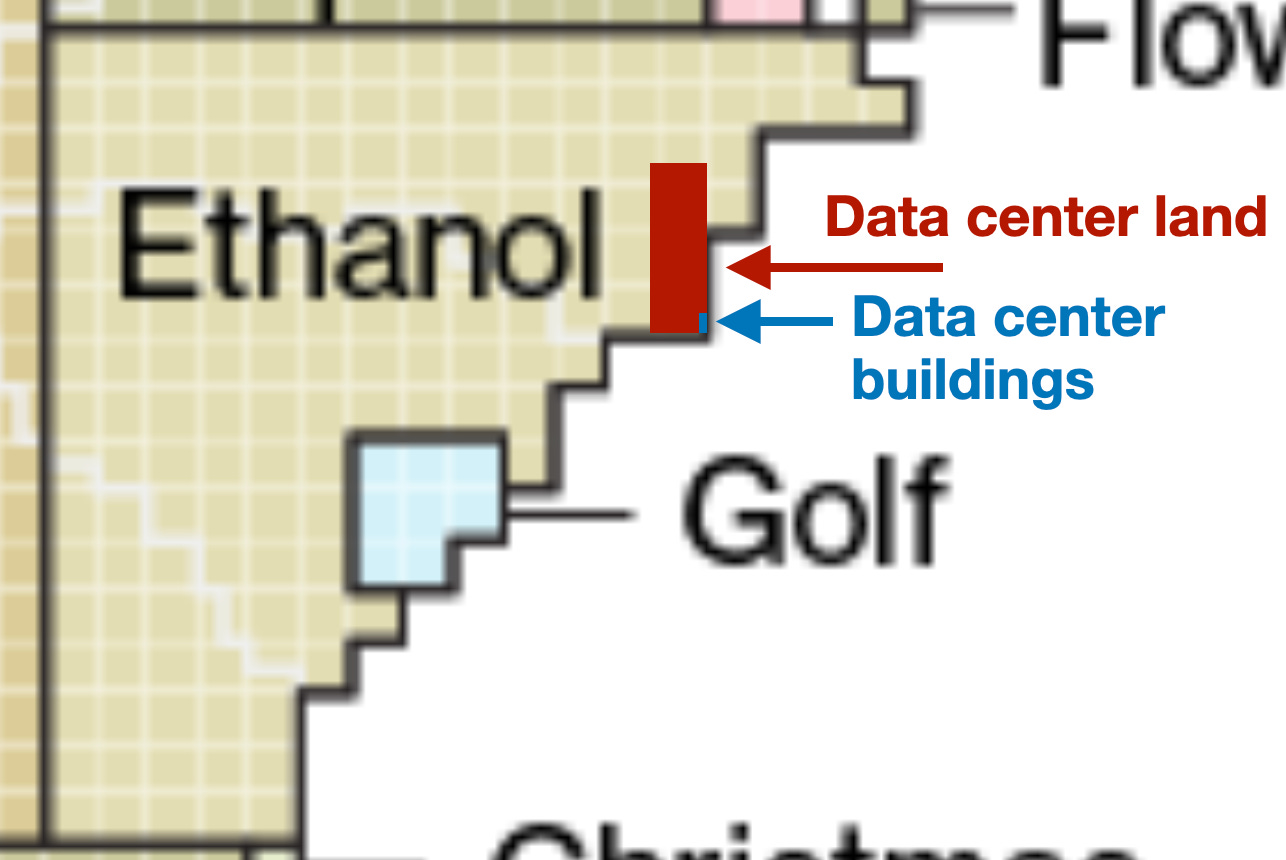
With the buildings themselves taking up an incredibly small part of that:
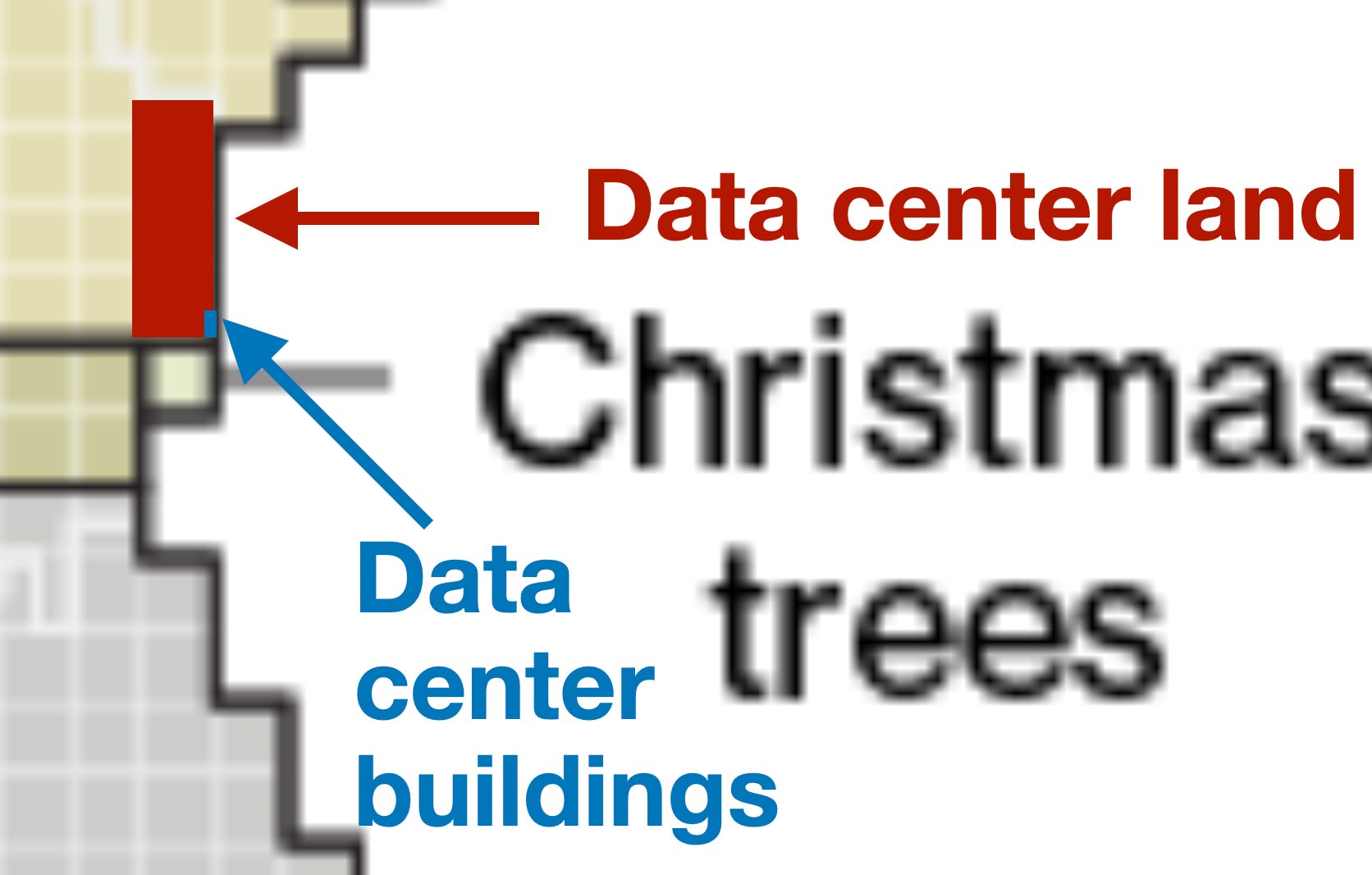
By 2030, data center buildings themselves will take up 1/15th of the land area we use to grow Christmas trees.
Data centers are uneconomical to build way far out in completely undeveloped land, since they need access to reliable large power grids. But they also don’t need to be built in or near dense residential areas. The vast majority of the contiguous US is within reach of high power lines, and the places data centers are built are mostly farmland or low-value scrub.
Data centers mostly don’t compete with housing
Some people worry that data centers take up land that could be used for housing instead, but data center companies want fundamentally different land than where housing shortages exist. Housing demand is overwhelmingly concentrated in and near existing urban cores, like California, the Boston-to-DC corridor where I live, Seattle, Denver, Austin, or Nashville. These are expensive because demand concentrates in specific neighborhoods already built out. The blockers on housing in those places are zoning, parking minimums, height limits, environmental review, neighborhood opposition, and the general legal apparatus that makes it illegal to build apartment buildings on most residential land in America. It’s rarely access to raw land.
Data centers want flat, cheap, large amounts of land with access to high-voltage transmission, fiber, and water for cooling, in places that permit a windowless industrial building. Anywhere with significant housing demand has land too expensive for large data centers. Data centers are mostly only built in exurban and rural land on the fringes of metro areas.
The fact that data centers don’t create many jobs makes their land use way smaller
If a new business that requires lots of workers moves into a town, lots of new residents have to move there too. This creates demand for massive land use changes. There will be more homes, commercial buildings, public services, and roads. I don’t think this is bad, but for people worried about land use changes in a specific area, a data center has a much lighter impact per unit of revenue because it needs so few employees.
A town allowing a large data center to be built is like buying a very large computer that hums in the background generating tax revenue with minimal maintenance. It doesn’t require reconfiguring the town the way a new large industry or commercial center would. Data centers are ideal for small towns that need lots of additional tax revenue but don’t want to have to deal with the infrastructure costs of having a lot of new people move there at once.
What about the land use of new power and transmission capacity data centers will require?
By 2028, US data centers are projected to use around 450 TWh of energy per year (the middle of Lawrence Berkeley National Laboratory’s 325–580 TWh range, with most other major forecasts clustering nearby). Data centers run with high load factors (meaning load is essentially flat and high 24/7) so 450 TWh annually works out to maybe 55 GW once you include grid losses. If served by firm power sources you’d need somewhere around 65–80 GW, or more if it’s coming from intermittent renewables.
The land footprint depends heavily on what gets built. Just getting to 450 TWh with solar would require ~1,500–2,000 square miles of panels2, and delivering that as reliable 24/7 power would require 1.5-3x as much, plus storage and batteries. So if data centers were all served by solar, they’d require maybe 2,500-5,000 additional square miles.
Wind requires way less land (unless you’re worried about infrasound…) but it seems unlikely to be a big part of data center power.
Natural gas plants are very land-efficient. One large new plant generates about 1 MW per 0.05 acres, and this drops to ~0.01 acres per MW if you just look at the buildings themselves. 80 GW of new natural gas would need between 12-40 square miles of plant sites depending on how you measure. I’d almost always prefer using more land to emitting more, so I’m not excited about gas and discouraged by the scale of new gas demand data centers are adding.
Nuclear is similarly compact, at about an acre per MW for the plant. I’d be much more excited about nuclear power serving data centers, but that seems unlikely in the short term.
A reasonable range for the additional power-generation land footprint is 50 to 1,000 square miles. This is significant but doesn’t dramatically change the picture. Adding it to the ~1,400 square miles of data center land for 2028 brings us to a maximum of 2,400 square miles. Definitely not nothing! But this means that all data centers, the land around them, and the power plants serving them would together come to at most 5% of the land used for ethanol, and roughly 0.08% of the contiguous US.
Transmission is harder to estimate, and it has the one land-use problem I think is real: utilities using eminent domain to route new lines through people’s property. I expect serious conflicts here. But transmission is also where data centers are most plausibly positive-sum. The green energy transition already requires roughly doubling US high-voltage transmission capacity by 2050. Data center demand mostly accelerates a buildout that had to happen anyway, and a line built to serve a data center cluster also moves clean power to everyone else on it. The eminent domain cost is real and serious, but it probably has to happen anyway. Farmers in other countries are far more likely to be seriously harmed by climate change, the green transition is necessary to fight it, and we need to pull a few eminent domain levers to enable it. The net positive effects of data centers forcing way more high-voltage transmission will outweigh the negatives, even though here the negatives are real.
Data centers free up lots of land elsewhere
The US has about 12 billion square feet (430 square miles) of retail real estate, and double that if you include the parking lots. Mall vacancies hit record highs in the 2010s, because people buy online instead. Amazon now operates about 11 square miles total of warehouse space, handling a large portion of all American retail sales. Hundreds of square miles of physical retail floor space and parking have been replaced by a few dozen square miles of warehouses, and a small fraction of that in data centers running the website, payments, and logistics.
There were about 100,000 bank branches at the 2009 peak. Today there are around 70,000 and falling because most banking moved into apps. Other things like travel agencies, photo labs, video rental, music stores, bookstore chains, paper-map publishers, have all either disappeared or sharply contracted, along with their land use. On net, data centers have freed up way more land than they use. Data centers have also enabled way more people to work from home, causing office demand to crater.
Is this all good? I’m not sure. Maybe it’s preferable to have malls over Amazon warehouses, or physical video stores over streaming. But regardless, the main effect of data centers on US land use has been to free up incredible amounts of land relative to the ~25 square miles they sit on. Most conversations about data centers only focus on the physical footprint of the buildings themselves without considering just how many other buildings they’ve made unnecessary.
It is not a crime against locals to raise their land value
A surprisingly common complaint in news stories about data centers buying land is that they raise the price of land around them.
In reading about bad environmental effects of industry, I’m used to reading stories of ugly industries moving in and lowering the value of land nearby. This is a problem because Americans have so much of their savings tied up in the value of their land and homes. The land value of farms specifically is a huge percentage of farmers’ total wealth. I’m not used to reading stories complaining that a new industry moved in and made nearby land way too valuable.
Data center effects on nearby land is really understudied. The few studies that have been done seem inconclusive, and have only focused on the effects of home prices specifically. The most thorough study looked at home sales in Fairfax, Loudoun, and Prince William counties near data center alley in 2023. They found that homes closer to data centers sold for higher prices, and their model (controlling for 13 factors that usually push up home prices) explained about 87% of price variance. The authors guessed that maybe this was because data centers cluster near the same infrastructure that makes housing valuable, and that a lot of data centers are tucked into places residents don’t even notice. The authors warned against generalizing too much from this study, especially in looser housing markets.
The potential way data centers make rural land around them more valuable is pretty straightforward: they’re willing to pay way more for land, pushing up the potential price for nearby land that has the same qualities data centers might be interested in in the future. If a data center causes a location’s grid and fiber to be built out, everything around it also becomes more valuable to future data centers.
Raising land prices benefits land owners and harms people who want to buy land. Lowering land prices harms land owners and benefits people who want to buy land. Which one is “right”? It depends on who you’re considering. In general, the locals who own land in the area where a data center is built benefit when their land goes up in value. Because Americans (especially rural farmers) have so much wealth tied up in their land, this often increases the wealth of people in the community where the data center is built.
The two complaints that usually pop up are that this raises local’s property taxes and that it makes it harder to buy land.
The property tax issue is real, but the same thing happens whenever any high value industry sets up in a rural area. Many states solve this with tax policy that taxes agricultural land based on its use-value, or other things like creating homestead exemptions or assessment caps. In states like Indiana that do this, when data centers are built, farmers nearby get immediately wealthier without having to pay more in taxes.
New buyers being priced out is also a real problem, but it’s a problem with making any place in America more desirable to live. Is the solution to keep rural land cheap by making sure nothing economically valuable ever happens there?
Building anything new in an area at all have some effect on local land values. Would you rather an industry raise or lower the value of the land around it? If you saw a headline that said “Data center built, lowers the value of everyone’s property around it” would you be mad? If so, it’s weird to also be upset that data centers are raising the value of people’s property. I think what’s happening here is that both involve trade-offs, and winners and losers (alternatively, the land owners or the people who want to buy land), and in both it’s very easy to focus exclusively on the loser while ignoring the winner. This leads to people being mad when a data center lowers property values, but also when it increases them. Loss aversion is often inherently change aversion.
A clear example of how strangely this issue is talked about in the media is this section of a More Perfect Union video (this one, at 2:00). They interview a local farmer, who complains that the land around him has become so expensive that he can’t buy more farmland to “feed more people.” They then talk to a guy explaining how new businesses can’t buy land there because the land’s become so valuable.
More Perfect Union frames this as “increasing costs,” but it’s increasing costs by making the locals way richer. The farmer’s complaint is that the data centers made his neighbors so much richer that they don’t want to make a deal anymore, and it’d be easier to buy their land if they were poorer and were more willing to sell it off. This is a bizarre complaint. In no other circumstance would we hear someone say “I would like to own more of my community’s land, but this evil company moved in and made all my neighbors so much more wealthy that they don’t want to sell to me anymore” and be sympathetic. But as we’ll explore in detail in the next section, farming has a weird halo effect where it warps our usual thinking about what’s fair.
We have way too much farmland
Farmers have the same combination of virtues and vices as the rest of us. But I think farmers (like any profession with a big positive halo) benefit so much from popular narratives that they get away with more environmental and economic harm, and their halo makes them harder to regulate and criticize. By the end of this section, I’d like you to share my intuition that it’s pretty normal and fine for farmers to sell their land to data centers (or solar power plants) if they want to. These are two private actors making an economic decision that might make sense for both of them. There isn’t some deep evil happening when farmer land is converted to a data center. Farming should be treated as one industry among many, that we can criticize or praise like any other industry, and that shouldn’t get special treatment or handouts because of the inherent virtue of toiling in the soil.
Question farmers
Once you start writing about any environmental issue, especially water, you quickly discover that farmers occupy a special place in American discourse where both right and left refuse to criticize them, because “they grow our food.” People have a simplistic idea of the inherent virtue of farming compared to other professions. This is how you get viral clips of local farmers “bravely” saying no to a data center company politely offering to buy their land for 10x what it’s worth, and reactions like this when you politely point out this is a little overblown:
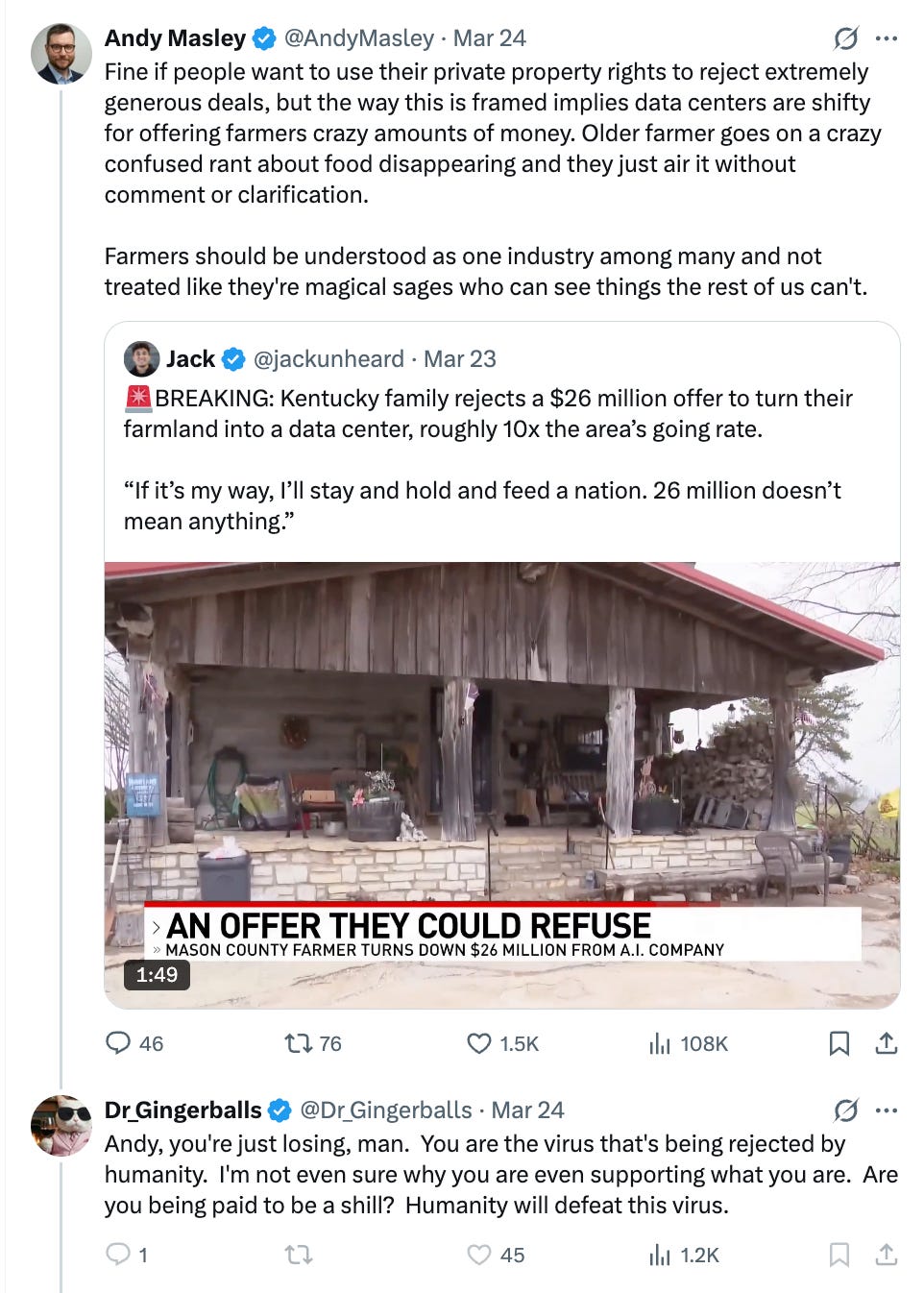
Cultural conditioning has trained us to see the good rooted people standing up to the far-off unrooted elites as always in the right. You can sometimes sneak in criticisms of farmers by referring to them as “big ag,” but this term ignores small farmers, who are not without fault.
I was happy to see Tomi Lahren come out strong against the horrific “Save Our Bacon” act. It’s nice to see animal welfare becoming depolarized. But even here she danced around the main issue, and imply that it’s not the small farmers who are at fault, it’s the Chinese:
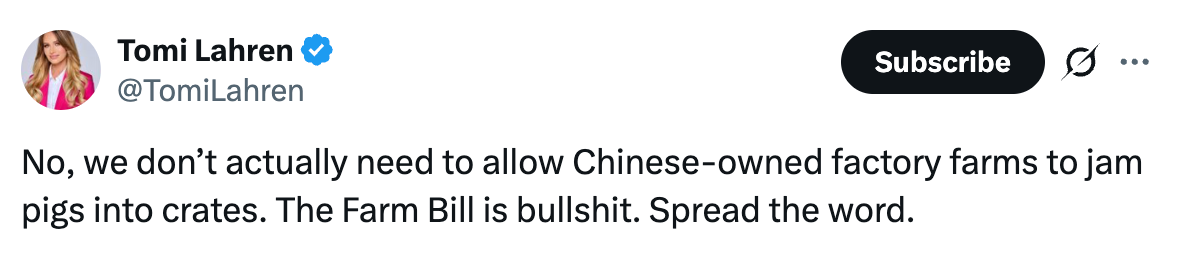
In reality, pig welfare on small American-owned farms is often just as bad as on large ones.
Once you see that people often find it offensive to criticize farmers at all, you start seeing it everywhere. Take this story from last year:
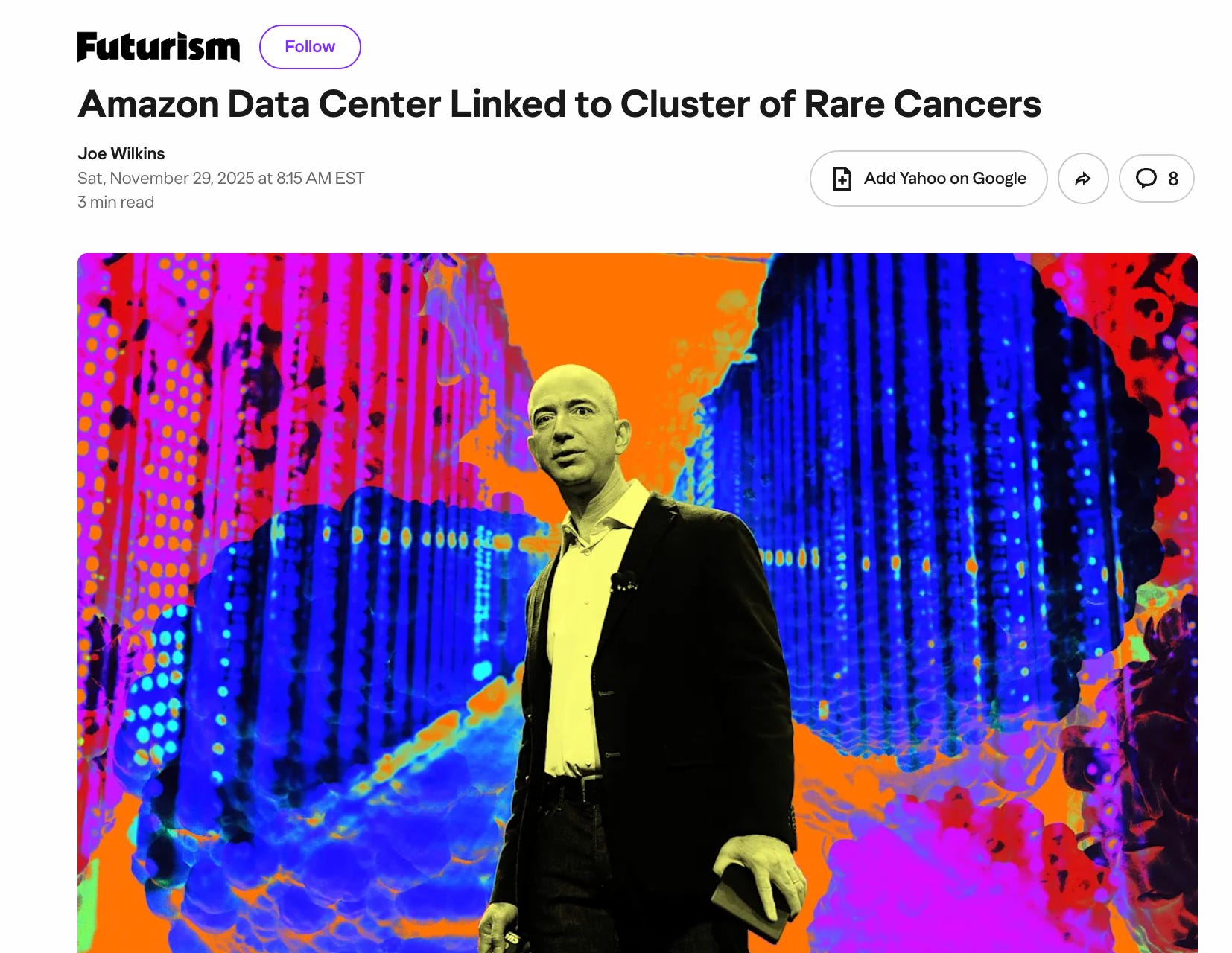
As I’ve talked about before, in Morrow County Oregon, an Amazon data center bought water from a source heavily polluted with nitrates, evaporated it, and sent the rest back to a wastewater treatment plant. Since nitrates don’t evaporate, the water sent to the treatment plant had a higher concentration. This likely raised nitrate concentration in the wastewater facility by less than 1%. Amazon was using a small fraction of the region’s water, but Futurism chose to superimpose cancer cells on data center server racks. They should have superimposed them on the main industry adding the nitrates:
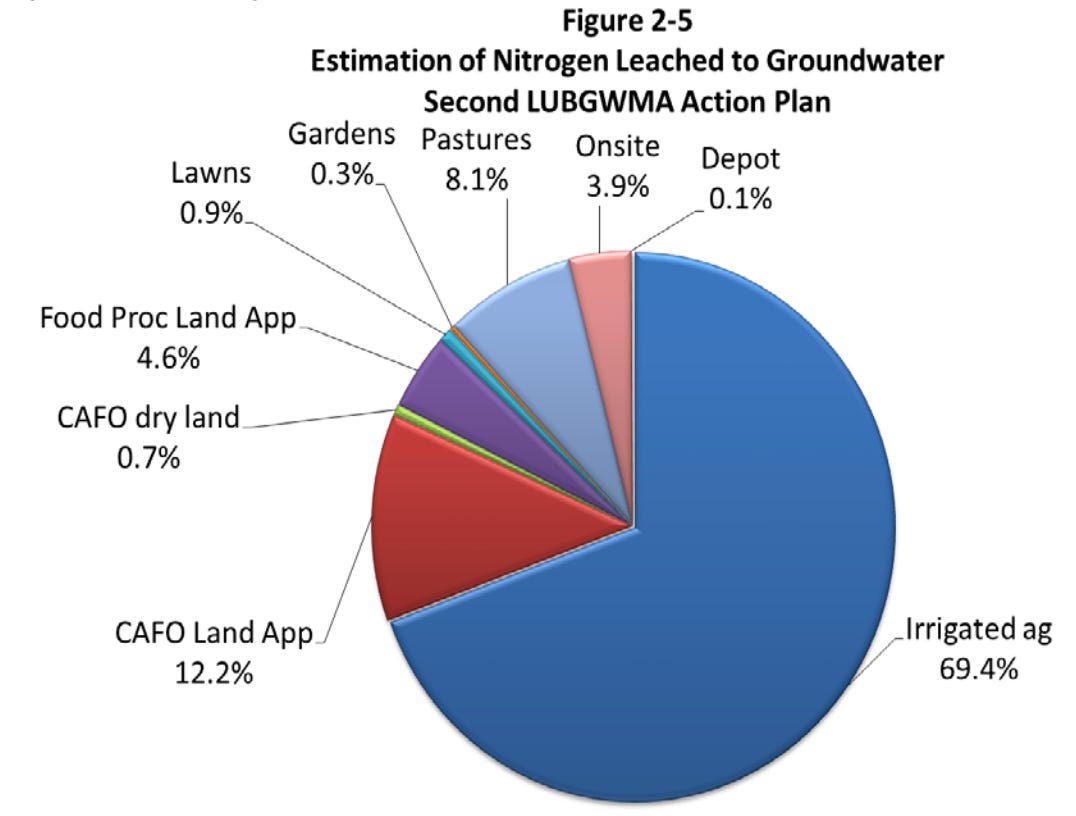
Farmers!
For 35 years Oregon’s government has known nitrate pollution was worsening in the Lower Umatilla Basin, the only drinking-water aquifer for Morrow and Umatilla counties, and has known the main source was irrigated agriculture. For most of that time, the government response was just suggesting “voluntary best management practices” and “stakeholder engagement.” Meaningful enforcement was limited to the Port of Morrow wastewater facility. By 2024, hundreds of domestic wells had tested above the federal nitrate limit, with some exceeding it 7x. Residents reported clusters of miscarriages, kidney failure, thyroid disease, and rare cancers. In 2022, Morrow County declared the first groundwater state of emergency in Oregon history.
Why were farmers allowed to build up nitrate pollution in the water here for 35 years?
In early 2025, state senator Khanh Pham introduced SB 747, which would have required farms over 200 acres (the largest 10%) to fill out a form telling the Oregon Department of Ag how much fertilizer they used, the kind, and the crop it was used for. The bill imposed no limits on fertilizer use. It did authorize civil penalties up to $10,000, but only for failing to file the form, or for being judged by ODA, after the fact, to be over-applying based on the reported data. Pham told the committee that “Senate Bill 747 does not impose restrictions. It simply collects data so agencies can provide better technical support, improve efficiency and prevent fertilizer waste.”
About 75% of the testimony on the bill was opposed. The Farm Bureau called it a “fishing expedition” that turned family farmers into “boogeymen.” One rep told the committee that 96% of Oregon’s farms are “family-owned and struggling.” “Family-owned” is basically meaningless: it means that any family, no matter how rich, owns the farm together. Walmart is a “family-owned” business. Farming families have slightly higher median incomes and way higher median wealth than Americans overall.
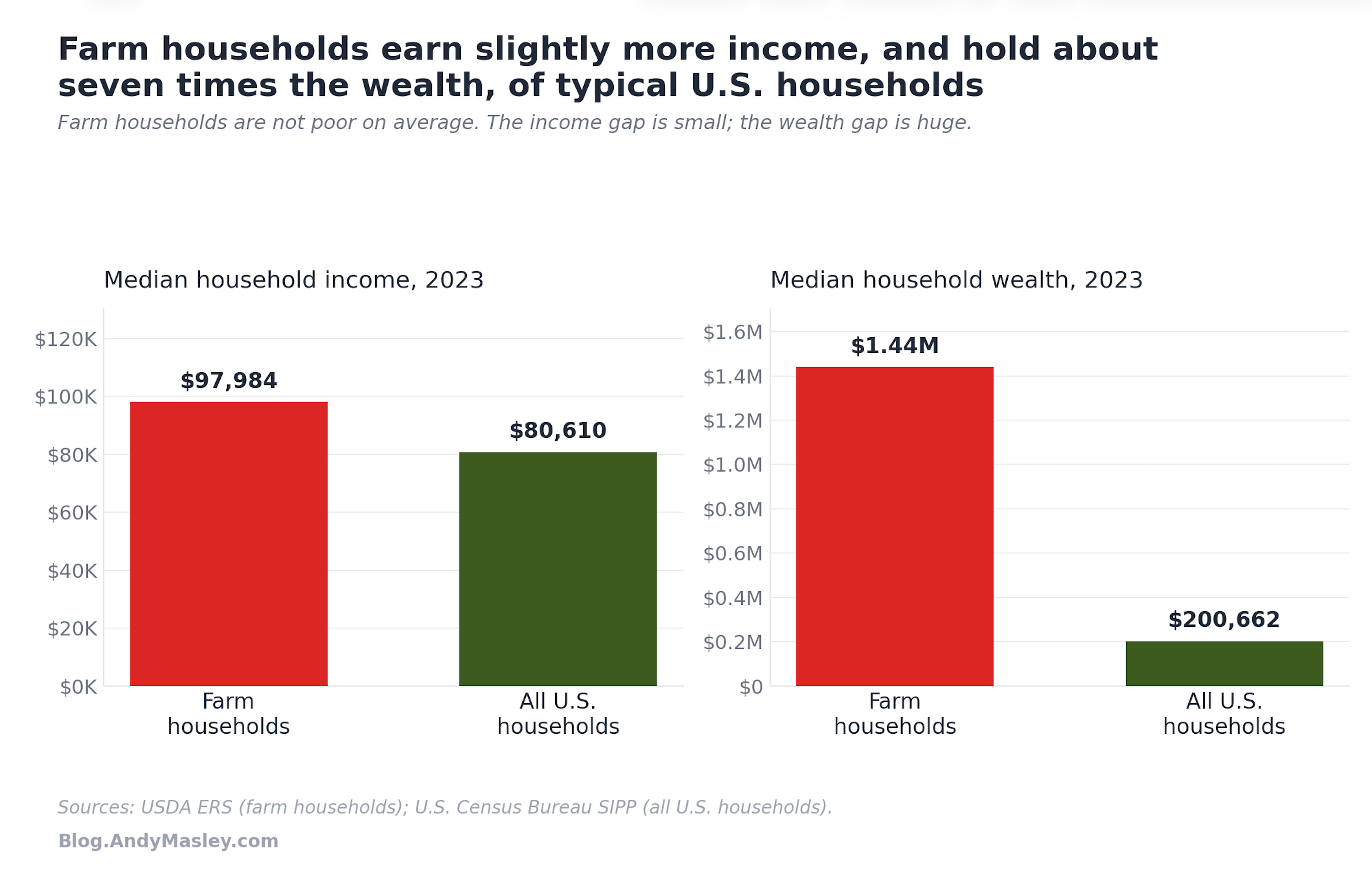
Another complained the bill “arbitrarily targeted” large farms while ignoring “municipalities and urban homeowners,” even though in the Lower Umatilla Basin specifically, agriculture and CAFOs together caused over 80% of the nitrate pollution. The farm coalition’s position was that being asked to share this simple information on dangerous pollutants would be a ruinous burden.
Rep. Bobby Levy was the most prominent voice opposing the bill. Her family’s farming business, Windy River, is inside Morrow County and draws from the polluted aquifer the bill was meant to protect. She told the Senate committee that “making the suggestion that over application of fertilizer is widespread is both inaccurate and unfair.” The committee declined to schedule a work session before the deadline, and the bill quietly died without a vote.
A month after Levy’s testimony, the Oregon Department of Environmental Quality issued a citation identifying the Levy family farm as having over-applied fertilizer on its own corn fields throughout 2023, polluting the same aquifer the bill was meant to protect.
This all happened under a Democratic trifecta and while the Morrow water crisis was on the front pages of Oregon newspapers. It happened because you basically can’t say ‘small farmers are part of the problem’ in American politics and expect to keep your job. At best, you can blame “big ag,” or maybe China, but the politics of farming is so crazy that farmers are a permanent third rail politicians won’t touch, even while they poison a local community. For any other industry, this would obviously be crazy, and every other industry has regulations on how much it can pollute water. But farmers are organized, numerous, and have silly folk theories about the inherent virtue of growing food on their side.
Finally, in March 2026, the Oregon Department of Agriculture adopted the first ever mandatory nitrate management rules for the area. Even this only applies, to start, to farms over 1,000 acres, who don’t have to submit plans until May 2027. Farms between 500 and 1,000 acres will be phased in by May 2028, and smaller farms aren’t required to submit their plans to ODA, only to draft them and keep records. ODA only has one staffer to oversee the whole basin and will audit “as agency capacity allows.” The data center here served as a useful if unintentional scapegoat to distract from the people directly adding pollutants to the water.
This fits a national pattern. The 1972 Clean Water act explicitly exempts “agricultural stormwater discharges and return flows from irrigated agriculture” (meaning nitrates, phosphorus, manure, and herbicides washed into a river or lake from a farm by rain) and requires no permit, monitoring, reporting, or upper limit. Farmers are not obligated to tell anyone how much nitrogen they use. This is regularly upheld by federal courts, most recently in 2025.
Agriculture is by a wide margin the main source of nitrate pollution in the US in US water. 12% of domestic water wells in agricultural areas exceed the federal nitrate MCL of 10 mg/L, versus 1% of public supply wells in non-agricultural areas. Nitrate concentrations in agricultural streams run about 6× higher than in undeveloped watersheds. When a rural well or a small-town water utility tests over the legal limit, the source, with rare exceptions, is corn, soy, or manure upstream.
One peer reviewed estimate found that nitrates in drinking water cause between 2,300 and 12,500 cancer cases per year, four-fifths colorectal plus 3000 cases of very low birth weight, and 1700 very preterm births. They estimated that the total medical cost is between $250 million and $1.5 billion per year, plus $1.3 to 6.5 billion in lost productivity.
A few obvious policies in the US could fix most of the problems with nitrates:
Mandatory reporting, where every farm above some size submits annual plans for how much and where they’re using nitrates.
Specific number limits on how much nitrates farmers can apply.
Treating large farms as point sources for water pollution in the way the Clean Water Act treats other industries.
Forcing farm polluters to pay the cost of water treatment.
Stop subsidizing ethanol, which alone is responsible for roughly a tenth to a fifth of all nitrates in US water.3
Denmark, the Netherlands, and Germany all have major agricultural sectors that operate well under way stricter rules than anything on this list. The only reason we don’t have these rules is that farmers are more politically untouchable here.
About 1.5% of the contiguous United States is used for a farmer handout: ethanol
Every year, the federal government forces oil refiners to blend 15 billion gallons of corn ethanol into America’s gasoline supply. This uses about 40% of all American corn. This is mandated by the Renewable Fuel Standard (RFS), and was sold as a policy to help address climate change.
However, every argument for mandating corn ethanol is terrible, and the only reason it survives is that politicians cannot question farmers.
The ethanol mandate was originally presented in 2007 as a path to energy independence and lower greenhouse gas emissions. Both arguments kind of sort of made sense then. Oil prices were high and the US was dependent on Saudi Arabia for petroleum. Not good! Ethanol’s lifecycle emissions looked like they might fall below gasoline if ethanol replaced part of the supply. Other arguments at the time held that ethanol would cut NOx emissions or sequester carbon.
But none of this is true now. Since the shale revolution, the US is now a net petroleum exporter. Studies now find that corn ethanol’s carbon intensity is at best roughly comparable to gasoline, and probably about 24% higher once you account for land-use change, nitrous oxide from fertilizer, and the conversion of grassland back into corn fields.
Because ethanol’s made of corn, it also has a high water cost. Corn used for ethanol is responsible for around 1–1.5 trillion gallons of withdrawals per year from aquifers and lakes, this is ignoring any rainwater it might use. That’s about 3% of all water withdrawn for US irrigated agriculture, for a stupid bad mandated product. I can’t help but add that this is roughly 40 times as much water as all the thousands of American data centers are forecast to consume onsite in 2028. Ethanol is generally more expensive than gasoline per unit of combustion energy. So on top of everything ethanol also increases gas prices.
But what’s most shocking to me about ethanol is its land use. About 1.5% of the contiguous United States is used to grow corn for ethanol.
Corn farms for ethanol specifically take up half as much space as all urban housing and commercial land.
So why do we have this mandate? The only people who benefit are corn farmers, ethanol producers, and fertilizer and equipment providers.
Like most bad laws, beneficiaries are concentrated and organized while those harmed are scattered and unorganized. Every American pays a tiny bit more for gas, the Gulf of Mexico absorbs more fertilizer runoff than it otherwise would, the climate as a whole has a little more CO2, aquifers are drained faster, but these harms are spread so thin across so many people that we don’t notice or get organized. In comparison, farmers notice what’s happening. They organize to keep the mandate, and no one bothers to oppose them, because it’s so politically toxic to criticize farmers.
Compounding this, rural Midwestern communities are amplified in American politics by the electoral college and presidential primaries, and the Senate’s overweighting of low-population states. There’s a strong bipartisan voting bloc in midwestern politics that treats the ethanol mandate as a third rail that politicians cannot touch.
So we’re stuck forcing oil companies to pay to support 1.5% of the contiguous United States being used for a stupid product no one wants.
When you see people talking about how any business, be it a data center or a solar farm or anything else, is “taking away our farmland” and that “soon we won’t have any left,’ consider this. Farmers currently have an area the size of New York State, as large as half of all American urban areas (suburbs included), specially dedicated to growing a product oil companies are forced by the government to buy, that makes our gas more expensive and dirtier, with zero benefit to anyone outside the farmers themselves. In an ideal world, farmers would lose the surface area of New York State to companies who would make better use of it, or even shut down and be replaced with nothing so that we stopped wasting 4% of our agricultural water on a product no one wants that makes our lives and the climate worse.
By 2028, all American data centers, including the land around them, will use about this much land compared to ethanol:
Converting all the land used by ethanol in the US to utility-scale solar farms would generate roughly 11,000 terawatt-hours of electricity per year, about about 2.5–3x current US electricity use, or roughly 35% of total world electricity generation.4 Consider this the next time you see news stories of corn farmers getting mad that their land is being bought by solar plants.
Solar plants and corn ethanol both have the same end-goal: generating usable energy. If you measure how much electricity solar panels generate vs how much energy is contained in the final corn ethanol product, and include all the energy costs of growing the corn, solar panels generate over 100x as much energy per unit area as corn farms used for ethanol over the same time period. This makes sense, because corn is in some sense just an extremely inefficient solar panel, slowly storing up energy from the sun to eventually release when it’s mixed in with gasoline. Fields of corn used for ethanol are kind of like very old-fashioned solar panels that are 60x less efficient than our current method.5
As a vegan, I do also have to highlight one other major land user:
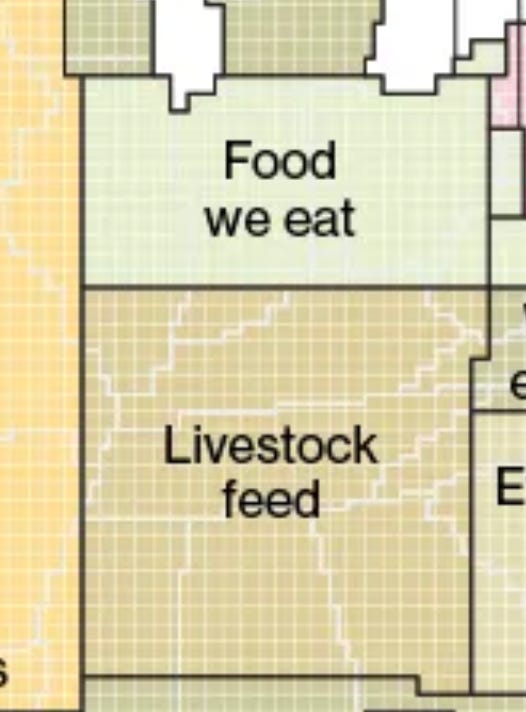
We use more land to grow food for the animals we eat than to grow plants we eat directly. Everyone going vegan wouldn’t free up all this land, because we’d need more land to grow fully nutritionally complete meals. The best estimates we have right now is that this would free up roughly 141,000 to 289,000 square miles of American cropland, depending on if we also cut animal feed exports. It would free up around 1,250,000 square miles altogether, because most of the land footprint of current American diets is pasture.
We have too much land dedicated to farming.
Addressing a few other defenses of ethanol
Some argue ethanol is actually good despite its negatives because it reduces NOx emissions, a harmful air pollutant. But this seems to no longer be true. Every US gas car built after 2017 has a catalytic converter that removes NOx from the exhaust to very low levels no matter what fuel you burn, so any small NOx benefit ethanol gives during combustion gets erased. A 2022 California study on 20 cars found no meaningful NOx difference between regular E10 gas and higher-ethanol gas, and a 2025 UC Riverside study found the same.
It might be worse. The EPA now predicts ethanol blending raises NOx, smog-forming VOCs, and fine particulates compared to ethanol-free gas, because ethanol makes gasoline evaporate more easily. And for small engines that don’t have catalytic converters, like mowers, leaf blowers, or generators, the Department of Energy found ethanol blends raise NOx by 50–75%.
Some people bring up that fossil fuels also use water to extract. That’s true, but ethanol uses way more water per unit.
A lot of people are really bad at thinking about farms in a marginal rather than an absolute way
When a data center or solar plant replaces a farm, the public conversation often turns to which product is more valuable in total. Would we rather have food, or silly computers? People will say things like “We can’t eat AI.” This is obviously ridiculous, because the question is never “Should we replace all farms with data centers?” It’s always “Should we replace one specific farm with a data center?” Because we farm way more than we need, and data centers are so efficient with their land use and in so much demand, the answer is often yes. Because we have way too much farmland, I would support replacing many corn or alfalfa (water-hungry and used mainly for animal feed) farms with nothing, never mind another building.
People sometimes bring up soil quality and “prime farmland” as if it were sacred. Prime farmland in the USDA sense is a soil classification for land that could grow crops well 23% of the non-federal open land in the continental United States qualified as prime farmland. We don’t need every last piece of prime farmland actually farmed. We are not going to run out, and shouldn’t turn all of it into farms right now.
It’s true that we can’t eat data centers, but we also can’t eat the corn grown on the New York State-sized chunk of land used for ethanol. The relevant question is always “Is this specific piece of land better used as a farm or a data center?” rather than “Should all farms be replaced with data centers?” The absolute all-or-nothing way of thinking about farms would justify tearing down all our cities and public infrastructure, because we don’t need anything else as much as food.
A very common talking point when anyone suggests that we could use less farmland is “City boys think that food just comes from the store.” To use an outdated analogy, this feels equivalent to the government mandating that way too many copies of Grand Theft Auto get produced, and any time this gets criticized the main response being “Oh do you think games just magically appear at GameStop?” This talking point always assumes that saying the marginal farm shouldn’t exist is identical to saying all farms shouldn’t exist.
What about the effects of climate change on farmable land?
Maybe this is all true now, but we may need to worry a lot more about farmland as climate change worsens, right?
Under most mainstream forecasts, the US ends 2100 with roughly the same or modestly expanded total climatically suitable cropland area, but with the productive zone shifted 100 to 300 miles north of where it sits today.6 This is still going to be wildly disruptive, because this will reshuffle what can be grown where, but on net the US will have the same or more total farmable land. The issue is going to be what can be grown where, not total access to farmland.
There’s a viral talking point that the corn belt in the upper midwest will become unsuitable for corn by 2100. We’re not sure if this is true, because corn varieties have been continuously rebred for changing conditions for the last century. The corn grown in Iowa today is not the corn grown in Iowa in 1925, and that wasn’t the same corn grown in 1850. By 2100, after 74 more years of adaptation, it seems unlikely Iowa farmers won’t be able to grow corn. The Corn Belt-collapse literature mostly assumes static management.7
Climate change will create lots of other problems for US crops. Higher levels of CO2 in the air reduce the nutritional value of grain crops, so we’ll need to grow more food to get the same nutritional value. Water might become a more serious issue, and if the median climate forecasts are slightly off, a lot of formerly irrigated farmland won’t be useable because the water will be gone. This is a serious concern, but it’s mainly about water rather than raw access to land.
I think the most serious response you could give here is that we’ll need more farmable land to feed the global population stuck with way less farmable land. That’s fair, but the clearest way to free up land for this is to join me and others in our quest to end industrial animal agriculture. Buildings that will collectively take up under 100 square miles in the US won’t ruin farmable land.
More evidence we have too much farmland
The federal government literally pays farmers not to farm
For the Conservation Reserve Program, the federal government pays $1.85 billion a year to over 302,000 landowners to keep their collective 40,000 square miles of land idle. This is about the size of Kentucky, and 28x the projected 2028 footprint of all data center land in the US.
CRP was created in 1985 partly because farm groups were alarmed at how much food American agriculture was producing. Prices were low because too much was being grown, so the government started paying farmers to grow nothing. Since then the justification has shifted more toward environmental issues, but the program still runs mainly because the country produces more food than it can sell at prices farmers want. The program has been reauthorized in every farm bill for 40 years. The main intra-industry fight over CRP is how big it should be and which land it should target. 67% of producers support expanding CRP acres while only 10% disagree, and demand regularly exceeds the cap. So farmers themselves largely support spending even more than the billions we currently do to convert even more farms into unused land.
America is a major food exporter
About 20% of US food production by value is exported. The US is the world’s largest exporter of food, we shipped $176 billion in agricultural exports in 2024. Foreign trade is good, but we’re not at the edge of some failure in country-level self sufficiency in food.
We throw out a third of the food we grow
30 to 40% of the US food supply is never eaten. One estimate suggests that if all America’s wasted food were grown on one farm, the farm would be 125,000 square miles, or 89 times the size of all land owned by data center companies by 2028. This means that a 1% reduction in food waste would free up enough land for all data center building over the next 3 years if literally all of it were built on farms.
This wasted farmland generates as much greenhouse gas emissions as 42 coal-fired power plants, 3% of all US emissions. If you add in the emissions from ethanol, 5% of all US emissions come from unnecessary farming.
We’ve been shrinking our farmland for decades and growing more food on it the whole time
Total US farmland peaked decades ago and has fallen since. From 2000 to 2024, it shrank from 945 million to 876 million acres, an loss of 108,000 square miles, about the size of Colorado. This is 77x the projected footprint of all data center land in 2028, and not many people seem to know it happened.
Why did farmland shrink this much? It’s purely that yields per acre grew. American corn yields in the 1930s averaged 24 bushels per acre. In 2024 they averaged 180, a 7.5x increase. Total corn production is now more than 6 times what it was in the 1930s, but uses less land than it did in the 1930s. The same is true for soy, wheat, and most major crops.
The trend keeps on going. Corn yields have been rising at about 1.9 bushels per acre per year for 70 consecutive years with no signs of stopping.
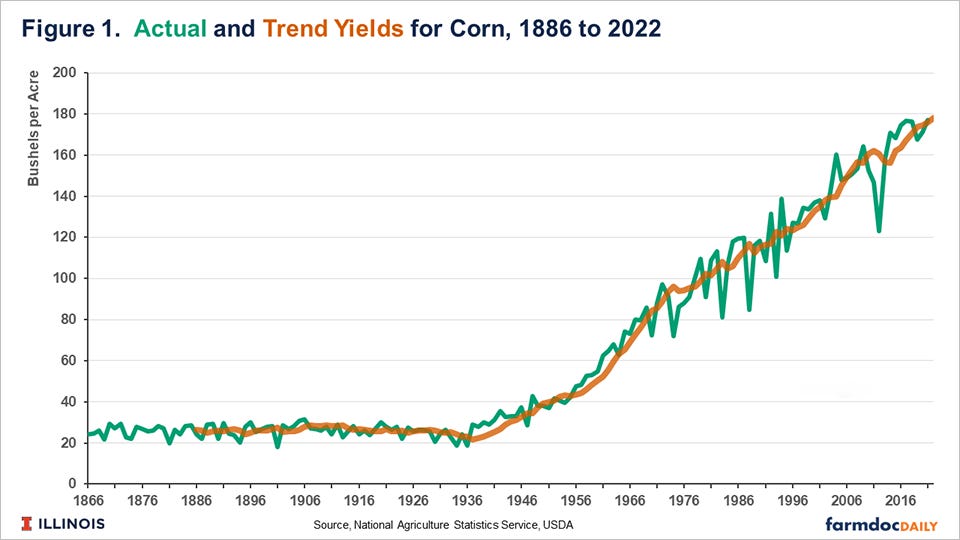
If you follow this line, average corn yield in 2050 will be around 230 bushels per acre. We’ll need less land to grow the same food 25 years from now than we do today.
We’ve already abandoned tens of millions of acres of farmland and it was great
In 1850, much of New England was farmland. Vermont was about 70% pasture and cropland. Then mechanized farming opened up the Midwest’s deeper soils, the Industrial Revolution pulled rural labor into cities, and New England farms became uneconomic. The land turned back into forests. Today, about 70–80% of New England is forested. Where I grew up in Massachusetts, you can regularly find old stone walls from farmers hidden deep in the woods. The region has more forest cover now than in 1820. Vermont went from a stripped agricultural landscape to one of the most heavily forested states in the country.
Across the eastern US, hundreds of millions of acres followed this pattern between 1850 and 1950. The country was fine. The abandoned land was the marginal stuff barely worth farming, and the land that kept being farmed was the productive Corn Belt and Central Valley.
If a few thousand acres of mediocre Loudoun County farmland end up under Amazon and Microsoft and Google data centers, I suspect that nothing bad will happen, for the same reason that it’s not a disaster that most of New England was changed from farms into forests. The marginal hay field on the exurban edge is producing way less value to anyone than a hyperscale data center on the same land. A farmer who sells to a data center company for 10x what their land is worth is doing something economically rational, environmentally reasonable, and morally fine. They’re doing exactly what their grandparents in Vermont did when they sold their farms and let the trees come back.
More examples of the goofy ways our politics and land use is warped by farmers
There are too many other ways farmers’ disproportionate political power makes land use and policy goofy to keep writing about here. For more, you should look into ag-gag laws, the decline of the Ogallala Aquifer, use-it-or-lose-it water rights, and the “family-farmer” myth (discussed a bit above) which wealthy farming families use to garner sympathy. And on top of this, the unimaginably huge moral catastrophe of industrial animal agriculture. For a deep dive on the weird world of farm economics I’d recommend this podcast series from the Agricultural Economics Institute.
Conclusion
American farmers grow more food than the country eats, export 20% of the surplus, and we the buyers throw out another third of what’s left. Farmers collect $1.85 billion a year from the federal government to keep a Kentucky-sized 40,000 square miles of farmland intentionally idle, an area 28 times the full projected footprint of all land on American data center property in 2028 (with data centers themselves occupying just 2% of that land, just 25 square miles). The federal government forces oil refiners to buy 15 billion gallons of corn ethanol every year, occupying roughly the surface area of New York State, draining aquifers at 40 times the rate of every data center in the country combined, and producing a fuel that, once you account for land-use change and nitrous oxide, is 24% dirtier than the gasoline it replaces. The food we waste, if grown on a single farm, would cover an area 89 times the size of all land owned by data center companies by 2028, and emits as much CO2 as 42 coal plants, 3% of all US emissions. Between 2000 and 2024, farmers sold in total a Colorado-sized chunk of land all on their own, 77 times all land on data center property in 2028, and grew more food than ever on what was left. None of this caused any problems for US food access.
And then, in the middle of all this, a farmer in Loudoun County sells a few acres of mediocre hay field to a hyperscaler for ten times its agricultural value, and the response is that we’re running out of farmland.
The marginal Virginia hay field is worth more as a data center than as hay. The marginal Iowa cornfield going to ethanol would be much better if it were nothing at all. When a farmer in Loudoun County wants to sell to Amazon for ten times the land’s agricultural value, the correct response is to wish them well. We need way less farmland than we currently use, and it’s fine if data centers buy some.
Some bad recent articles on data center land use
“Farmer Hailed as Hero for Rejecting Huge Payment to Turn His Land Into a Giant Data Center”
The immense hype surrounding AI has caused enormous data centers to crop up across the country, triggering significant opposition. It’s not just the loss of land: enormous power needs are pushing the grid into meltdown and driving up local electricity prices, catching the attention of politicians and their irate constituents.
idk I think it’s more than hype.
One 86-year-old farmer in Cumberland County, Pennsylvania, has heard enough. As local Fox affiliate WPMT reports, Mervin Raudabaugh, who has farmed the surrounding land for more than 60 years, turned down more than $15 million from data center developers in a package deal that involved three neighboring property owners as well.
The farmer was offered $60,000 per acre to build a data center on his property. But giving up his family legacy wasn’t in the cards for him.
“I was not interested in destroying my farms,” he told WPMT. “That was the bottom line. It really wasn’t so much the economic end of it. I just didn’t want to see these two farms destroyed.”
Instead, he sold the development rights in December for just under $2 million to a conservation trust, taking a significant loss but guaranteeing that it would stay farmland in perpetuity.
This guy turned down $58,000,000 to ensure that America continues to have way more farmland than we need.
Users on social media called him a “legend,” and argued he had “more integrity than the whole government.”
“Now that is a real hero in these gutless times!” another user tweeted.
“$15M is huge, but clean water, quiet land, and legacy don’t have a price tag,” another user argued.
Data centers don’t really pollute water anywhere.
The sheer amount of land being earmarked to construct enormous energy and water-sucking data centers is remarkable. A data center in Mount Pleasant, Wisconsin, is set to take up 600 acres, which could cost local residents their land, as ABC News reported this week. Another octogenarian farmer, the 83-year-old Tom Uttech, who has lived on his 52-acre Wisconsin property for almost 40 years, told the broadcaster that he “couldn’t believe” that a local utility company was looking to build “power lines that are 300 or something feet tall, taller than apparently the Statue of Liberty,” through his land to power the data center.
“Cost residents their land” meaning “Could mean residents are paid way more than what their land is worth if they choose to accept the deal.” 600 acres is about a square mile. Each of these is a square mile:
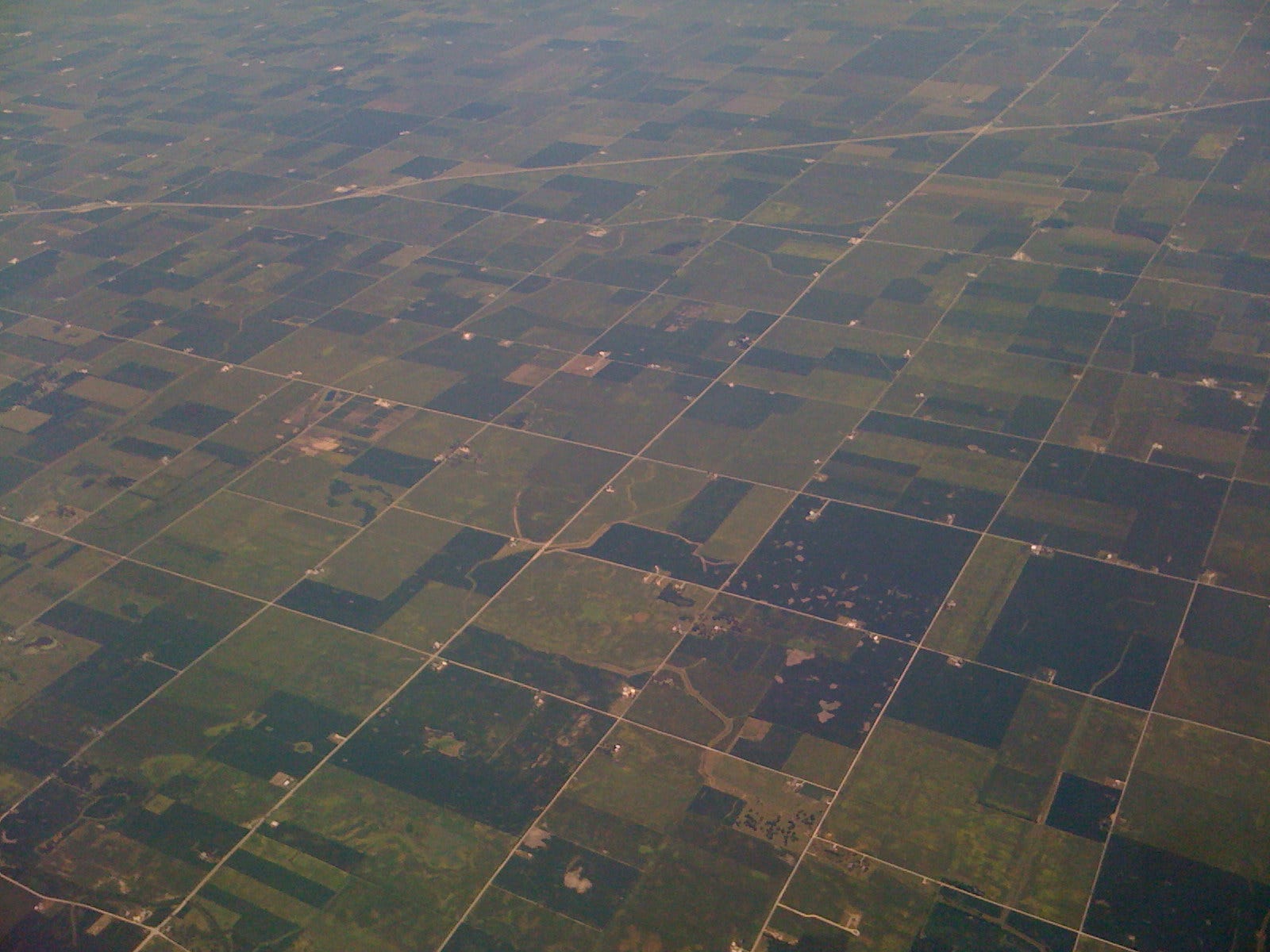
A private company purchasing a single square mile farm in a rural area wouldn’t make headlines. But data centers are seen as weird and untraditional, so they get way more scrutiny. We would need to build 50,000 data centers at this size to use as much land as ethanol corn.
“It breaks my heart to think of what’s going to take place here, because only the land that’s preserved here is going to be here,” Raudabaugh told WPMT. “The rest of every square inch is going to get built on. The American farm family is definitely in trouble.”
This is an insane hyperbolic thing to say. We have so so so much farmland, way more than we need. Every square inch is not going to get built on, and the average American farm family is incredibly well-off and coasting on powerful political allegiances and the confused goodwill of populists.
This same story was reported on in Fortune and Newsweek.
A data center using as much land as 51 Walmarts
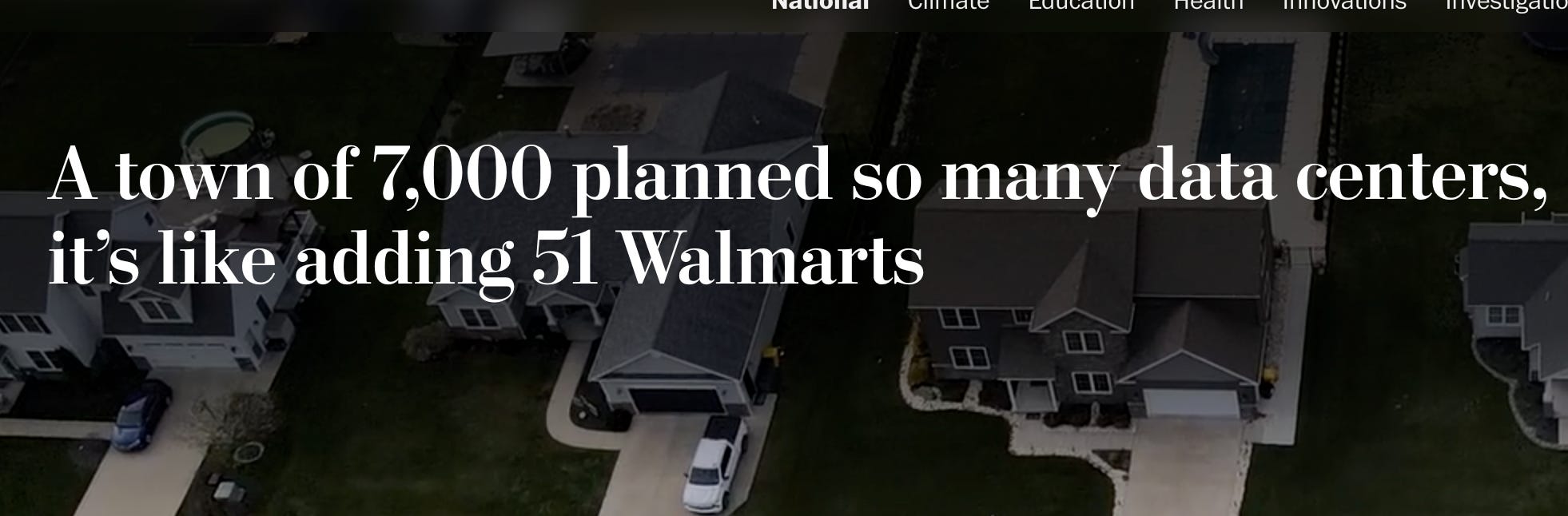
The town didn’t “plan” the data centers, they approved a private company to purchase land. This is a common weird framing in the data center discourse. People often talk as if data centers are a collective decision we're all making. In reality, private companies buy land, power, and water from towns and utilities like any other company.
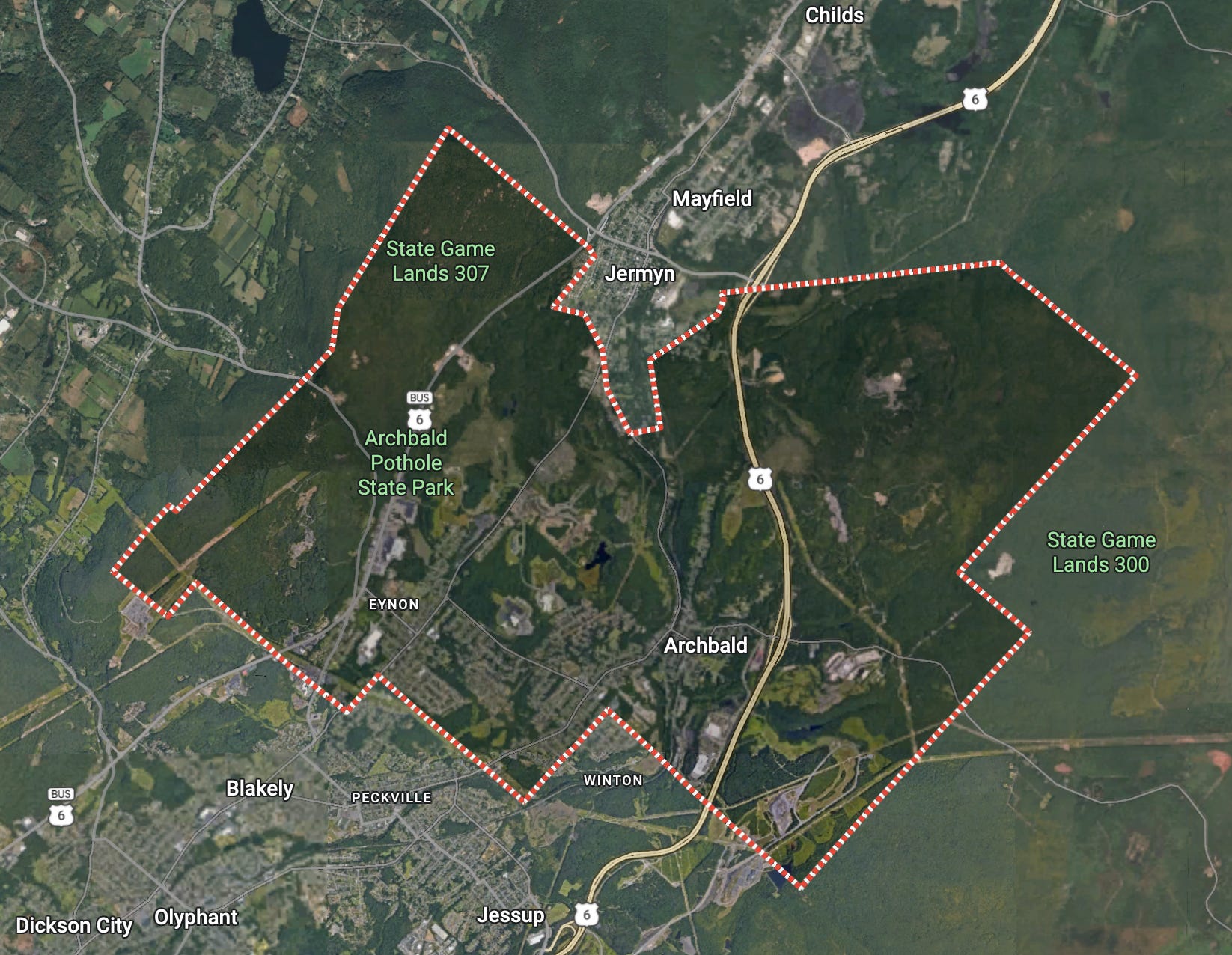
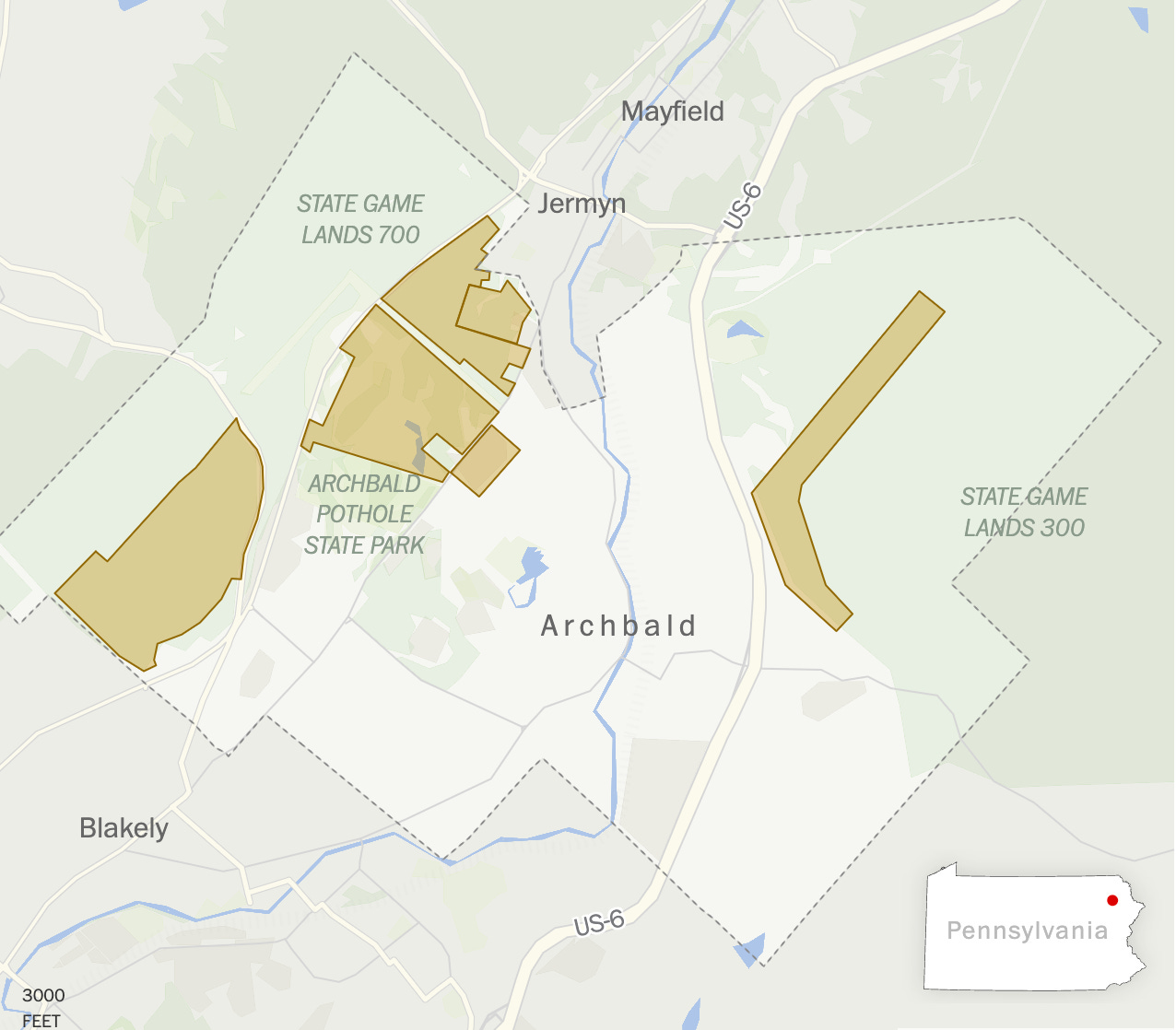
This town is 17 square miles. The article says the data centers would together take up 14% of the town’s land, so ~2.4 square miles.
This is the town of Archibald PA that the article’s about:
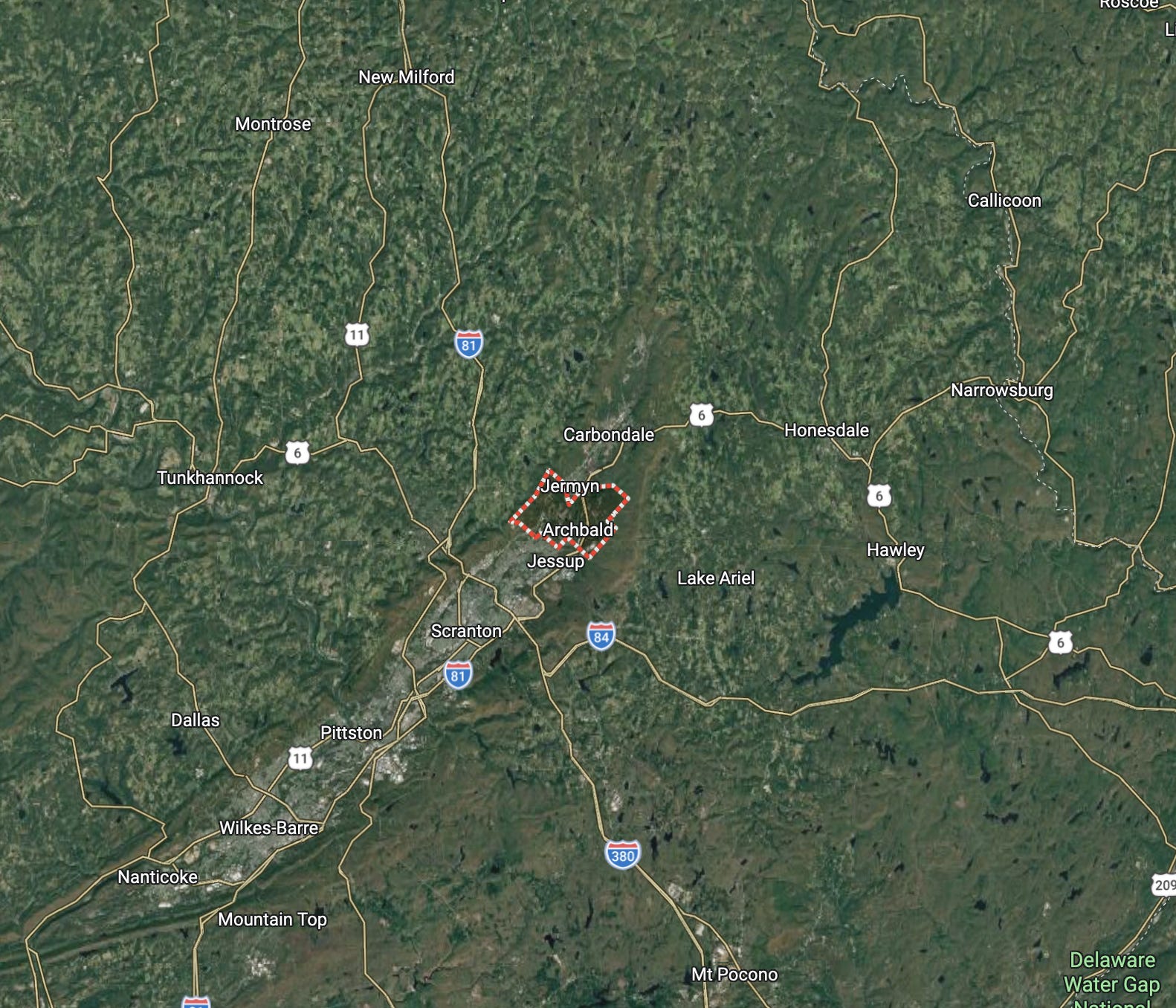
It’s in a pretty rural area:
These are the sites where the data centers have been proposed:
If you found out that a small town like this were getting a college or farm, how would you react? Would this be an unacceptable imposition on the locals? The college would radically change the general culture and infrastructure needs of the town, whereas the data centers hum in the background.
There are definitely serious issues the locals bring up in the article (electricity costs, air pollution, noise) but the land use framing makes no sense to me. Archbald is in a pretty rural area with tons of wide open land. Purchasing 14% of a small town’s land on its own doesn’t seem newsworthy.
“This Land is Their Land”
The title image is already promising:

The subtitle is “Farmers are fighting AI companies offering fortunes to build data centers on their land. Can they withstand the pressure — and live to farm another day?”
Farmers are always framed as the good guys. Question this.
“Life-changing money.” That’s how Wendy Reigel describes the windfall developers are offering farmers for their land, potential sites for hyperscale data centers to meet AI’s massive processing needs. Reigel is a grassroots anti-data-center activist who successfully fought the building of a center just 300 feet from her house in Chesterton, Indiana; she now helps other communities mobilize against data center incursions. She can only make an educated guess as to how much money is on offer — almost everything about these facilities is shrouded in secrecy.
“$20,000 an acre would be low-balling it,” Reigel said. “$40,000 would be maybe a starting point. And I’ve heard as high as $90,000.”
This doesn’t exactly sound nefarious. They’re offering crazy amounts of money for people’s land. Would it be better if they offered less?
And with this wind beneath their sails, AI-giddy companies like Amazon, Google, Meta, Microsoft, and Oracle have embarked on a national land grab.
The new land grab here being in total about 2 times as much land as we use to grow Christmas trees by 2030.
Some farmers are loath to condemn fellow farmers who sell their land for this purpose. They don’t begrudge life-changing money to anyone who’s contended with their industry’s often brutal fiscal realities, although a farmer in Michigan who sold his land for an “astronomical” sum — in the interest of what he called progress — says his neighbors don’t wave at him anymore. With or without the animus, farmers who opt not to sell are left to contend with the potential destruction of their operations and their lives. “It ruins all our little farms around here that we worked all our lives on,” a couple in Coweta, Oklahoma, told the local news.
I think all farmers should be loathe to condemn other people for making private financial decisions that work out well for them if they don’t harm other people. The question is will the data centers harm the nearby farmers?
There are data centers popping up almost everywhere, from Oregon and Nevada to Georgia and Virginia. (Loudon County is our country’s “data center alley.”) But Indiana has become an especial target for hyperscale facilities, of which there are an estimated 1,130 globally; since Indiana produces a lot of corn, soy, and hogs, it’s also illustrative of the challenges that farmers in particular are up against.

43% of Indiana's corn crop went into ethanol production in 2024, and ~95% of Indiana hogs are in factory farm conditions. Neither inspires sympathy from me.
“That hurts us, because they’re paying a higher price than market value for the land; that drives property values up, then farmers are struggling to pay their taxes,” Blalock said. That price is also “completely out of reach” for any farmers starting out or looking to expand their operations. When data centers are willing to quadruple or quintuple an already-inflated price, affordability for farmers goes up in smoke.
Okay, well we have one answer to how data centers are “harming” farmers. They’re making the farmers’ land so valuable that property taxes go up.
For any farmer who owns the land they farm (which most do), rising land values are a massively good outcome. Land is by far the largest asset on most farms’ balance sheets (the article will go on to note this). They can borrow against it, sell and retire on it, or pass it to their kids. The article is asking us to feel sorry for farmers because someone is making their land massively more valuable. I need anyone reading this to ask: if it’s bad for the data center to raise farmer land values, doesn’t that mean it would be good for it to lower their land values? But if a data center moved in and made everyone’s farmland way less valuable, I think we’d also hear lots of negative stories about how it harmed a community, and there I’d take it more seriously.
The weirdest thing about all of this is that Indiana’s agricultural land tax is not supposed to be based simply on speculative industrial value. The state says agricultural land value is based on productive capacity, regardless of the land’s potential or highest and best use, and the 2026 agricultural base rate is listed at $2,120 per acre. So I’m not sure if rising land value will even raise taxes here.
Morgan Butler is a senior attorney at the Southern Environmental Law Center, who helped the tobacco- and dairy-producing community of Pittsylvania County, Virginia, fight off a 1,000-acre AI facility. He said developers are drawn to farmland because “They see a huge area. In their eyes there’s nothing on it, nothing particularly valuable, there aren’t that many residents so hopefully they won’t kick up a firestorm of public opposition.”
What needs opposing here? A data center drops in and offers so much money that it inadvertently makes all the land value around it go way up and all the farmers who didn’t interact with it got richer? What?
That rural “nothingness,” though, is precisely what community members opposed to data centers hope to preserve. One farmer in Kentucky turned down an $8 million offer for his land, citing his family’s sentimental ties to it and the community’s fondness for the landscape as it is. However, one bitter truth for farmers is that much of their net worth can be tied up in their land; retirement might necessitate selling property because they have few or no other assets, making a generous offer for acreage hard to refuse.
Okay, so far this article’s been implying that it’s a massive crime that the data centers are raising farmer land values so much, and now it adds that much of an average farmer’s net worth is tied up in their land. This implies that the data centers are doing farmers a massive favor by increasing so much of their total net worth? But the article never acknowledges this contradiction. In fact, a pull quote appears right below that makes this contrast more obvious:
A hyperscale data center can use upwards of 8 million gallons of water per year, mostly for cooling its servers. “We don’t have the water supply” to meet those needs, said farmer Bart Snyder. Snyder lives in Wolcott, an ag-centric town 135 miles northwest of Henry County, where Amazon is scouting a 330-acre facility 1,000 feet from one of his farm properties. He’s suing his town’s commissioner and redevelopment committee members (all of whom signed NDAs) for approving a farm-to-industrial land rezoning on behalf of that facility. “To consume that much water would absolutely devastate our row crops” and potentially create a deficit for Snyder’s 30 beef calves, which each drink 15 gallons of water daily. “People are literally scared to death,” he said.
Blalock is concerned that if a data center is approved in her county, it could deplete the local aquifer, causing neighbors’ wells to run dry and preventing her family from ever drilling one of their own for their cattle. She said that would put them out of business and leave their land valueless. “No one has answers for us about, what’s our backup plan? What if people lose water? You can take your family to go stay in a hotel but it’s not like doggy daycare; you can’t show up with 50 head of cattle.” And she worries: “Are we going to be the generation that loses the farm?”
The data center seems unlikely to do this.
Wolcott is in White County, Indiana. Irrigation on corn typically runs 6–10 inches per season. 8,695 irrigated acres at ~8 inches of supplemental irrigation consume roughly 1.9 billion gallons per year. The 8 million-gallon data center is 0.4% of that. This data center is using as much water as a local 35 acre irrigated farm. If one additional 35 acre farm appeared, I don’t think the farmers would be talking this way.
The rest of the article has legit worries about pollution and electricity prices. It also has an interesting concern about infrasound I hadn’t addressed last time: its effect on animals. I think that if animals can detect infrasound because they evolved to hear different frequencies than us, it makes complete sense that infrasound could be harmful to them. I will circle back on this once I know more about infrasound and animals.
This is a back-of-envelope estimate. Nobody tracks total US data center parcel acreage directly. As of late 2025, Cushman & Wakefield reports the Americas hosts 43.4 GW of operational data center capacity, with 93.6% in the US (so ~40 GW US operational), plus 25.3 GW under construction. Capacity forecasts for 2030 cluster around a 2.5–3.5× expansion: McKinsey projects US data center power demand to rise from 25 GW in 2024 to over 80 GW by 2030, S&P Global’s 451 Research projects 134 GW by 2030, and Bain forecasts global capacity reaching 163 GW (the US is roughly 80% of the Americas total). Skeptics including Grid Strategies argue these are inflated by speculative projects and that ~65 GW of additional load is more realistic. Assuming a central case of ~85 GW US operational by 2030. Cushman & Wakefield’s 2025 Data Center Development Cost Guide reports the average data center parcel acquired in 2024 was 224 acres — a 144% increase since 2022, with hyperscalers routinely buying 1,000+ acre sites for phased buildout (Meta’s 4-million-square-foot Louisiana campus sits on 2,250 acres for ~2 GW). Combining current operational acreage (~300,000 acres across roughly 4,000 facilities, most of which are small legacy colocation on tiny urban parcels) with new hyperscale buildout at ~1,500–3,000 acres per new GW gives a total in the 600,000–1,000,000 acre range, roughly 1,400 square miles at the central estimate, or about the area of Rhode Island.
Building-footprint math: existing US data center floor space is roughly 300–400 million sq ft, or ~11–14 sq mi. By 2030, capacity is projected to roughly triple (from ~25 GW today to ~85 GW central case), but power density is rising sharply at the same time — AI racks now run 40–60 kW vs. legacy racks at 10–14 kW, so new facilities pack much more compute into the same square footage. Assuming new-build density runs 1.5–2× legacy stock, ~85 GW × ~7,000–9,000 sq ft per MW (blended legacy + AI-dense) gives roughly 600–765 million sq ft, or ~22–27 sq mi. 25 sq mi is in the middle.
Using LBNL’s empirical median energy density (447 MWh/acre fixed-tilt, 394 MWh/acre tracking), 450 TWh works out to ~1.0–1.15 million acres or ~1,575–1,800 sq mi. See Bolinger & Bolinger 2022, “Land Requirements for Utility-Scale PV.
USGS SPARROW modeling attributes 52% of nitrogen delivered to the Gulf of Mexico from the Mississippi/Atchafalaya basin, which drains ~41% of the contiguous US and dominates national nitrate flux, to corn and soybean cultivation. Corn drives most of that share, since soybeans are nitrogen-fixers receiving little synthetic fertilizer, and corn alone receives over 40% of all commercial fertilizer applied in the US. Ethanol uses ~40% of the US corn crop. Multiplying through (40% of corn × ~40–45% of US water nitrate attributable to corn) gives ~16–18%, rounded to one-fifth. This is a gross attribution; netting out distillers grains coproducts that return as animal feed would bring it closer to ~12–14%, and Lark et al. (2022) frame the RFS-attributable marginal effect (vs. a no-RFS counterfactual) as smaller still.
Ethanol corn occupies ~30 million acres (USDA ERS; about 1.5% of contiguous US land per Bloomberg US Land Use). Utility-scale solar in the US generates ~370–470 MWh per acre per year (LBNL 2021 PV Land Requirements, Figure 8 median energy density). 30 million acres × ~400 MWh/acre/yr ≈ 12,000 TWh/yr, rounded to ~11,000 TWh. US electricity generation in 2024 was ~4,200 TWh (EIA Monthly Energy Review), so 11,000 TWh ≈ 2.6x. Global generation is ~30,000 TWh (Ember Yearly Electricity Data), so 11,000 TWh ≈ 37%.
US corn averaged 186.5 bushels per harvested acre in 2025 (USDA NASS), and modern dry-mill plants yield roughly 2.88 gallons of undenatured ethanol per bushel (EIA Monthly Energy Review, citing Argonne’s GREET model), giving ~537 gallons of ethanol per acre. At ethanol’s gross heat content of 3.539 million BTU/barrel, or ~84,000 BTU/gal (EIA), that works out to roughly 13,000 kWh/acre/year of gross chemical energy. Net of fossil-fuel inputs the number is far smaller: USDA’s most favorable accounting puts the energy return on investment at about 1.3, while independent estimates put it closer to 1.0 (Murphy et al., 2011), implying net energy on the order of 1,000–3,000 kWh/acre/year.
A US utility-scale solar PV plant delivers a median 447 MWh per acre per year for fixed-tilt and 394 MWh for single-axis tracking (Berkeley Lab analysis of 736 plants built 2007–2019), or roughly 400,000–450,000 kWh/acre/year, with newer plants denser than the median. Comparing gross ethanol energy to solar, that’s ~30–35× more energy per acre from solar; comparing solar to ethanol’s net energy, it’s well over 100×. Even crediting corn ethanol generously for its DDGS animal-feed coproduct (~30%) doesn’t move the gross-energy ratio below ~25×.
For the global northward shift of agricultural climate zones, see King et al. 2018, “Northward shift of the agricultural climate zone under 21st-century global climate change,” Nature Scientific Reports (boreal regions reaching crop-feasible growing-degree-days for the first time, with the leading edge shifting up to ~1,200 km north by 2099). For US-specific crop mix projections, see Cho & McCarl 2017, “Climate change influences on crop mix shifts in the United States,” Nature Scientific Reports.
See e.g. Burchfield 2022, “Shifting cultivation geographies in the Central and Eastern US,” Environmental Research Letters, the most cited recent paper for the Corn Belt-collapse claim. Burchfield herself notes that “these projections may be pessimistic because they don’t account for all of the ways that technology may help farmers adapt.”
I do think it is good that this article is so detailed, but the core of the argument is so obvious, that even the need to say it points to something pretty bad.
AI needs much better critics. Any industry needs physical space and if humans are to make anything at all, they will need space for it. Compared to what industries exists Data Centers are *extremely* gentle on the environment. Do people not know how dirty e.g. the chemical industry can get and how much land and water they use?
If you are vaguely aware what industrial production looks like, you immediately recognise that data Centers are one of the nicest things you could have in your area.
I suspect this will be controversial, which is kind of the point. But I appreciate you saying these things clearly because I suspect many of us policy nerds are a little bit too nervous about violating assumptions to make this point publicly. That I say this anonymously kind of proves the point.
Outside of the specifics, which are great, I was really struck by this:
“I try to use data centers as a prism through which to understand much larger but invisible environmental problems, hidden by our tendencies toward populism and localism that data centers offend.”
I’d go one further to suggest this is an even broader synecdoche for policy work beyond just land-use and the environment. It’s something that replicates in my area of expertise (healthcare/science) where valorization of the noble profession obscures the terrible terrible incentives in place, making it so we can’t explicitly critique conduct or fix problems and need to work on minor issues on the margins.
That, of course, leads to a lot of antipathy towards political winds that barnstorm into the room from the SMEs, when the pressure has built. You can see this with a lot of the attempts at reform currently in the news.
Great work.