

In a lot of my writing I’m trying to demonstrate how to apply high-level effective altruist (EA) ideas and intuitions. They’ve been a uniquely important ideological cluster in my life since I was a teenager, and led me to think more coherently and ambitiously about the world than I expected to be able to. They’re also currently regularly being smeared and mischaracterized since EA has been launched back into the national spotlight. To be clear, I think there are a lot of not only valid but important criticisms of the ways specific people and organizations in EA have operated, or EA ideas themselves, but I’m finding that a significant chunk of the public conversation has been based on simple fake caricatures that I’m worried are causing people to miss out on what continues to draw so many people to it, and thus miss out on this idea cluster that’s been so useful to me personally.
This post is written for anyone already kind of into EA or thinking about EA comms, or who just wants to read my perspective on it. I have 3 thoughts on EA comms I want to get across. For what the specific deal is with EA I’d read the first part of my longer series on it here.
Promoting the ideas should not have to mean promoting any one specific community or individual associated with EA
I think of effective altruism in the same way that I do other big ideas that have influenced me, like specific ideas in philosophy or economics or science. I can talk your ear off about Hilary Putnam or Quine or markets, but I can’t guarantee at all that any one person or group of people who are into Putnam, Quine, or markets will be good to hang out with, professional, or safe. Similarly, while I’m obviously excited to promote EA ideas, I don’t want this to be read as endorsing any one person or org who happens to be into EA. It’s the same reason I’d like to be able to write a lot about why capitalism is so useful without having to add “And you should like and trust people who identify as capitalists!” I don’t actually believe that.
EA is in a weird place right now. The term is used to mean both the cluster of ideas and the “community” around it, and both are drawing scrutiny at the same time. I was personally involved in building up the EA network in Washington DC, so I’m intertwined with specific communities of people into EA. But even as someone that intertwined, I never meet someone into EA and immediately think “Ah, they must be a good person, I should trust them, and other people should too.” It’s the same experience as meeting a self-identified capitalist or physicalist. All that tells me is that I’ll have a lot to talk to them about on a very very specific topic. So in my writing, my goal isn’t to get my readers to vibe with any one person or org in EA either, but to get across the ideas I like and want to spread.
This all seems so straightforward that it shouldn’t need to be said, but I’m worried that a lot of people are hesitant to write explicitly about what’s been useful to them about EA ideas, because they’re rightly ambivalent about specific ways parts of the EA community have behaved, now or in the past, and they have an understandable fear that writing about the ideas means endorsing some or all of what’s actually been done in the name of those ideas.
I think a lot of us should do a lot more work to separate promoting the ideas from endorsing the people as much as possible. I see the specific people who happened to get into EA as somewhat incidental, and as a small slice of a potentially much larger group of people thinking with the basic mental tools the idea cluster provides. To be clear, there are a ton of people and orgs in the “community” who I’m very honored to be associate with, but also many I’m not at all. Any suggestion that by identifying with the ideas you’re also identifying with the specific people who hold them seems harmful to taking the ideas themselves seriously.
None of this is to say that anyone should feel obligated to promote EA ideas if they’ve been put off by the people involved. It’s only to say that if you’re considering communicating EA ideas that have been useful to you, you should know that you have zero obligation to defend or associate with any one of the people or orgs currently associated with EA (or even most of them). This is one of many reasons I’d personally like to drop the “community” framing of EA that I mentioned in this other post. I’ll go into that in a lot more detail in the next few.
I’m writing more posts in this series on how EA has influenced my thinking. If you, dear reader, have enjoyed “my thinking” in general, it’s difficult to get across just how many of the mental moves I’m making have their roots in the EA intellectual scene. I’m hoping the rest of the series will make that clearer. I see the brand of effective altruism as basically a useful bridge to these ideas, and I want to keep that bridge solid so that other people can get the specific value out of them that I did. What I’m not trying to do is argue that anyone else who’s crossed the bridge must be a great person you should trust with power and influence.
I do want to clear up a lot of misconceptions about us, about that bridge, and about the cluster of ideas it leads to. Most of all, I want to try to show why I and so many other people continue to be attracted to an idea that many have come to associate with simple-minded, one-dimensional utilitarian bullet-biting social games that no serious person could entertain. Underneath that surface-level impression there is in fact a very dynamic idea cluster that’s wildly different from the average person’s understanding of it. I think we could use a lot more well-rounded adults who are willing to try to write clearly about what that underlying idea cluster is actually like, who feel zero obligation to defend “the EA community,” and who know they can speak freely about any people or orgs they don’t like or agree with in it.
The good quadrant of EA comms
I think of a lot of effective altruist comms as existing in two of four quadrants:
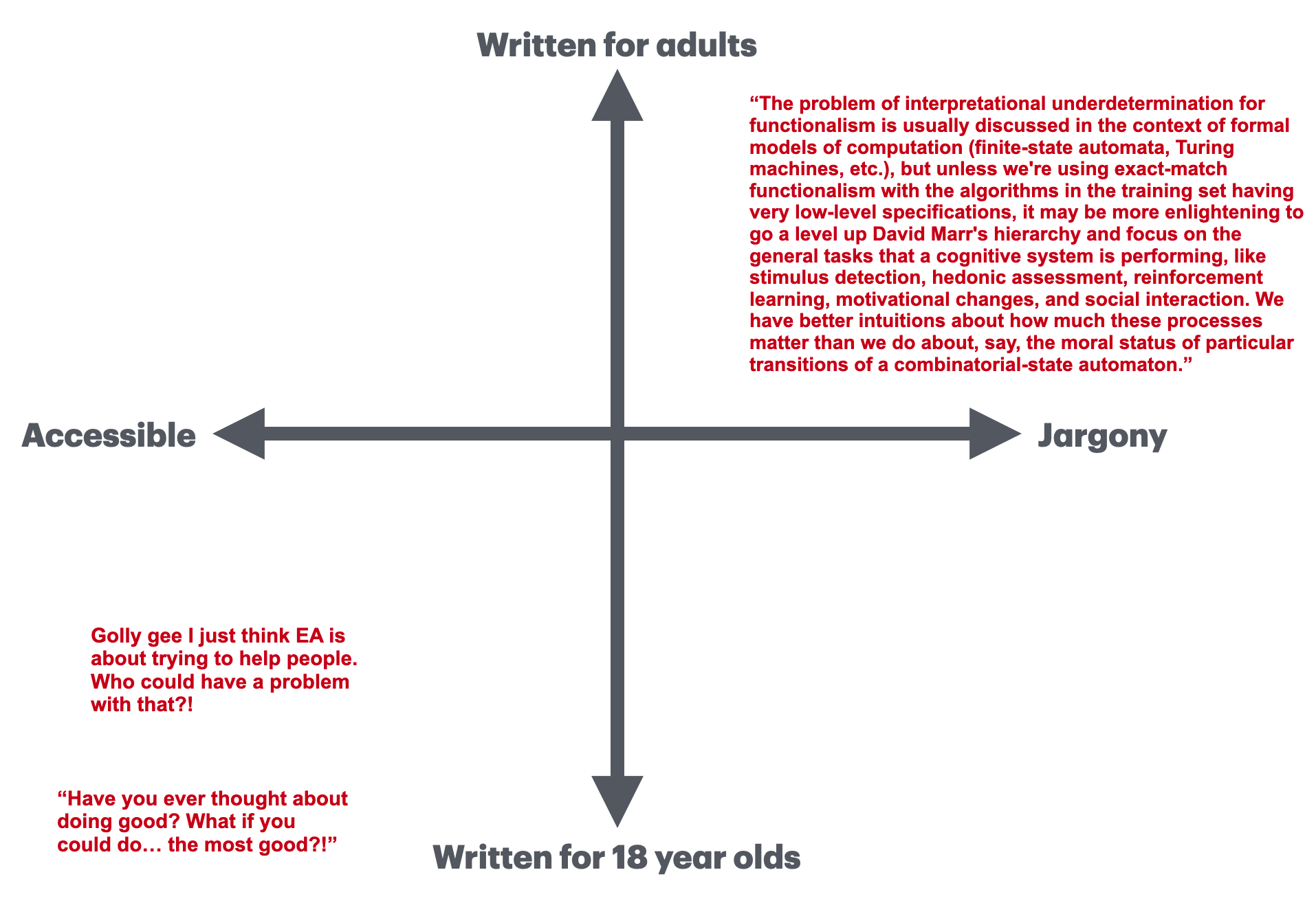
If you can’t tell, I’m not a big fan of the bottom left quadrant. I really don’t think we need to write more books or blog posts about how we “just want to do good” and how EA is just about “doing the most good,” because it’s not. The value I personally get out of the idea cluster feels far removed from “doing the most good” in the abstract, because I realize how philosophically contentious that idea is.
The kind of thing critics mean when they talk about effective altruism isn’t the (still under-discussed) fact that you can compare charities to each other and some are wildly more effective than others. They specifically mean the glued-together cluster of ideas around ethics, philosophy of mind, evolution (for thinking about animals and AI), evolutionary psychology (for trying to understand why people, including people into EA, often fall short of their lofty moral language), markets and economics, history, and trying to get at truth in general that make up what both I and critics of EA see as the core of the idea. I think this idea cluster looks completely insane when you only look at its strange outputs (AGI might happen soon, we should probably donate way more abroad or to animals than we are, and a lot of people are getting these questions wrong), but compelling once you’ve seen the full picture and the reasons smart, well-rounded adults might be drawn to it.
I think there are a lot of great examples of this type of communication (the 80,000 Hours podcast and article series, Cold Takes, plenty of blog posts, etc.), but I consistently feel like I don’t have enough resources on these ideas that I can send to my own smart, well-rounded friends in their 30s to help them understand what I specifically see as so special about the idea cluster, despite seeing what I’d personally say if I had time so clearly. A lot of the best EA writing isn’t even labeled as EA, so people leave without making the connection. That’s why I’m taking a shot at writing the series I’d like to send those people. I’d basically like to contribute to the very top of the top left quadrant, and I think this is the main thing a lot of EA comms is missing right now.
To be blunt, I think it looks a little ridiculous at this moment to start skeptics off in the shallow end of the pool, guiding them with baby steps through “Well, suppose you wanted to do MORE good, where would you go next?” This is condescending to smart people. My goal in my own writing is to basically start way way way in the deep end, and just trust that people will follow me if I use clear, accessible language to get across what’s going on in that deep end and what’s interesting to me about it. I know a lot of other people who have been motivated by these ideas are also capable of this, but I’m worried they’re limiting their vision of EA comms to object-level “See look at this individual neat thing I did that’s broadly popular, AND I’m into effective altruism!” I’d personally really love to hear a few people who have done lots of interesting stuff go into much more depth about what the actual idea cluster has been like and done for them in a lot of specific detail, that could make their entire honest thinking about what they’re doing clear and compelling to someone who hadn’t bumped into EA before.
I’d like to fill more of that top left quadrant with what I’d want to say to a smart friend in their 30s about what’s actually up with the ideas popular in EA, and why the cluster is interesting to me. Right now I can see other people trying to do this, but I still find there’s a huge amount I’d want to say that isn’t being said. I personally know a lot of people I’d trust to do a good job walking any smart person I know through what’s up in the EA idea cluster, but they’re mostly too busy to write or otherwise communicate. I cannot tell you how much comms about EA ideas needs more hands on deck to preserve the bridge to these ideas that I think are so useful. (And remember, I’m talking about the ideas here. I’m really not asking you to defend every last part of “the community.”)
If you’re on the fence about trying to communicate what’s up in EA, I’d very strongly encourage you to try your best at writing something for the top left corner of that top left quadrant. Write something that would’ve been clear and useful and direct for your past self about what’s actually up at a high level, and where the most useful ideas are, without holding back disagreement or disapproval or anything else you actually think. You might be surprised at what you have to say.
I’d like a lot more people writing about what they actually think about EA ideas at this high level, that would fit in this top left quadrant, and less stuff that sounds like a sales pitch.
Building bridges to weird beliefs
A lot of people first stumble on EA ideas when they’re in their 20s, because so much of the package is oriented around careers. In your 20s, it’s easy to be attracted to ideas that make you stand out, that make you feel ascended beyond everyday people, and that you can use as a kind of conversational spell to signal to “normies” that you’re so above caring whether they think you’re weird. EA supplies these in bulk, and since it’s so appealing to people in their 20s, you often get people into EA flashing the weirdness in everyone else’s faces. I basically think this is a unique disaster. It destroys the very easy bridge we could build to everyday smart people, and treats those people as so stupid that they couldn’t possibly be worth reaching.
In my last year of teaching, I got the chance to teach a philosophy class (“Theory of Knowledge” in the IB curriculum, for those of you in the know). Toward the end of the year, after the IB tests were done, we had some free time, and I decided to present the drowning child thought experiment. I was averse to sharing anything about my life or ideology with my students, so they didn’t know anything about EA. But I found that over the course of the conversation, they kind of reinvented EA from first principles. At one point, one student said “Well obviously, everyone’s obligated to donate almost all of their money,” and then another said “No wait… what if you’re working on something so important that you need to stay comfortable enough to work on it?” That conversation was a microcosm of the history of good and terrible ideas in EA. Turns out these ideas are easy not only to communicate but to arrive at independently!
More recently, now that AI existential risk has gone mainstream, it’s become incredibly easy to have high-level conversations about basically anything related to AI with anyone I meet. This is a good time to build bridges!
I’m worried that a lot of people who are thinking about EA comms right now are basically thinking in terms of managing the “weird” beliefs that everyday people won’t get, or they think of their “weird” beliefs as something that they need to just accept most people will never think about, and instead just weather the storm of public criticism and remain unpopular. I’ve personally become an optimist on this, and think we’re living in a time when people are much, much more willing to entertain most if not all of the “weird” ideas that fall out of the EA ideological cluster, like the now apparently common view that AI could be radically, maybe dangerously, capable soon. I’d prefer people just try to write directly and clearly for a general audience to build bridges to our weird ideas, instead of treating them as landmines to be avoided in public comms.
Thinking about every conversation as full of landmines that “normies” won’t get is basically a recipe for condescending to your audience, and it’s very, very easy for most people to pick up on when they’re being condescended to. Instead of writing the most watered-down, PR-compliant, vague post that says absolutely nothing interesting or new, it might be good to just rip off the bandaid and try writing the way you’d write to a smart, skeptical friend. Way, way more people are like your smart, skeptical friends than you might think.
How would you say that this has gone in your data center writing? It seems like you converted some people on water issues and also ended up in a greater number of fights on X over whether you’re a bad person
'“Well, suppose you wanted to do MORE good, where would you go next?” This is condescending to smart people.'
I don't think this is condescending. I'm not into EA because I start with different premises, but this question seems to be foundational to EA. Leaving out this argument at the start of comms would seem more condescending to me.