

I write a lot about misconceptions about data centers, which until recently people saw as a weird niche obsession that didn’t matter in the national discourse. Now that the (I think mostly unfounded) panic over data centers’ impacts on the places they’re built has taken off, I want to tell the story of where it came from, as I see it.
I don’t actually feel invested in the data center buildout itself, but I do feel very invested in opposing some but not all of the background beliefs guiding data center opponents, and I’ve been disturbed at how common these beliefs have become in educated circles. I’ve described these beliefs here, and if you want to know where I’m coming from that post is the best place to start. This series will be more political than usual, since I can’t help but bring up the political dynamics I see happening and how I react to them. I’m especially worried about the decline of institutional trust and political liberalism in popular thinking.
I’m exclusively writing about panic over data center impacts on local communities and the environment. I don’t mean panic about AI risk, which I see as very real. One person who won’t feature in this series is Bernie Sanders, because when he talks about data centers he’s mostly talking about them from an AI risk perspective. I think AI risk is real and serious, and because I don’t know what to do about it, I don’t jump in to criticize different people’s plans for how to stop it. I’m personally skeptical that local opposition to data centers will help with AI risk, but that’s an argument for another day. Here’s my list of recs of things to read on AI risk. You don’t have to agree with me on this at all to read this series.
Part 1: Pre-ChatGPT and the creation of common wisdom
There are a few key things that happened in the lead up to the data center panic that are each necessary for understanding it, that all happened before ChatGPT was released and AI moved from being a niche interest to a major public debate. First you need to understand the situation with the early environmental critics of AI. This will be the bulk of this post. At the end I’ll reflect a little on the political situation leading up to ChatGPT, the state of popular environmentalism at the time, and the loss of technical talent in journalism.
Early environmental critics of AI
In 2019, Karen Hao wrote “Training a single AI model can emit as much carbon as five cars in their lifetimes” for the MIT Tech Review. This was at the time a shocking statistic. The training of the AI model in question was very different from what we currently think of as training. Here, thousands of the same model were trained at once, and Google researchers selected the one that performed the best at the end. This looked like it carried a big energy and carbon cost, resulting in a just slightly better model for translating English to German that didn’t end up being used by anyone anyway. This seems pretty wasteful! Spending this much emissions on a slight improvement on a specific model was probably not worth it.
Right?
The original research Hao was citing was from this paper, one of the most cited of all time on AI and the environment, by a research team at UMass Amherst, who had made a few goofy assumptions that made the cost look 90 times larger than it actually was. They had made 3 key mistakes that a later researcher flagged and explained in this paper. In a nutshell, the mistakes were misunderstanding the algorithm, hardware, and background grid:
The type of training Google did tests thousands of candidate models to find the best one. The Google team ran a very low energy screening test on each model candidate and only fully trained the ones that looked promising, but the UMass team assumed that all the thousands of models were fully trained.
The UMass team assumed the training ran on standard graphics cards, but Google was using specialized TPU chips.
The UMass team assumed Google was using an average commercial data center, which at the time could lose 60% of its electricity to cooling and overhead, but Google’s data centers lost closer to 10%.
Together these made the training process look like it used two orders of magnitude more energy than it actually did.
This statistic made it into the most cited AI ethics paper of the era, where it played a pretty central role. “On the Dangers of Stochastic Parrots: Can Language Models Be Too Big?” from 2021 has over 13,600 citations on Google Scholar. The environmental section opens with the UMass Amherst team's numbers and leans heavily on them, treating them as the typical cost of training language models. That paper was widely read, and so the conventional wisdom that training an AI used preposterous amounts of energy and emissions was in the water by the time ChatGPT came out a year and a half later.
This number was repeated in lots of other foundational articles that went on to influence the current discourse. The Nature article “The Carbon Impact of Artificial Intelligence” has over 100,000 reads and over 400 citations. It uses the UMass study as its central example, and says “This is of the order of 125 round-trip flights between New York and Beijing, a quantification that laypersons can visualize.” This is one of the first instances of one of the more slippery comparisons made in the space. “125 round-trip flights” doesn’t tell you if this is per-passenger or the whole plane, and if you do the math it’s the per-passenger cost. Correcting for the 90x error, saying “training an AI model emits as much as two of the AI researchers flying from LA to Paris and back” doesn’t sound quite as shocking. Every year, 20-30,000 AI researchers fly to the NeurIPS conference alone, so Google doing this research had about as much impact on the environment as maybe 1/10,000th of the conference. This does not make it look like training emits unreasonable amounts.
You might pause here and ask how serious of an issue this is. Getting this wrong at the time might have been bad, but they were “directionally correct” because models did in fact grow to use huge amounts of energy. I’d argue that what matters throughout is how many users each AI model will end up getting, for the same reason that you can't assess the total environmental cost of producing large amounts of cans of Coke without knowing how many people are buying them.
The resulting model was going to be used by relatively few people to slightly improve one specific translation function, and was mainly a piece of research. I think it’s okay for 2 AI researchers to sometimes take long flights to meetings in other places if they think the result might yield useful research results. I also think it’s okay for hundreds of millions of people to each purchase a CD to install a computer program, and the per-person carbon emissions of manufacturing CDs are about the same as the per-person emissions of training frontier models. See my full argument on training AI models here, which boils down to the fact that if we compare the emissions cost of creating new AI models to other products used by similar numbers of people (hundreds of millions) they don’t stand out as being especially wasteful:
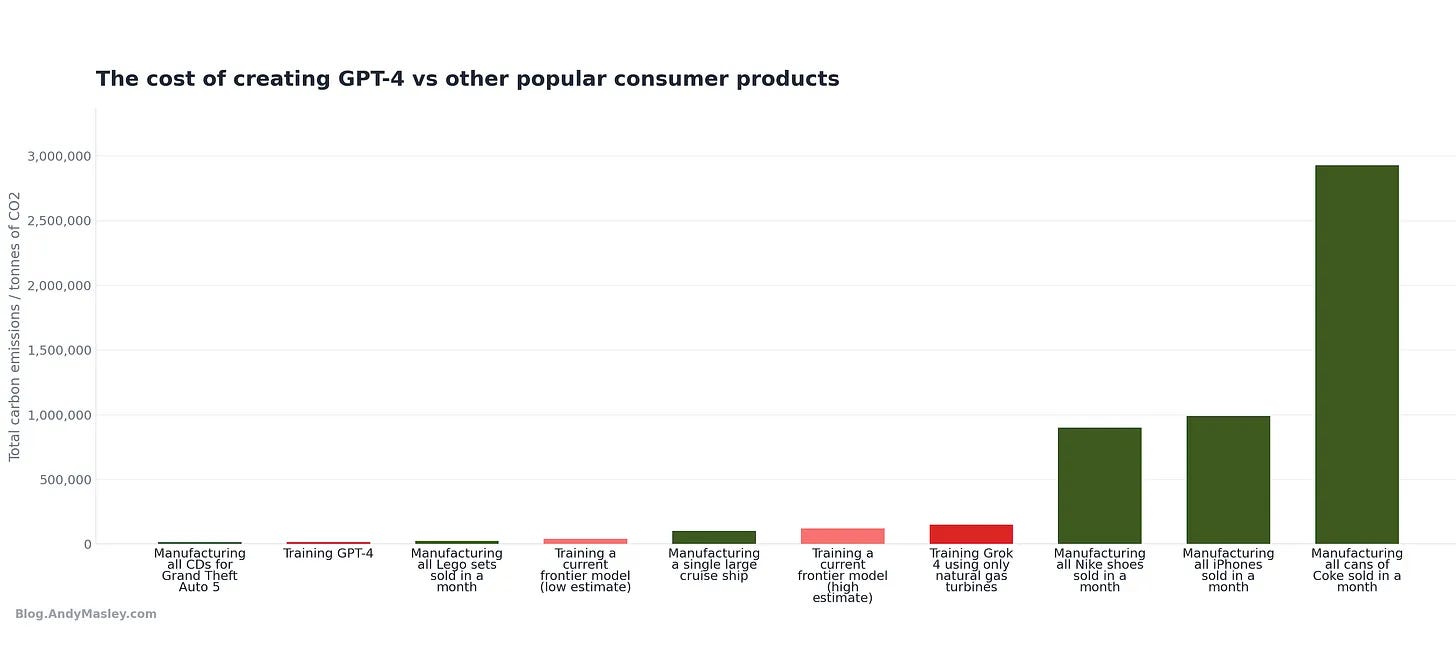
So both before and after ChatGPT, the idea that training was especially environmentally wasteful was, I think, wrong, and only looked plausible if we accepted the 90x inflated number that got shared everywhere. The common wisdom invented here was, I think, completely incorrect.
Coverage of this study also gave us the earliest instance of one of the worst comparisons in the space: the cost of building an AI model used by hundreds of millions of people vs your personal consumption costs.
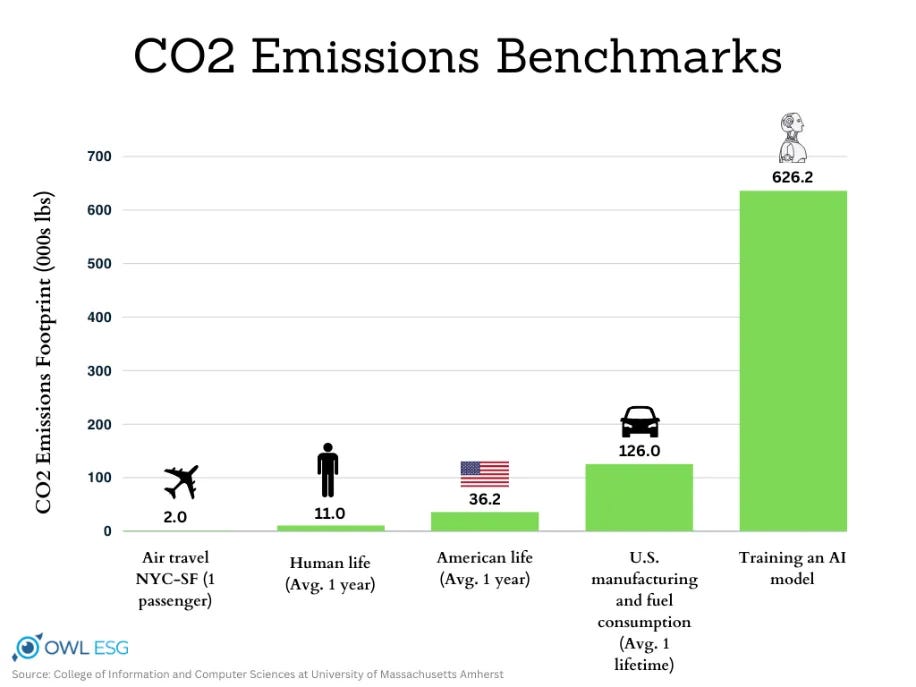
This might have made more sense if you assumed the user base was going to be really small, but now graphs like this make as much sense as saying you shouldn’t buy a can of Coke because the combined emissions of global Coke production are much larger than the emissions of your personal car. This talking point has always been goofy, and was invented by a study that was super clunky with numbers and amplified by both the media and people researching AI’s environmental impacts at the time.
There's a big split between how much attention the correction got from researchers and how much it got from the media. The UMass study has 2730 citations compared to the correction’s 1613. But the correction itself was barely covered in the media. The original statistic was promoted by:
Earth.Org, which just published another article using the same bad statistic last November
Many articles covering the Stochastic Parrots paper also mentioned the environmental costs the paper brought up.
Jeff Dean at Google had publicly asked the original lead UMass author to stop citing the debunked statistic after seeing it in a more recent paper of hers, and argued the original figure had actually been inflated by more than 3000x. The author didn’t update the paper, and Stochastic Parrots has also not been updated.
A lot of the early bad comparisons between AI’s costs and other things came from the bad UMass number. The comparison of training to things individual people do, the “flights” comparison without clarifying if it’s passengers or the whole plane, the failure to contextualize models with how many users they’ll get, all came from discourse about this single misunderstood statistic, and became part of the common wisdom before ChatGPT launched. This also started the pattern of lopsided media coverage, where alarming statistics are understood to get attention but corrections and clarifications mostly don’t. I don’t know of other statistics on AI’s energy and water use at the time that got similar amounts of attention or pushed the idea that AI was uniquely bad for the environment. The whole idea seems to flow from this single error. Other prominent researchers on AI’s environmental cost, like Shaolei Ren, were mostly making sober comparisons between different data centers and chips and algorithms and writing about how their energy and water cost could be gradually reduced. The environmental critique outside of this number seemed completely level-headed and similar to normal environmental science research on any other topic.
If you look for scientific studies on AI and the environment pre-ChatGPT, Parrots is the most cited of all time, and the UMass study is the second. The Nature paper is #15. Besides those, all the rest seem pretty great and stand up to scrutiny. The story of bad early thinking on AI and the environment is I think the story of specific echo chambers hyping up the UMass study claim and inventing lots of new misleading comparisons that would explode in popularity when ChatGPT later entered the scene. Here are the top 20 papers by citations on Google Scholar. I’ve bolded the ones that use the bad numbers from UMass:
On the Dangers of Stochastic Parrots: Can Language Models Be Too Big?
Energy and Policy Considerations for Deep Learning in NLP ← the UMass study itself
The role of artificial intelligence in achieving the Sustainable Development Goals
Sustainable AI: Environmental Implications, Challenges and Opportunities
Towards the Systematic Reporting of the Energy and Carbon Footprints of Machine Learning
Green Algorithms: Quantifying the Carbon Footprint of Computation
The Carbon Footprint of Machine Learning Training Will Plateau, Then Shrink
Aligning artificial intelligence with climate change mitigation
Estimating the Carbon Footprint of BLOOM, a 176B Parameter Language Model
Carbontracker: Tracking and Predicting the Carbon Footprint of Training Deep Learning Models
So the field itself was producing a lot of great work, but a few specific mistakes that went unnoticed for years in the very most cited papers, more media attention on the alarming numbers, and weird rhetorical moves together seeded common wisdom that AI was uniquely bad for the environment, which would later be picked up once ChatGPT took off. I’ll cover that more in Part 2.
Stochastic Parrots ends its section on the environment like this:
These models are being developed at a time when unprecedented environmental changes are being witnessed around the world. From monsoons caused by changes in rainfall patterns due to climate change affecting more than 8 million people in India, to the worst fire season on record in Australia killing or displacing nearly three billion animals and at least 400 people, the effect of climate change continues to set new records every year. It is past time for researchers to prioritize energy efficiency and cost to reduce negative environmental impact and inequitable access to resources — both of which disproportionately affect people who are already in marginalized positions.
I don’t think this conclusion would have made as much sense describing two individual people taking a round trip for an AI research conference. It only really makes sense assuming the inflated number. Writing about AI’s unique environmental harm became common in AI ethics papers as a result.
And that’s how it became common wisdom to talk about the unique environmental harm of AI.
Deep history
In 1999, computers were using more and more energy.
This alarmed some people, who saw it as ridiculous that digital products could have such an effect on the physical environment. Forbes published the article “Dig More Coal — The PCs are Coming” and opened with “Southern California Edison, meet Amazon.com. Somewhere in America, a lump of coal is burned every time a book is ordered on-line” The contrast between physical infrastructure and something you do online was meant to shock.
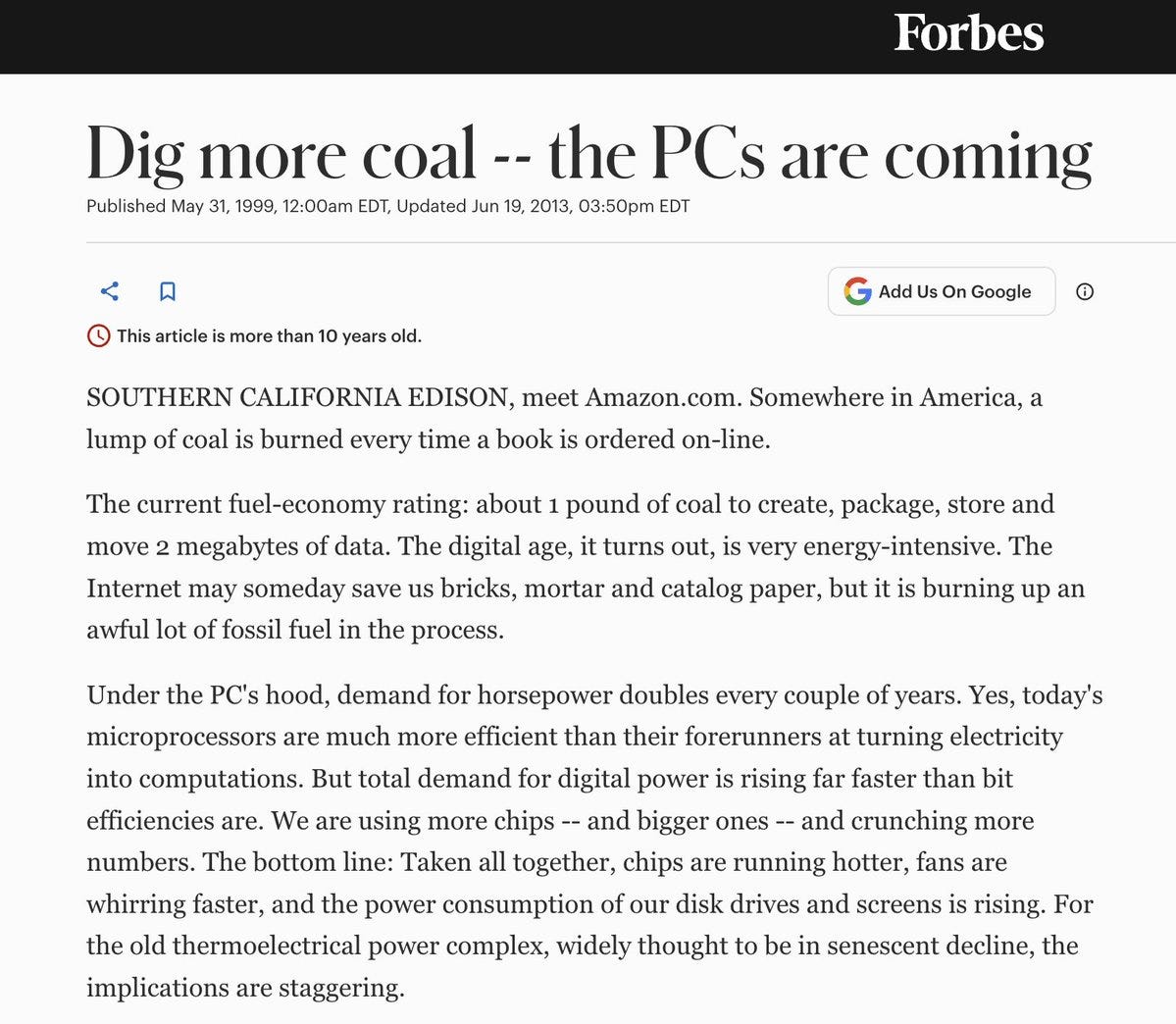
I’d really recommend reading through the whole Forbes article. It’s full of the exact moves I write about a lot, more than anything giving contextless large numbers over and over. I’d be especially interested for strong environmental critics of data centers to read this article and tell me what it’s getting wrong that modern criticism isn’t. There’s also this great debunking of the article and others on the environmental “harms” of online activities, focused on contextless large numbers. More articles on this topic include the goofy “Climate Crisis: The Unsustainable Use of Online Video” from 2019, or this fun one about the time the UK government considered cracking down on one-word emails for the sake of the climate due to a misreported inflated statistic.
An underrated aspect of the story of AI and the environment is that it has always been offensive to readers to find out that ephemeral digital goods have a physical real-world cost. I think this is one reason the water objection to AI is so popular compared to the others. Water is precious and physical, and AI is ephemeral and flashes on your screen quickly and then you forget about it. The contrast offends people.
This time is different. AI will in fact on net use more energy than all of these. But is this on its own bad? I think an underrated part of the story of the data center panic is that computers are now rising to truly industrial levels of energy usage and emissions, and people think only physical goods should be allowed to do that. I personally think that if computing is proving to be so valuable that people want to use it this much, it should be allowed to rise to meet the demand.
The left and right become more anti-tech
The rise of anti-tech sentiment on the left and right is a key part of the story of the data center backlash. There are a few complaints about tech the left and right share, like the general idea that smartphones have mostly made the social world worse. Another is that technology in the last ten years has only really gotten good at giving us quick dopamine hits, little treats that don’t actually make our lives better. On this I feel like I’m living in a parallel reality. The internet especially has been a utopian technology for me personally, but it’s become very unpopular to say that out loud.
On the left, tech became much more associated with right wing politics. A lot of liberals and leftists came to see social media as being a big part of why Trump won in 2016 and 2024, and reacted to the rise of alternative media promoting anything from anti-vax conspiracy theories to the manosphere. They also began to associate tech leaders with right wing politics, and obviously weren’t entire wrong. Tech leaders cozying up to Trump after 2024, and the general rise of the tech right, made it clear that the left had powerful new enemies who had been made rich by technology that often seemed either neutral or positive when it was first rolled out.
Elon descending into posting almost daily on Twitter about insane racist conspiracy theories deserves a special mention here. The richest person in the world who made his money in tech regularly retweeting and publicly agreeing with vocal white supremacists has given the left completely legitimate reasons to think there’s a huge danger in ignoring the values and beliefs of the people selling us new gadgets. Here I’m in complete agreement.
The place I strongly disagree with many of my fellows on the left-of-center is that they’ve coupled this justified suspicion of the current Silicon Valley elite with a distrust of the value and abilities of the products themselves. It’s easy for me to say that Elon is an evil person who’s made extremely useful products. I would very happily give up all those products in exchange for the richest person in the world not being a white supremacist. But this is very different from saying that Starlink is useless. It’s become frowned on in populist left-wing spaces to imply that Silicon Valley is capable of producing anything new and useful at all, and saying so is seen as coming from a secret desire to give status to evil people. In low trust populist politics, the only real question is who you’re giving status to with your words and actions, not the complex boring questions of what we actually want out of our lives and how to get them together, so any question of the usefulness of a new technology becomes a question of whether you like the people who made it, and it’s seen as naive to think otherwise. To even imply that AI can be useful enough to make it worthy of any carbon cost at all is seen as completely missing the big picture. It makes sense to me that people would want to boycott AI to not empower tech leaders, but the idea that AI itself must be a scam that has no use value at all is very common in conversations about AI and the environment, and I suspect a lot of that comes from this background sense that Silicon Valley can’t produce anything useful.
I’m less familiar with right wing anti-tech sentiment because most of my time is spent with people left-of-center, and the right wing people I do talk to regularly are all high institutional trust and generally pro tech. Specific factions on the right have obviously always had an uneasy to negative relationship with technology. MAGA contains warring factions of various shades of pro-tech and pro-market capitalists or anti-tech and anti-market localists, and I can’t really tell who’s ascendent right now. The right is also much more wary of corporations on average than they were when I was growing up.
One last note on politics is that I get the sense that both the right and the left have become more low trust in general, less interested in preserving pluralism, and think more often in terms of good guys and bad guys. It seems less likely that the average educated adult, when asked “is it okay if a corporation buys some land, power, and water in your town and uses it to do something that benefits people far away instead of you and makes a lot of money doing it?” will answer yes. But I don’t have the data to back that up.
The rise of pop environmentalism, and the good feelings of discovering a villain hiding in everyday life
This section is almost entirely pure armchair speculation, but it’s also about the area I’m most familiar with, so I feel I’ve earned some right to pontificate.
When I became a physics teacher I was motivated in large part by wanting to improve the general state of science education to get students to a higher level of understanding of the climate situation. Over my time following the issue I came to think that the public was veering off course from what actually helps the climate, and developed an armchair psychology reason for why they veered.
The most important thing we need to do for the climate is to change the energy grid. This can be accomplished with good policy, like carbon taxes, or the government funding renewable energy projects or allowing high energy transmission lines. The grid also needs to be massively scaled up as society separately electrifies formerly fossil-fuel dependent processes. Making all cars electric will require huge amounts of new power plants and transmission.
This means that by far, the way you can impact climate the most isn’t actually by changing your lifestyle. It’s by helping to move this process along, either by local political advocacy or national communication or donating to the right places. I made this tool to compare different climate interventions you can make, mainly to show that changes to the grid completely dwarf everything else you can do even if you divide by the number of people you’re working with to make them happen.
If you are going to make a change to your lifestyle, most people who think seriously about helping the climate agree that tiny individual cuts you make to your lifestyle don’t help at all, because they basically just buy you moral license or literal saved cash to spend on other things that emit just as much. There are a few big cuts you can make that do make a difference, going vegan or living in a big city and walking or biking or taking public transit a lot instead of driving. I’m already doing this, and it’s nice to know that I have a meaningfully lower carbon footprint than average, but I know these cuts are still completely dwarfed by tiny ways I could contribute to changing the grid around me.
I already knew this when I was in college in the early 2010s. If I could go back in time and tell my past self that in 2026, people are worried about the emissions of their personal use of a computer program, past me would feel like the basic message of climate had failed to reach average people. But this is weird, because people are consuming a ton of content about climate now, way more than when I was in college. The issue I think (and here’s where I get really armchair) is coming in large part via short form video.
I’m not a short form video hater by default. I know Jonathan Haidt’s work mostly doesn’t replicate, yada yada. But I do think the nature of short-form makes it a uniquely bad place to communicate about climate well, and there’s a specific dynamic that incentivizes hyping people up about the very least effectual things they could do.
When you watch short-form video, you’re often getting a quick parasocial hit of companionship with the person talking back to you. Something that feels really, really good is finding a hit of companionship that makes you feel like you know a secret about the world the people around you don’t, you’ve ascended, and there’s something that’s polluting them that you’re free of now via your newfound companionship. These evil invisible parts of everyday life do in fact exist, but the tendency to go looking for them can veer you off course, because it’s so good to feel like you’ve discovered them regardless of whether they’re real.
I’m vegan, and when I’m out at a restaurant and see someone eating meat, I have to admit that my brain sends me the general vibe “There’s this big global struggle that I’m a part of, and the civilian over there doesn’t even know about. I’m not just some guy in a restaurant eating the same mapo tofu I had a few days ago, I’m part of a global struggle against evil.” That feels good!
A lot of conversations about climate on short form video take the form of someone speaking into the camera to you about how something small in your daily life is actually evil. I think stuff like this is basically perfectly fit to make us feel the same thing I feel when I see someone eating meat: by making this cut, you will ascend into a big global struggle against the forces of evil. The smaller the cut, the easier it is to ascend. You’ll be on the same team as this person speaking to you. It’s like you’re a secret agent getting assigned a mission. We should expect this style of advice to be pretty popular, and for people to be pretty excited about videos that advise tiny cuts to individual lifestyles (the least effectual thing you can do to help with climate) over contextualizing and helping with the situation with the grid (the best thing you can do).
And in my personal experience, this has been a huge part of the climate conversations I’ve had over the last ten years. A lot of people will talk as if small individual things other people do are actually carrying some deep, secret evil that needs to be purged. This precedes social media, but I suspect people are getting a lot more hits of this style of thinking now that short form video’s more popular.
I suspect the basic tendency I’m describing here was a big underrated contributor to the chatbot moral panic. I go into more armchair theorizing on that here. The panic about chatbots is a necessary step to the panic about data center impacts on local communities more broadly, which I’ll get into more in the next post.
A result of more people’s understanding of climate coming through social media influencers also meant other fake common wisdom was invented. A very common one is that because we’re in a climate crisis, we can’t allow “new emissions” from a new industry. When you think about it, the category of new emissions is weird, because every time we emit at all, the emissions are new. This talking point maybe makes sense for talking about additional total emissions, but often gets warped to say it is unacceptable for a new industry to appear during the climate crisis.
The decline of science journalism
US newsroom employment fell by 26% between 2008 and 2020, from 114,000 to 85,000 jobs. Newspapers were hit the hardest and lost 47% of their staff, going from 71,000 to 38,000. Digital news outlets grew, by only added about 6,000 new jobs.
Some journalists are more expensive than others. Beat reporters who cover one specific area for a decade and get a feel for what quality research looks like are expensive. They get less out in the same amount of time and prioritize depth. Scientific specialists were more likely to be cut because they were more expensive. When the Canadian Science Writers’ Association was founded in 1971, there were at least 30 full-time newspaper science reporters in Canada; by the late 2010s that had dropped to about six. American newspapers once had dedicated science, health, and environment desks, but most of those are now gone. A 2024 Nieman Lab piece titled “Science journalism becomes plain old journalism” notes that every reporter, regardless of their beat, now gets deputized as a science reporter when the story calls for one. There’s just way less technical understanding in media than there was 20 years ago.
This left journalists much more eager on average to defer to credentialed experts on topics, without contextualizing a given problem with the other sources of harm to health or the environment. Journalism also maybe became more self-referential, as authors pressed for time would mainly just defer to other trusted publications, which left the field more susceptible to echo chambers.
The business model has also changed. The rise of the pageview economy in the 2010s forced journalists to prioritize clicks and reads and shares. Shocking titles often win out over in-depth writing, and much of the worst sources of data center misinformation have come from shocking and misleading titles rather than the contents of the article itself.
For example, the most influential piece on data center water use is this from the New York Times:
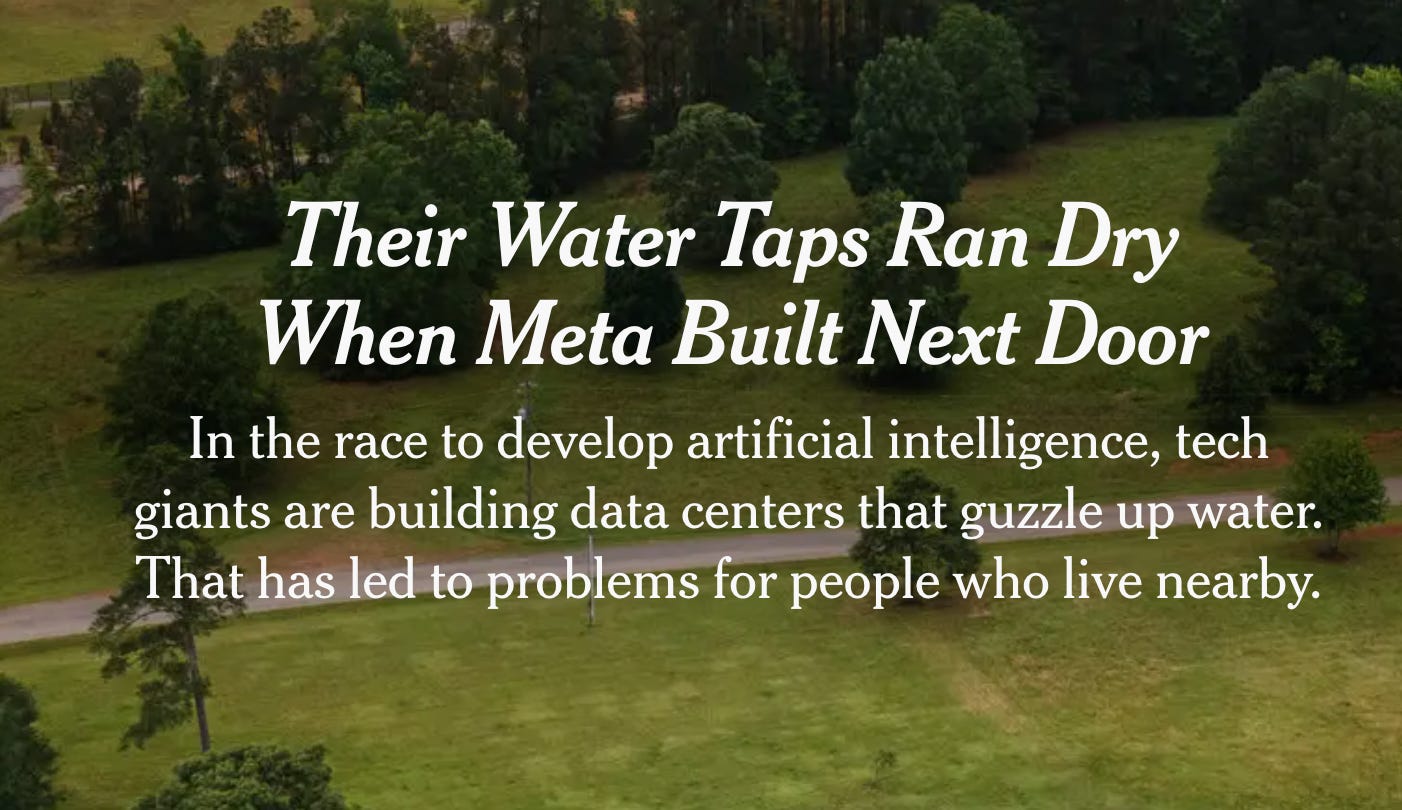
Almost every time I say anything about AI and water use online, this story gets shared, or this variant of the same story from the BBC:
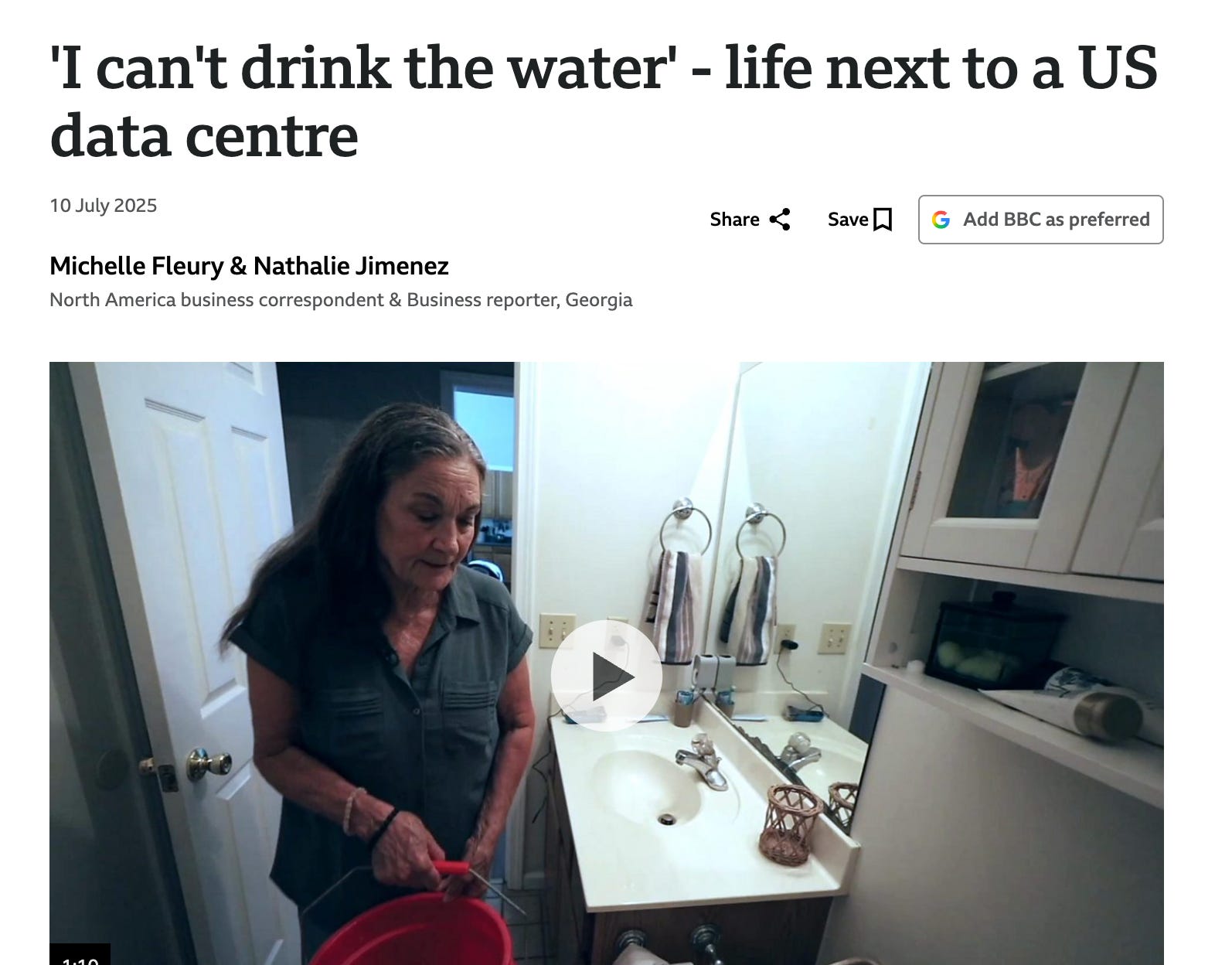
Almost no one sharing the articles seems aware that the water issues seem to have happened due to construction, either sediment runoff or issues with blasting nearby, and don’t have anything to do with the normal water draw of the data center, even though the content of the articles makes that clear. What’s happening here is that the alarming headline is a tool to get the article shared widely in the hopes that 1 in 10 of the people sharing it actually read and digest it. This is why the initial “Training AI emits as much as 125” flights talking point made headlines, but the correction didn’t. No one’s going to click on a story about how a process you’ve never heard of before doesn’t use much energy.
(Except for you, dear readers. Thank you for your support)
Journalists in general were feeling more precarious and burnt out before ChatGPT, and were probably not excited about a new major source of competition.
Conclusion
The political situation leading up to ChatGPT had primed both the right and left to distrust big tech, and to think their products weren’t worth any additional environmental cost at all. Politics had maybe become lower trust, and people were more interested in identifying good guys and bad guys than passively allowing lots of different types of businesses to operate out of sight. The popular understanding of environmentalism had been diluted by excitement about tiny personal cuts that could make you feel more with it than the people around you. Journalists had lost technical talent and were more incentivized to write shocking headlines to generate clicks and shares. And the two most cited papers ever published on AI and the environment contained a statistic off by two orders of magnitude that had inaugurated a series of bad comparisons and metaphors for thinking about AI and the environment. These together I think were the seeds of the data center panic we’re living through now.
Great essay as always, Andy! One thing I'm wondering is to what extent some of this disinformation against the tech industry has contributed to the rightward shift and radicalization of many of these tech leaders.
Most of the people on the tech right used to be Democrat-leaning. I remember Elon used to have libertarian-ish politics and was supporting Andrew Yang for president as late as 2020. The same goes for a lot of other tech titans like Marc Andreessen and Sergey Brin, who were disgusted by Trump in 2016 but are now much more aligned.
My intuition is that a lot of people's mental models of the world comes not from deeply researching every single topic (which would be obviously impossible time-wise) but from having a circle of sources that they trust for reliable information. However when people realize that some of these sources are clearly wrong on an issue, they start to lose trust in them and will look for new sources of information to add to their circle who they perceive as being closer to truth. I think this is what happened to Marc Andreessen. I read Nate Silver's book On The Edge and one of the really pivotal moments which contributed to Andreessen's transformation from Hillary to Trump supporter was his realization that the NYT's projections of the 2016 election (Hillary 97% winning) were way off-base.
I can definitely see how being bombarded with scadalous, but obviously wrong stories about your industry in the mainstream press day-in-day out would eventually make you lose trust in the media. And since most journalists are left-wing and tend to present their story in a left-wing framework of evil corporations versus ordinary people, that probably also means a loss in trust in the left as well.
A couple thoughts on your excellent article.
(1) New technology invariably seems worse than it actually is for segments of the population that do not like it. It also invariably seems better than it is for segments of the population that like it.
In short, AI, like so much else, is a tool. As you hint (I think), people in both directions imbue it with a sort of spiritual dimension. Very few tools (any?) on Earth seems to be absolutely evil or absolutely good, but in a politics of extremes, there is a tendency to label things absolutely. Of course, the tendency is not new (see (2), below).
We had a local councilman just win a primary based in part on his opposition to any AI datacenters. Not "we should study and consider," not "I am concerned about water use aspects in an area where many homes run off the local aquifer" but simply "NO MORE." I think we have one now.
(2) Running of my first comment, I was looking over claims about the radio, which appear not unlike some of the spiritual claims made about internet, ai, etc, such as:
Broadcasting bridges the cultural and social gulf which formerly separated the villager from the town dweller, and frequently also the poor from the rich and one people from another. By communicating to all in equal measure and making itself the proclaimer of the great moral forces of mankind, it creates a community in the spiritual realm which is not limited to one land, but gradually embraces the whole earth. - Wilhelm Miklas, president of Austria, published 1932 or so.
I'm sure there is philosophical-historical paper, someplace (Ellul, Ong...?) which considers this tendency to mysticism around new technology.