

One of my favorite images I’ve recently found is this aerial photo of Gwangyang Steel Works factory in South Korea (hat tip to Matt Beard):
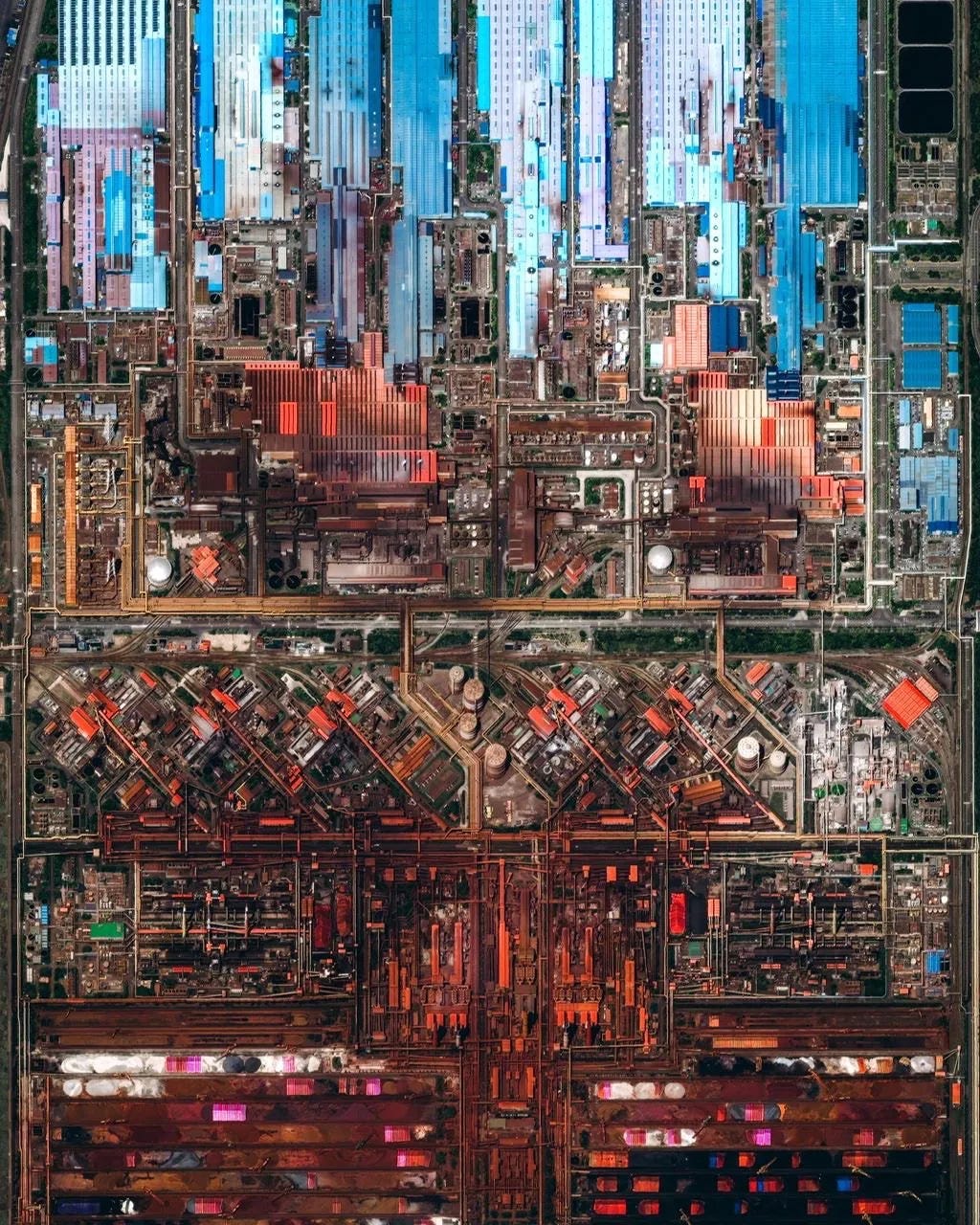
Part of the reason this image is so amazing to me is how easy it is to mistake it for a computer chip.
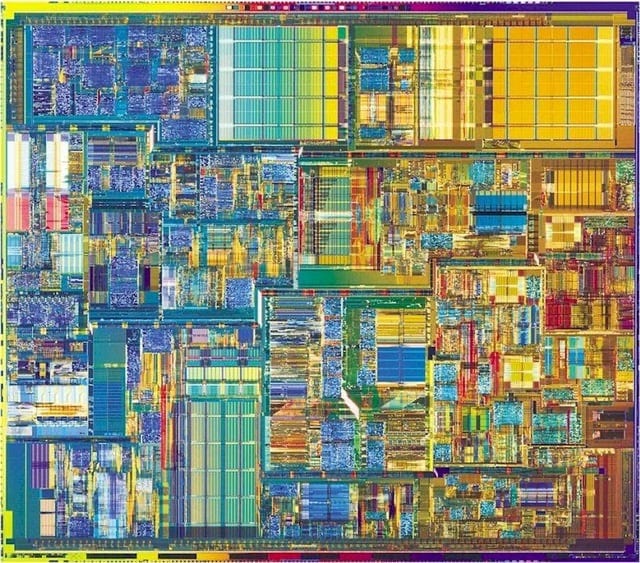
Among other things it’s a reminder to me that outside of my little neighborhood in Washington DC, the world is unimaginably large and strange, and humanity has a shocking, overwhelming ability to shape things at the macroscopic and microscopic level to optimize the flow of material or information using these incredibly abstract methods of thought mostly alien to me (that I’ve only approached while playing Factorio), and that my little bubble of friendships and calm cafes and nice little offices in brutalist buildings exists on the thin surface of a deep global system more vast and sprawling and strange than my meager human categories can grasp. It leaves me much more open to thinking that the near future might be incredibly weird and alien, because the present already is.
Gwangyang Steel Works is the world’s largest or second largest steel mill, depending on how you count. It has enough capacity to produce 10% of the world’s car production, about 22 million tonnes per year.
I’m worried that if we reported on and thought about Gwangyang Steel Works the way we currently report on and think about data centers, the coverage would look something like this:
Gwangyang Steel Works is an immense, imposing, ugly, and alienating building complex that guzzles gigantic amounts of water. It consumed about 9.8 billion gallons in 2024 (about half of the total water consumed onsite at all American data centers combined in the same year) and is one of the largest emitters in South Korea, responsible for about 30 million metric tonnes of CO2e in 2022, about 4% of the entire country’s emissions (and the low end of a recent estimate of all emissions from all global AI usage combined in 2025). It also adds a lot of local air pollution, emitting about 30,000 tonnes a year of dust, sulfur oxides, nitrogen oxides, and other pollutants, the highest total among the country’s large industrial sites. Local leaders say the Steel Works brings lots of benefits and is necessary as the world uses more steel, but a lot of steel is used for things like cars, which themselves have a gigantic climate cost. The plant has capacity for 10% of all steel going to cars, and if you include the emissions of those cars in its full cost, this makes it one of the most environmentally destructive buildings in the world.
All of these facts are individually correct, but leave the reader with just a small sliver of the full picture of the ethical, environmental, and economic trade-offs of the plant, to the point that I wouldn’t trust someone who knew only these facts to make the right call about whether to build the plant in the first place.
The ethics of attributing the emissions of the cars made with its steel to the plant seem pretty confused. Should local governments in South Korea decide that because a factory is making something very generally useful that can be purchased by any other industry, and one of those industries makes cars, and cars emit a lot, they should therefore ban the factory from being built? This would create global chaos as local bureaucrats and activists tried in vain to predict the broad trends of society, and to impose rules based on their likely arbitrary and confused conclusions. Steel production is also vital for renewable energy sources, so in deciding to block this plant, local governments and activists may unknowingly also slow the green energy transition. In general, broad rules (like a global carbon tax) that punish emissions while leaving the information flows of the economy otherwise free to operate, or industrial policy aimed at speeding up the learning curves of emerging green industries like solar, or investments in modernizing the grid, seem much more promising than attempts to stop complex global industry because some of what it produces will be used in products that emit.
Another framing my pretend coverage misses is that the world has billions of people in it who benefit from steel in complex ways, and concentrating the production of steel to meet this unimaginably large demand in an unimaginably large building complex likely reduces its environmental cost as opposed to spreading it across a lot of small steel mills, none of which would likely receive as much scrutiny. It’s very easy in lazy environmental writing to punish buildings for concentrating in a single visible spot something that no one would have an issue with if it were dispersed among the hundreds of millions of consumers it’s serving. Scale and centralization often allow incredible levels of optimization and efficiency that could never be achieved if everyone were given their own backyard steel furnace, but centralization also allows people to see the full environmental cost that used to be invisible, and to condemn it in a way they wouldn’t if it were dispersed and faded into the background. A lot of the ways people think and write about the environmental effects of specific buildings seem to punish and condemn scale without considering the efficiencies that centralization allows.
A lot of writing about data centers seems to imply that all large industries need a glowing, positive, almost loving relationship with the local communities in which they’re built, but I think most of the best and successful industries operate completely invisibly, set off from the communities they’re built in and the people who buy their products. It’s likely that right now you’re within a mile of some piece of steel produced by this mill, or maybe you’ve used a product with steel that came from it, but you never knew it existed. The mill hummed in the background unnoticed. The locals of Gwangyang obviously know the plant exists (it’s a popular tourist destination), but many other industries don’t ever bother to create these powerful relationships with local communities and instead just operate mostly unnoticed. If you were to draw a circle with a radius of 50 miles around you, do you think you’d actually be able to name the top 10 most lucrative large industries within it? Does it tell you anything about their relative virtue or importance if you can’t?
This is all to say that the default way many educated people think about the environmental effects of individual industrial buildings, which they believe is a morally serious and far-seeing way of questioning authority and fighting for the environment, often looks to me surprisingly childish and unserious. It often fails to reckon with the incredibly complex trade-offs of serving a world of billions of people with wildly different demands, and instead reduces individual buildings to heroes or villains, detecting their villainy by compiling a bunch of individually alarming isolated statistics that any industry at a similar scale would also come with. This can look numerate and informed, but I think it’s actually a clumsy and lazy failure to fully internalize the deep complexity of the world, and the trade-offs and systematic thinking this complexity demands of us.
To make what I’m saying here a little more concrete, I’d be interested in asking data center opponents: “Would you allow the Gwangyang Steel Works to be built? Why or why not? What specific environmental rules are you applying here? How do you think about the full trade-offs involved?” Then I’d want to see whatever rules they give applied to data centers. I’m worried that one of the rules people often seem to be operating under is “We can’t have any new emissions at all,” which would effectively ban all new industry until the climate crisis is solved. It would seal the current global system in amber and leave us with no way to adjust or progress to more promising technology over time, at a moment when we also need radical change to adapt to a changing climate. This rule would ban the steel works, and would have banned almost every industry we currently use. Seems like a very bad rule! The data center debate is awash in strange rules like this that appear to have been memed into existence only recently but are now often presented as if they’re obvious truths that all reasonable people believe. These rules are easy to nod along to when applied in a vacuum to a strange new industry like data centers, but mostly fall apart and appear ridiculous when applied to almost any traditional industry, like steel manufacturing. The green energy transition is going to require way more steel, and we can’t follow the rule “no new emitting steel mills until the green energy transition is complete” in the meantime. I suspect a lot of rules like this emerged from the internet in the last 15 years as people developed new general moral outlooks, often informed by degrowth and localist ideas, that went mostly unnoticed and unquestioned because American energy usage overall didn’t grow much.

Populists on the left and right now talk a lot about local communities being abandoned by industry while also holding a cluster of beliefs that wouldn’t allow any industry in the first place.
If I tried to write rules for which new industries that emit should be allowed to emerge during the green energy transition, they would look something like this:
Their local externalities are limited to the point that people nearby mostly don’t notice any meaningful effects of them being there.
If possible, the industry should be fully electrified, because this leaves it primed to eventually receive 100% green power and avoids the hard engineering challenge of greening primary energy usage, which is the main reason the transition is so difficult.
The industry shouldn’t be punished for being centralized and optimized. If we wouldn’t have a problem with the industry’s energy usage and emissions if they were caused by dispersed users running the same processes in their own homes, we also shouldn’t condemn it for centralizing and optimizing these processes in one location. I say a lot more about this one here.
If possible, the industry should help fund upgrades to the grid, or ideally be broadly useful for generating and delivering green energy in other ways.
AI data centers often easily pass 1, and pass 2 and 3. Their net effect on 4 is an open question. More broadly, outside of extreme examples, I’m generally skeptical of blanket bans on specific industries to solve climate change. The general policy solutions to climate change specifically as I see them are carbon taxes, industrial policy for renewable energy, society-wide regulations and standards, and massive investments in the grid. Compiling scary lists in a vacuum of the total environmental costs of specific buildings, which always sound large for anything centralized at all, will often just introduce ethical and economic confusion and leave us not thinking like adults about the incredible complexity and trade-offs of the green energy transition.
In general, I’m worried that because we’re often only exposed to the thin human surface of society in our little apartments and coffee shops and cars and offices, we don’t notice how almost everything that goes into making our little lives human and gentle flows from the operation of incredibly complex systems operating at inhuman scale, like the steel mill. We have a general attitude that inhumanly large, complex, systems that can serve many different value systems are bad, and it’s the tiny, local, simple systems that serve our specific values that always need to win. This attitude is incredibly dangerous to pluralist society, because a lot of what makes something “inhuman” is often just the fact that it’s so general that it can serve many contentious value systems at once, not just ours. I have a lot more thoughts on that in this post on liberalism and the environment.
Data centers are the first new inhumanly large industry that has been generally visible to us for a while, and I’m worried a lot of the debate about them includes this backwards story where the big things sap our humanity and the little things restore it. In reality, the little things are often where the broad goods we’ve received from the big abstract processes are spent and fill our lives with meaning, not where they’re generated, and the mindset that “small is often better” threatens to rob the world of many of the things that make it most human, and allow us to live alongside each other while wanting wildly different things out of life. To help break out of this mindset, it might be helpful to look at Andreas Gursky photographs or watch Koyaanisqatsi1 or Tie Xi Qu or play Factorio or listen to Sunn O))) or this EconTalk episode about making potato chips or think about markets a lot or read Vaclav Smil. I don’t know, you can also find your own path to this “big complex systems wow” mindset, but it’s important that you do. Decisions about global industries require people willing to entertain the complexities of the global system, and what I see as the standard educated “with it” opinion of the data center buildout is very far from doing that.
Death of the author. I have multiple friends who’ve watched it and confused everyone else in the room when their takeaway was how great society is
Another great post! In my mind I call this "footprint thinking" - only summing the negatives of a particular action/thing. It's the same thing that leads people to conclude that having children is bad. They never talk about the positives those children might bring! I feel like this puritanical way of thinking has had a ~15 year long incubation time on the left and it's a very powerful meme that only now we're building antibodies to.
I actually drew a 50-mile circle and it was an interesting exercise to try to think of the most valuable industries!
I used this to draw a circle
https://www.mapdevelopers.com/draw-circle-tool.php
and after some hazy guesswork on my own list gave it to Claude.
On your criteria:
> Their local externalities are limited to the point that people nearby mostly don’t notice any meaningful effects of them being there.
This seems like a pretty stringent criterion that would block many useful things like airports and refineries!
> This is all to say that the default way many educated people think about the environmental effects of individual industrial buildings, which they believe is a morally serious and far-seeing way of questioning authority and fighting for the environment, often looks to me surprisingly childish and unserious.
I attended a lecture in Vermont by some guys who were very proud of their quasi-natural organic farm, which includes practices like not clearing logs so that the nutrients could be reclaimed naturally and hand-tilling certain areas rather than using a combine.
Two of the three presenters didn’t appreciate me asking how many more acres of wildlands we’d have to convert to farmland if we wanted to keep the same agricultural output America currently has.
It’s the same error you pointed at with buildings: monocropping crops on gigantic plantations around the country looks destructive compared to an organic semi-wild rural farm, but the the former are a more efficient use of land. The number one cause of animal extinction is habitat loss and fragmentation, and all farm types sequester carbon more poorly than most ecosystems.
To his credit, the third presenter essentially argued that plenty of farms in Vermont already only exist for aesthetic or cultural reasons, so they might as well give a vision for a different aesthetic.
I came away very appreciative of the third guy, but utterly detesting the first two.