

A Heatmap poll in August last year found registered voters equally split on the idea of a data center being built near them. In a second poll in May, support had fallen to 21% and opposition rose to 71%.
More and more, I’m seeing people say that this backlash can’t be entirely homegrown. We should obviously consider this. There’s precedent for foreign interference in our discourse, and other countries have plenty of reasons to try to slow the spread of data centers.
There have been a few high-profile reports and claims purporting to show foreign involvement, and lots of people are sharing them as if they’re smoking gun evidence that China’s had significant impact. I’m worried that a lot of people are reading those headlines and nodding along without poking at the claims. When you do, they mostly collapse into a few specific examples of tiny organizations who happen to be based in China and other countries running some ineffective bot farms and behaving in ways that make them seem unlikely to be directed by the CCP, some negative coverage of data centers from Chinese state media, and a CCP-aligned billionaire funding networks of goofy goober fringe groups in the US like CodePink, or groups that overlap in leadership with the Party for Socialism and Liberation (PSL) which are now focusing a bit more on data centers, and in one or two places successfully blocked them with the help of lots of angry locals. All of these examples seem to be completely dwarfed by the organic local backlash driven by American media coverage, social media, and ordinary land-use politics. There have also been a lot of media headlines and graphics like this, that seem to imply that we know China’s played a big role in the data center backlash:
My goal here is to give you an overview of what we know about foreign influence on the data center backlash and explain why I think its effect has so far been pretty negligible, and why I think both the media and government coverage of China’s purported influence has been goofy.
Contents
My immediate reaction as someone who’s followed data center politics for a while
The evidence that China’s influencing the data center backlash is pretty weak
My immediate reaction as someone who’s followed data center politics for a while
When I hear that this backlash “can’t be homegrown” I wonder if the speaker went to college in the 2010s like I did. If I went back in time to 2011, and asked my past self: “If a massive new industry appears with significant emissions, associated with billionaires and new strange polarizing technology, and it comes in these massive imposing boxes that draw as much power as whole cities, and its users are all dispersed and invisible to the local residents around it, how will your classmates react?” I would have predicted that they would have on average been furious. Degrowth and localist ideas were already in the water, and had become the default for “this is what all the good people believe.” I was already running up regularly against the established wisdom recently invented in the cauldron of 2010s internet leftism, to the point that saying anything generally positive about corporations or markets was seen as “not getting the memo.” And now my generation runs society!
The buildout is actually the first time American electricity consumption has seen sustained growth since I was in college.
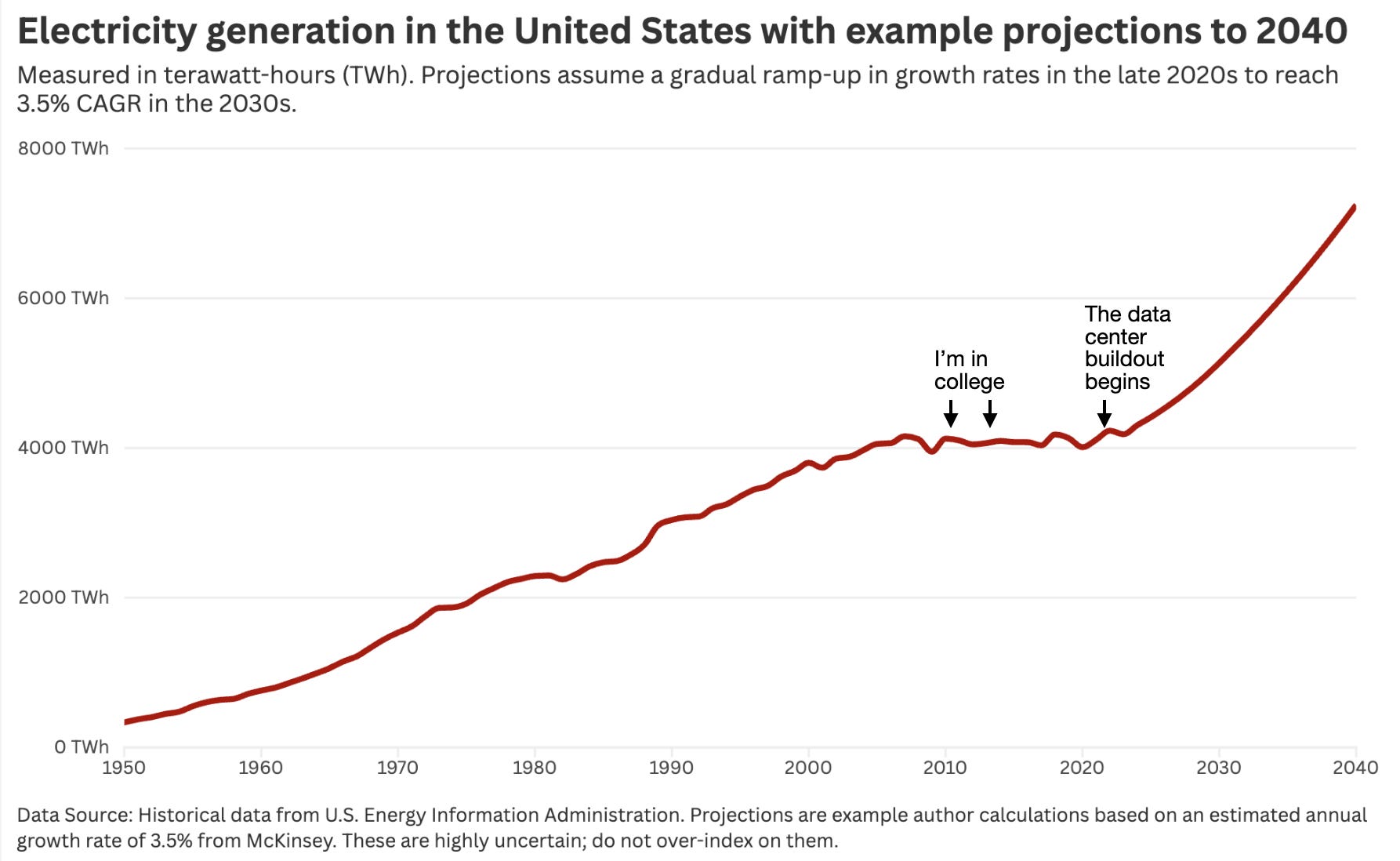
I suspect that in this time, general anti-building and anti-energy use sentiment has grown unnoticed, because there wasn’t much new building or energy use for it to react to and make itself visible. As I personally became significantly more liberal (as opposed to illiberal left), pro-market, and appreciative of the importance of economic growth, I also saw the default political attitudes of my peers slip away from me more and more into a general cluster of beliefs about climate and politics that, if I were asked, I could have easily predicted would have caused them to resist the data center buildout. Flat energy use in the 2010s left dry tinder ready to catch fire as soon as any hint of growth appeared. It’s to the point now that a lot of educated people seem to believe that there’s this agreed upon rule in climate that we can’t have any new industry at all until the full green energy transition is complete.
All this made me pretty temperamentally skeptical of the idea that the data center panic is too intense and targeted to be an organic result of local American politics. American politics is pretty wild right now! I had also been following the panic from the start, and knew that many of the most popular talking points and ways of thinking had come from specific overconfident or clumsy reporting from established US papers, and spread quickly because their claims were shocking and alarming when read in isolation, and also sometimes exciting to talk about on social media (it’s very easy to buy a water bottle to hold in front of a camera on TikTok and compellingly repeat a fake statistic). Unless the Washington Post or New York Times or Bloomberg or More Perfect Union are taking marching orders from China, I can always trace the panic to a decidedly American source, as well as the networks of people elevating it.
But obviously these are just my own intuitions. And there are compelling reasons to be worried. China and other countries definitely have a national interest in slowing the American data center buildout. In China’s case because it’s become more interested in AI and its relation to national power over time. Other countries may just want to cash in on the data center buildout, and the more American data centers they can block, the more the hyperscalers will turn to them instead as a place to build. And we know that foreign influence campaigns have amplified past political panics. I’m not temperamentally inclined to trust the CCP, and I’m aware of how strange the data center debate has been, so I went into this with an open mind. And yet…
The evidence that China’s influencing the data center backlash is weak
Most of the early reports on Chinese and other foreign influence in the US data center debate offered very weak evidence for any significant effect. Yet they’ve often been shared as if they’re smoking guns showing that China played a major part in the backlash. Looking at their details instead suggests that some foreign actors have definitely shown interest in the data center panic, but we have no clear evidence that they’ve played a meaningful role.
The American Energy Institute report
In April, the American Energy Institute published a report called “Foreign-Funded Opposition to U.S. Data Center Expansion.” It found that 12 US organizations opposing data centers had received more than $39 million from foreign donors.
That is interesting, but mostly about individual foreign private philanthropy from Europe. The donors are wealthy people and foundations in Switzerland, the UK, and Denmark. The most politically controversial is Hansjörg Wyss, a Swiss citizen who has lived in Wilson, Wyoming, for decades and funds Democratic-aligned advocacy groups and US environmental stuff.
Wyss has been somewhat shifty with his donating, sending hundreds of millions of dollars into US advocacy groups, including via the Berger Action Fund, a 501(c)(4) that is not generally required to publicly disclose its contributors.
The other donors in the report are Chris Hohn (a British hedge-fund manager who gives mainly through the Children’s Investment Fund Foundation), the British Quadrature Climate Foundation, Denmark’s KR Foundation, and Geneva’s Oak Foundation. None has a meaningful connection to China, with a tenuous exception for Oak that I’ll talk about below.
The AEI report itself doesn’t claim that this money involves China at all, but the report’s been regularly twisted to imply that it does. For example, a popular early write-up of the findings was this Center Square article syndicated in dozens of local papers. It opens like this:
A new American Energy Institute report shows that foreign billionaires have provided funding upwards of $39 million to the anti-AI data center movement in the United States, with experts saying AI infrastructure must be advanced in order to assert American tech dominance over communist China.
Founder, CEO and Chairman of State Armor as well as expert on Chinese influence in America Michael Lucci told The Center Square: “Either the United States or communist China will dominate artificial intelligence, and therefore, likely dominate the leading technologies of the 21st-century.”
“China is actively executing strategies to win this competition,” Lucci said.
“The world we leave behind for our children and grandchildren will be a very dark one if a communist regime has technological dominance over the United States of America,” Lucci said.
“We will enter a dark ages as communist China exports their governance and technological models to countries currently aligned with the United States,” Lucci said.
Lucci said that foreign money funding the anti-AI data center movement is “classic political warfare for the detriment of our sovereignty and ultimately our way of life.”
This leaves a strong impression that the report itself is about Chinese influence, but it’s not!
The $39 million number that gets shared a lot from this report isn’t all going to data center stuff, it’s the total amount given to climate orgs and progressive causes in general. Some of those orgs have then gone on to oppose data centers, often for climate reasons.
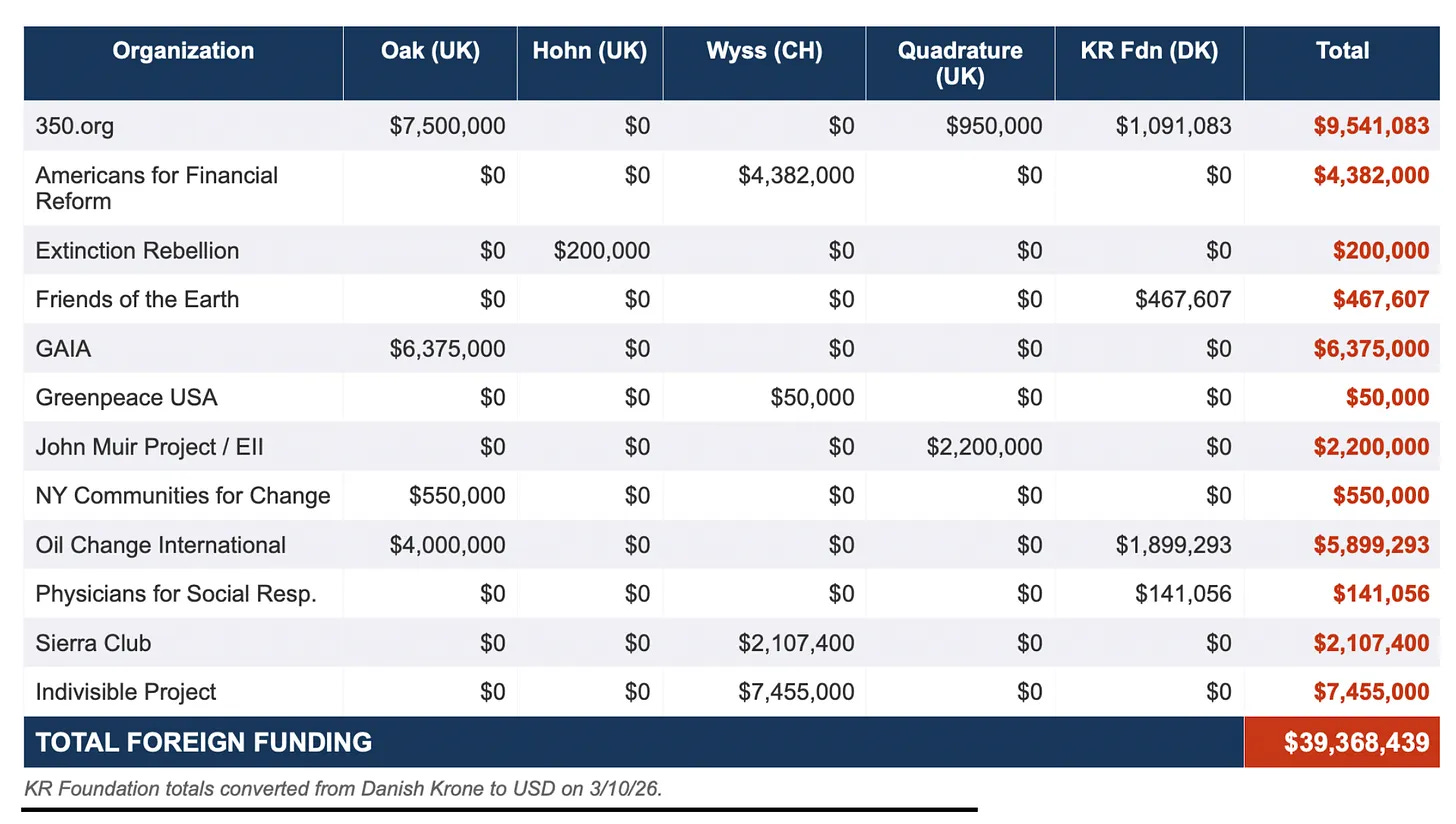
So framing this as “$39 million to the anti-AI data center movement in the United States” is silly. It’s $39 million to specific climate orgs from billionaires worried about the climate. The report doesn’t make it clear what time periods these donations happened over. If you look at their sources, most of these donations happened over a 10 year period or longer. So for most of the time these donations were being made, the data center buildout wasn’t even happening.
The report opens with an implication that the anti-data center letter from 230 environmental orgs that inspired Bernie Sanders’ data center moratorium was influenced by these donations:
A network of activist groups receiving significant foreign funding is waging a coordinated campaign against the development of critical AI infrastructure across the United States. According to tax filings, annual reports, and grant databases, 12 organizations actively opposing U.S. data center development have collectively received more than $39 million from foreign donors — including billionaires and foundations based in Switzerland, the United Kingdom, and Denmark.
In December 2025, more than 230 leftwing activist organizations — many affiliated with the groups highlighted in this report — signed a letter demanding Congress impose a national moratorium on the approval and construction of new data centers, calling the industry "one of the biggest environmental and societal threats of our generation." Local chapters have since organized protests, lobbying days, and public pressure campaigns in states from Louisiana to Michigan.
These are not isolated campaigns, they are a part of a repeat network of organizations funded by the same donor ecosystem. At least one organization identified in this report has also been included in prior analyses of coordinated energy policy advocacy networks. Previous research by the American Energy Institute has documented overlapping funding sources, shared partnerships, and aligned policy objectives among environmental groups engaged in opposition to domestic energy and infrastructure development.
This is a confusing framing of the numbers here. What happened here was foreign donors worried about climate donate to climate stuff over a decade, then some of those orgs go on to sign a letter signed by 230 orgs in total.
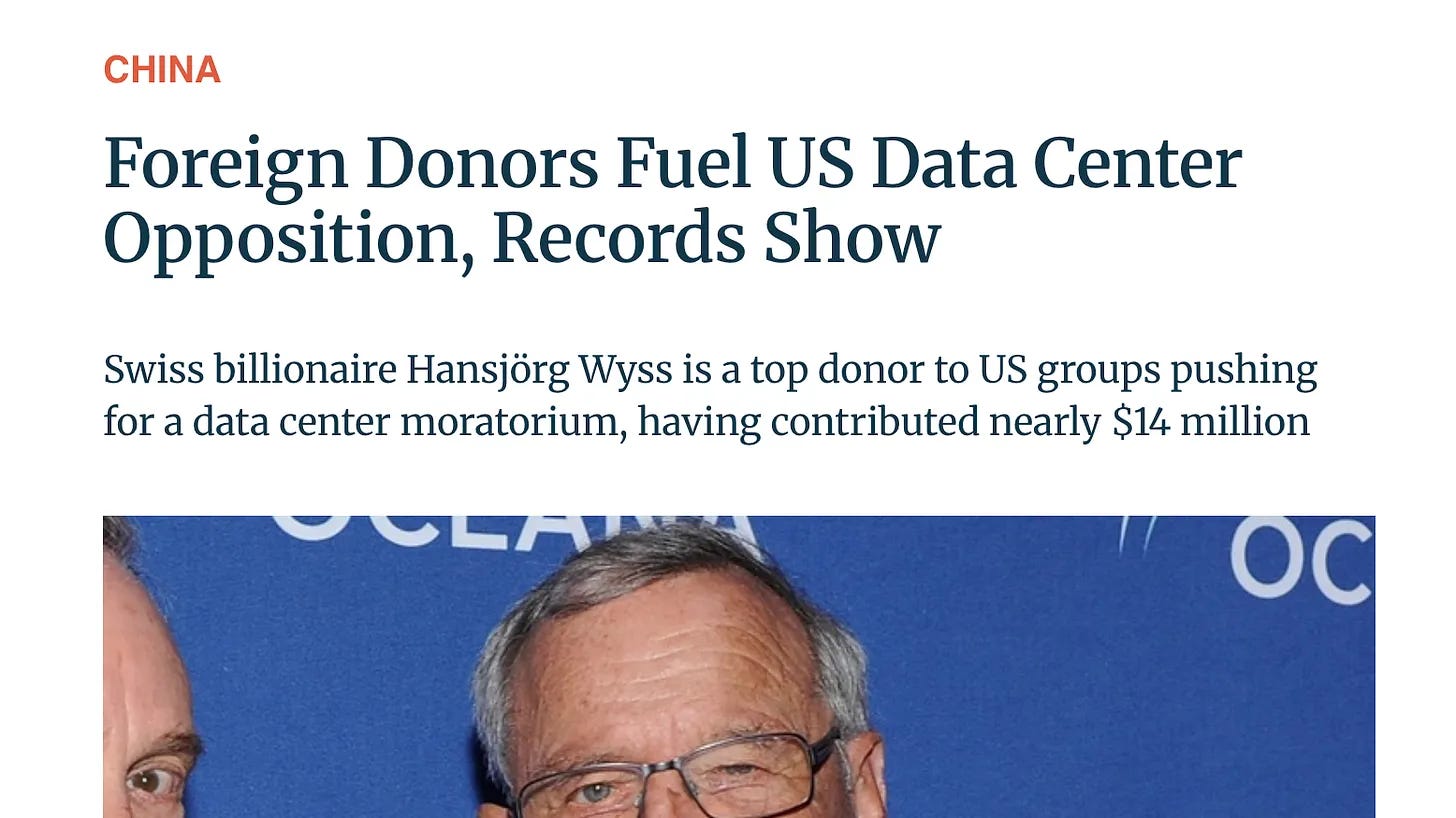
Here’s another goofy example of how this got reported on, from the Washington Free Beacon:
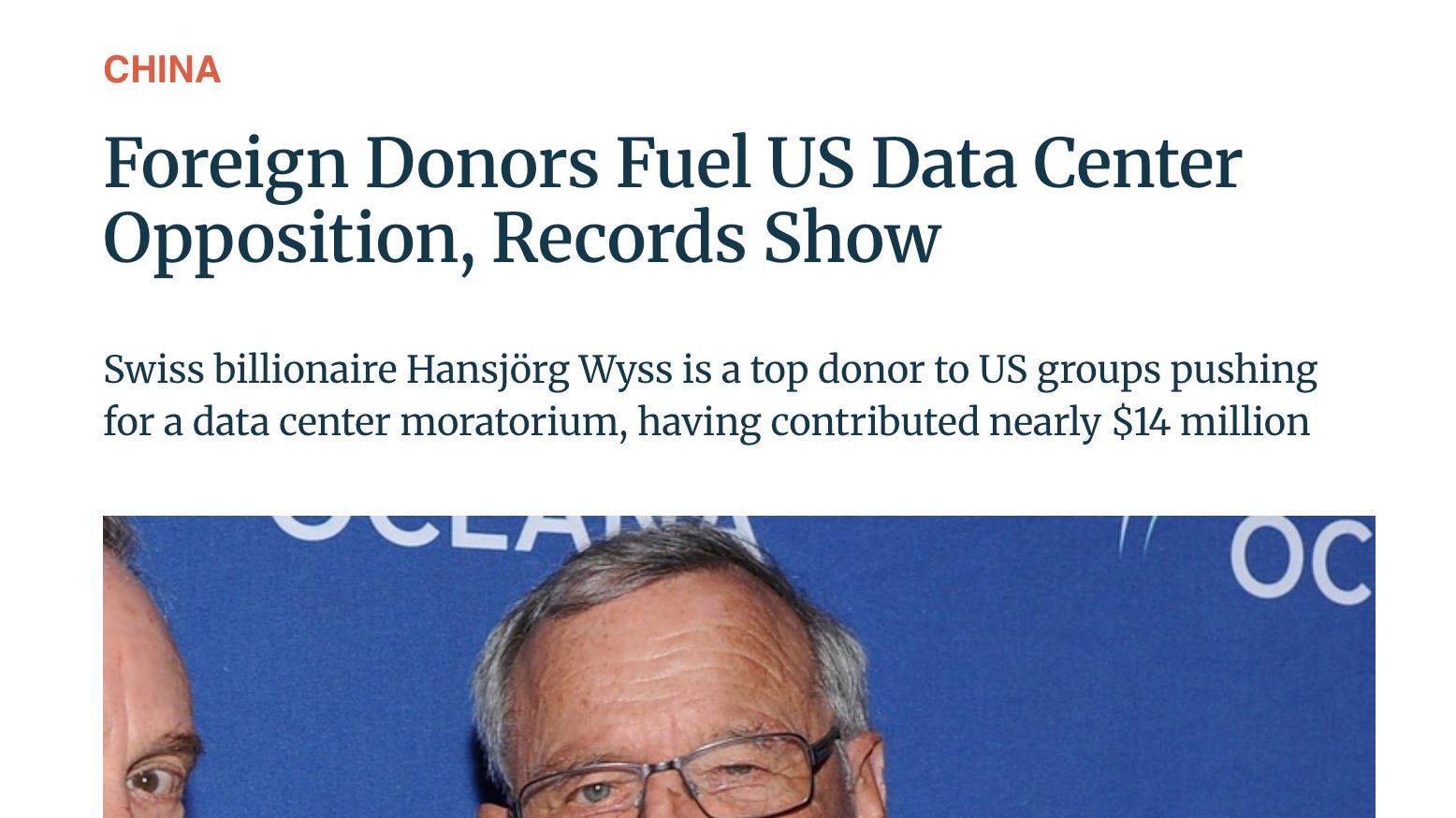
They put this in their China category despite all these guys being from Europe! These “groups pushing for a data center moratorium” are general climate groups, they didn’t just appear to fight data centers. The second half of the article pontificates about China’s role with a few examples of Chinese state media writing anti-data center articles.
The Bitcoin Policy Institute reports
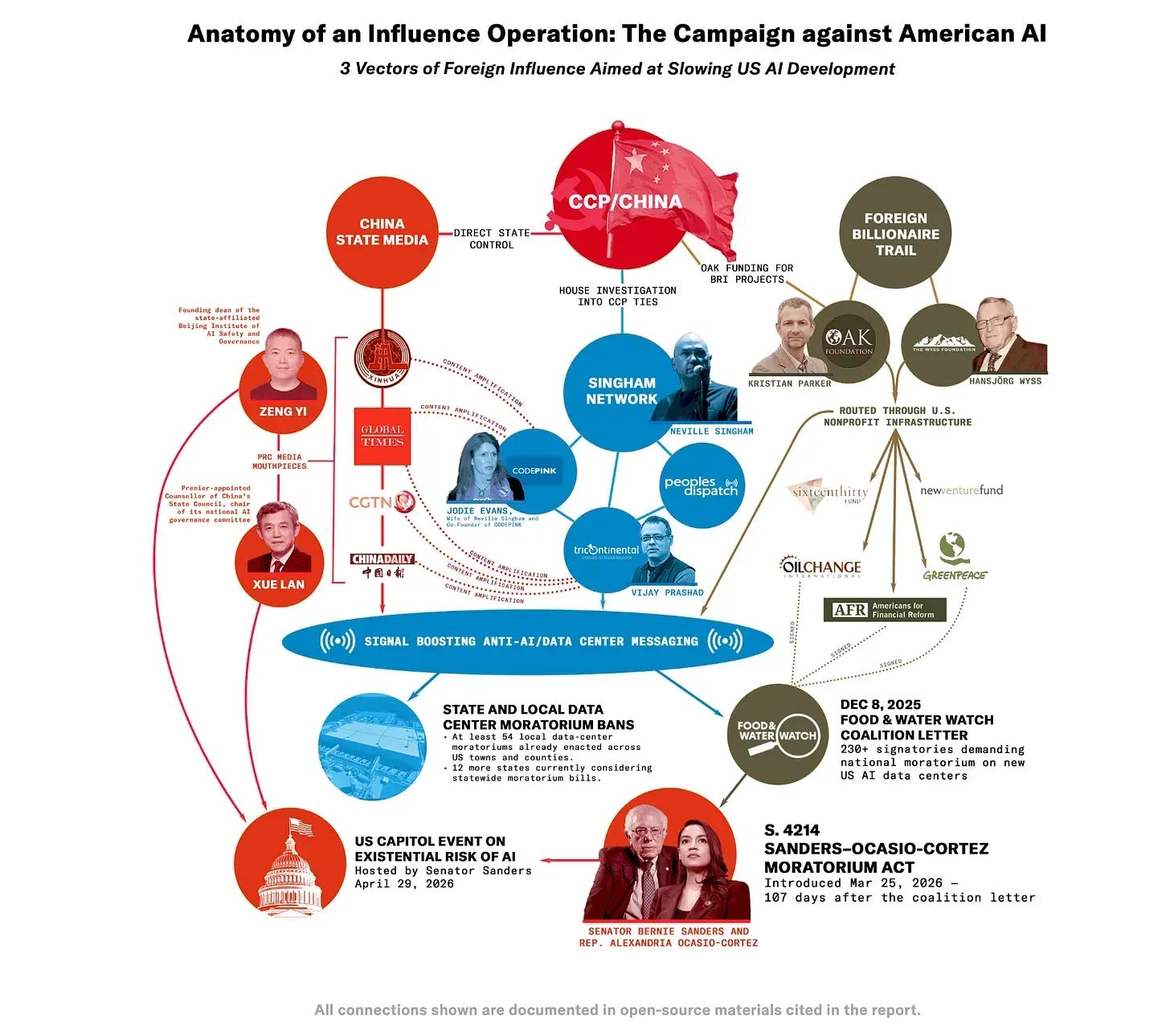
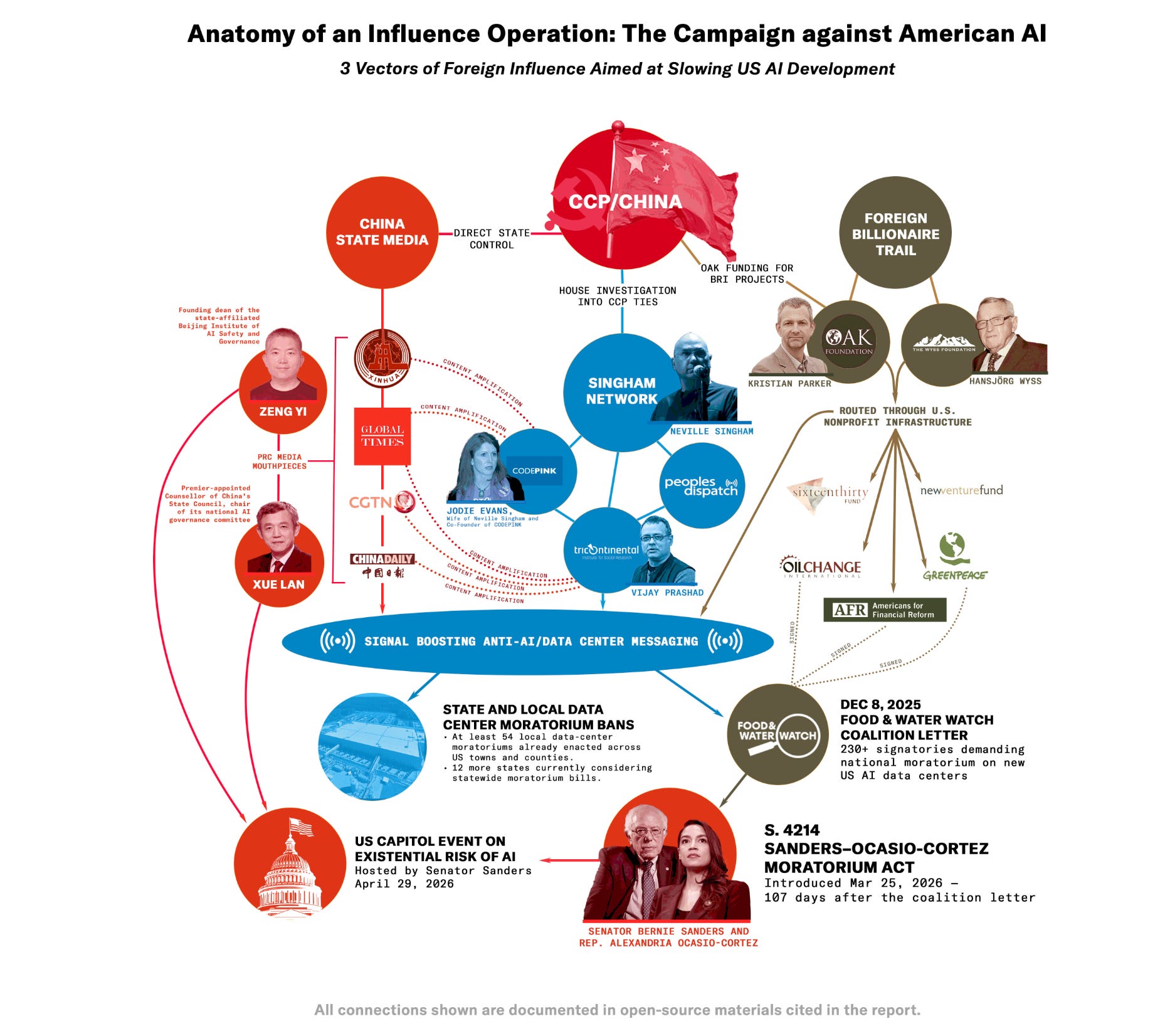
The Bitcoin Policy Institute (BPI) published the first of two reports on Chinese influence in the US data center debate on May 18. I don’t think the reports demonstrate significant foreign influence, beyond showing that specific fringe US groups like CodePink and the Party for Socialism and Liberation have focused more attention on data centers. And I think the infographic they made is getting shared uncritically as strong evidence that China’s playing a significant role in the debate, but when you poke at it this reading mostly falls apart.
First Report: Foreign Influence in the Campaign against American AI
This first report documents connections between the CCP and a US media and nonprofit network, and summarizes its case with this graphic:
The same European billionaires from the American Energy Institute report are here:
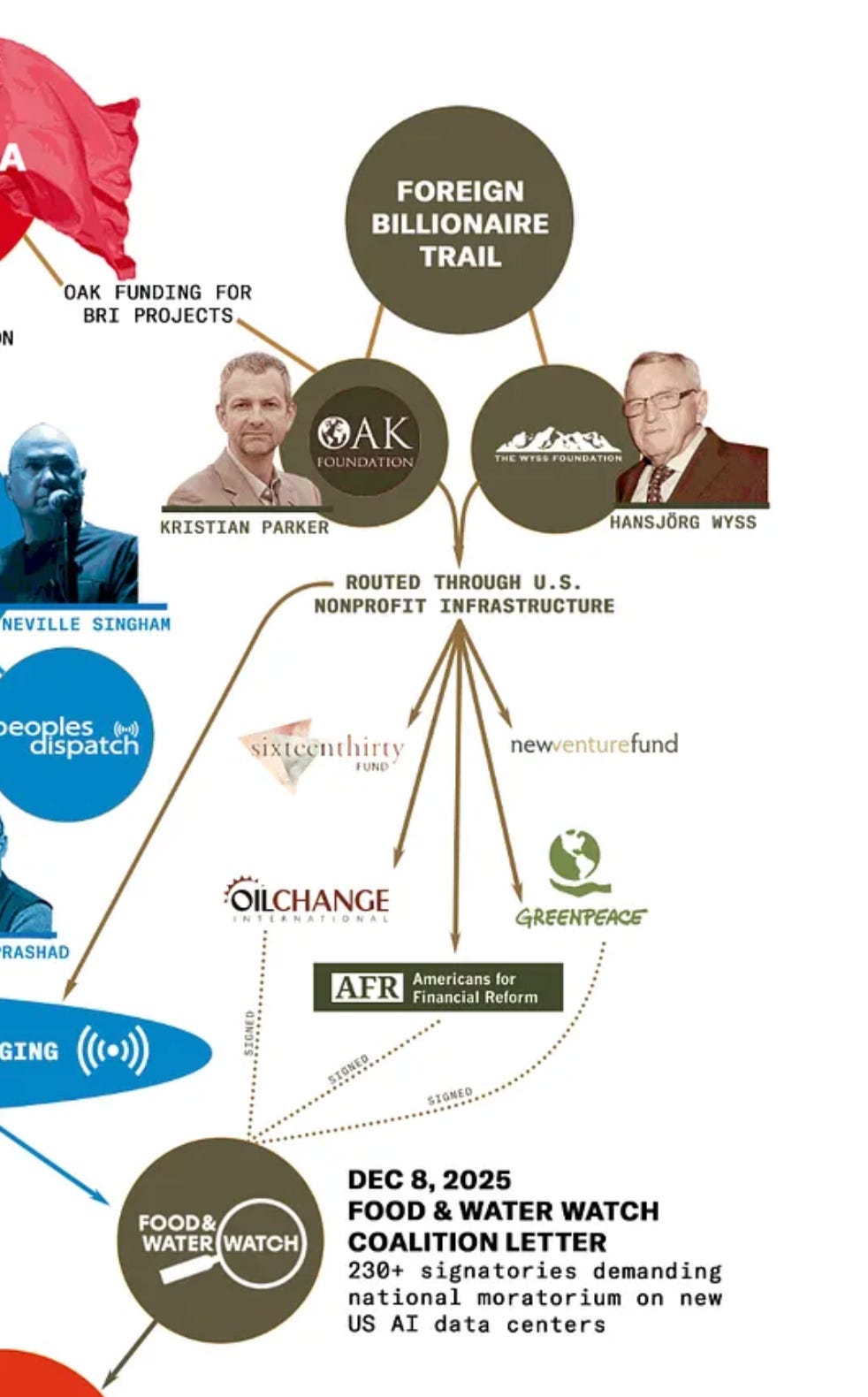
They’re donating to lots of climate causes and believe data centers are bad for the climate. They’re mostly reporting all their donations (with the exception of Wyss’s donation to the c4). The report frames them as donating billions of dollars into orgs which are now fighting data centers, but what this means is they’ve given a lot to US climate groups in general, and now some of those climate groups are anti-data center for climate reasons. The report notes:
Multiple foreign-tied charitable vehicles, including those of Swiss billionaire Hansjörg Wyss and British billionaire Alan Parker’s Oak Foundation, have funneled more than $2 billion into US 501(c)(3) and 501(c)(4) advocacy infrastructure. A significant portion of that money now flows directly into the organizations driving the anti-data-center campaign.
This is a reference to a number from this Americans for Public Trust report which at first found around $2 billion and in a revised report later bumped that to more than $2.65 billion in total grants from six foreign-based or foreign-donor-linked sources to U.S.-based orgs, mostly over 10 year periods. This is the same report AEI drew from above, with the same organizations like Wyss and the Oak Foundation. This money went to hundreds of advocacy orgs, that focus on things like climate, conservation, social justice, health, and other stuff. After 10 years of donating, some of these groups (like other US progressive and climate-focused groups) opposed data centers. We don’t know how much of this money was meant for anti-data center advocacy specifically, but it seems likely that it was pretty small, and importantly all coming from European billionaires and orgs, not China.
BPI doesn’t explicitly claim that these foreign billionaires are working for China, but still draws a line connecting them to China like this:
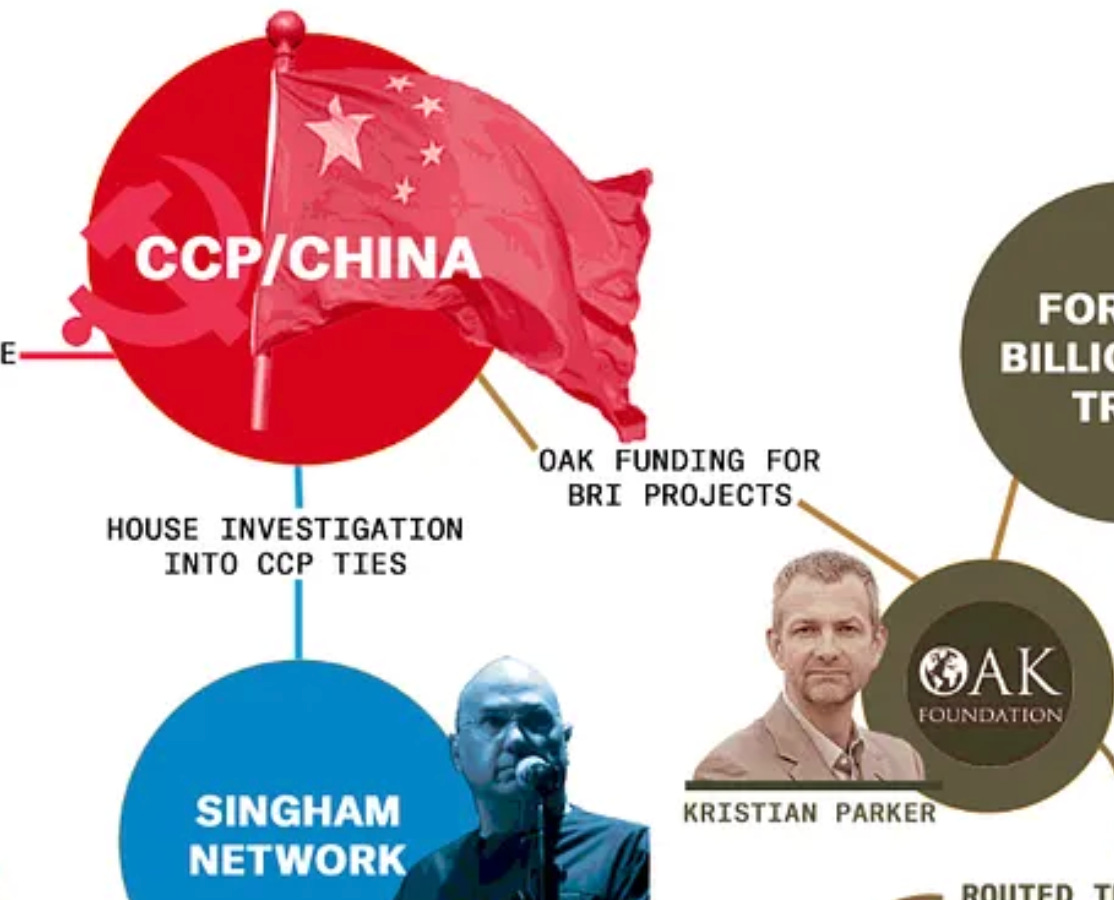
What’s “Oak Funding for BRI Projects?” It’s not the CCP influencing the Oak Foundation, it’s the Oak Foundation funding some Chinese Belt and Road Initiative (BRI) projects (China’s global infrastructure project). Why would they fund this? Well, they made a one-time $1 million grant to ClimateWorks in 2018 “to support the greening of the Belt and Road Initiative.” They also supported related work by the World Wide Fund for Nature, and BPI says they funded the Beijing-based Global Environmental Institute (GEI). The report describes these grants as evidence of “direct policy and financial ties to the People’s Republic of China.” That’s technically true but an incredibly silly framing once you know the details.
The Belt and Road Initiative builds, among other things, ports, railways, highways, power stations, and telecommunications, and is operating in 150 countries making up 75% of the world’s population and half of all global GDP. Opinions on BRI vary a lot, but the reason why a climate group would want to pay to make the massive infrastructure project greener is incredibly obvious. Throughout the 2010s, China was the largest public financier of coal power in the developing world. Lots of Western climate philanthropies funded research and advocacy to try to get Chinese banks and ministries to stop. The ClimateWorks report BPI mentions as funded by Oak, Decarbonizing the Belt and Road, finds that if BRI countries kept growing along carbon-intensive paths, they could make up 2/3rds of global emissions by 2050 and push the world past 2 degrees of warming even if everyone else hit their targets. This seems like a good study for a group focused on climate to fund!
The report also mentions the fact that Kristian Parker, the head of Oak’s environment program, is also on the ClimateWorks board. I know a bit about climate philanthropy and understand this to be pretty common.
The ClimateWorks grant was $1 million in 2018. I can’t find Oak’s total spending that year, but their environment program gave out $65 million in 2019. This all happened before the data center buildout. I think it’s goofy that the BPI drew this line connecting the CCP to Oak at all in a graphic about data centers.
What about the Beijing-based org GEI? This is a Chinese environmental nonprofit. They work with the Chinese government on making foreign investments greener. If you want to influence the government of China to build less coal power, it seems necessary to use an intermediary in China itself, which will by definition have to work with the government. Again, this seems like a necessary piece of one of the most effective climate philanthropy moves in the last few decades. I’m not seeing anything suspicious here.
This global campaign to green the Belt and Road Initiative may have worked! In 2021, Xi announced that China “will not build new coal-fired power projects abroad” and researchers tracking Chinese energy finance have found that new coal funding by the government actually did stop. This seems like one of the very best possible things a climate-focused group could spend money on! BPI includes Oak’s explanation that the giving was meant to reduce the Belt and Road’s projected emissions, but calls the ties “troubling” anyway. I don’t think they’re troubling at all.
It seems like none of the people or organizations on the right side of the chart are actually trying to influence the data center debate for national security reasons, or are working on behalf of foreign adversaries. And most of their donating happened for general climate or progressive reasons, and some of the climate orgs they funded became anti-data center. They don’t seem to be interested in “slowing AI development” in the way the chart implies. It doesn’t seem like these people are motivated by the pace of AI progress at all, the general climate and progressive orgs they’ve donated to just think the physical infrastructure is so wasteful that it should be blocked. I disagree, but they don’t seem to fit what the chart’s implying, so I’ll remove them.
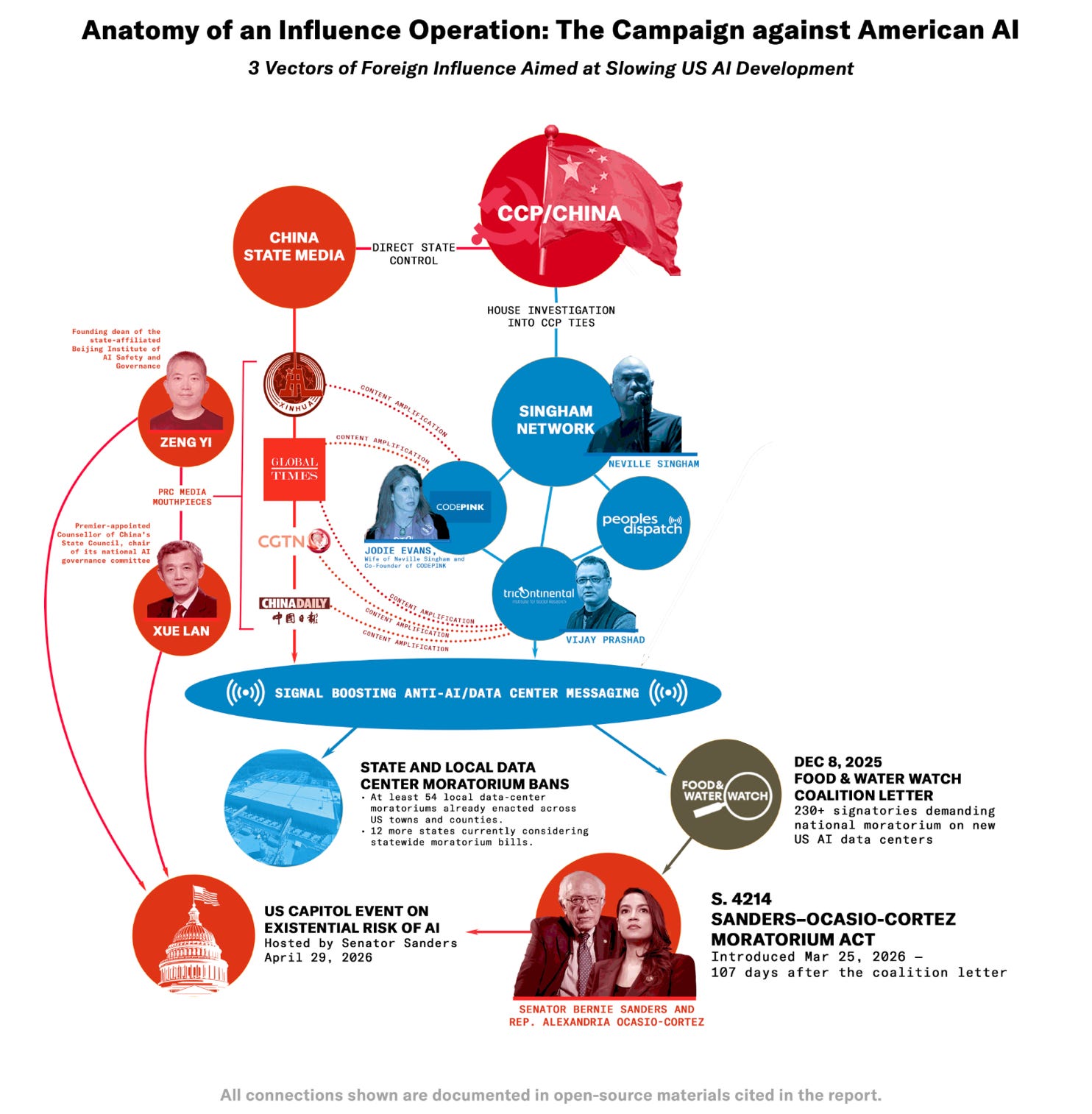
Let’s keep moving through this chart. Who are the guys on the left?
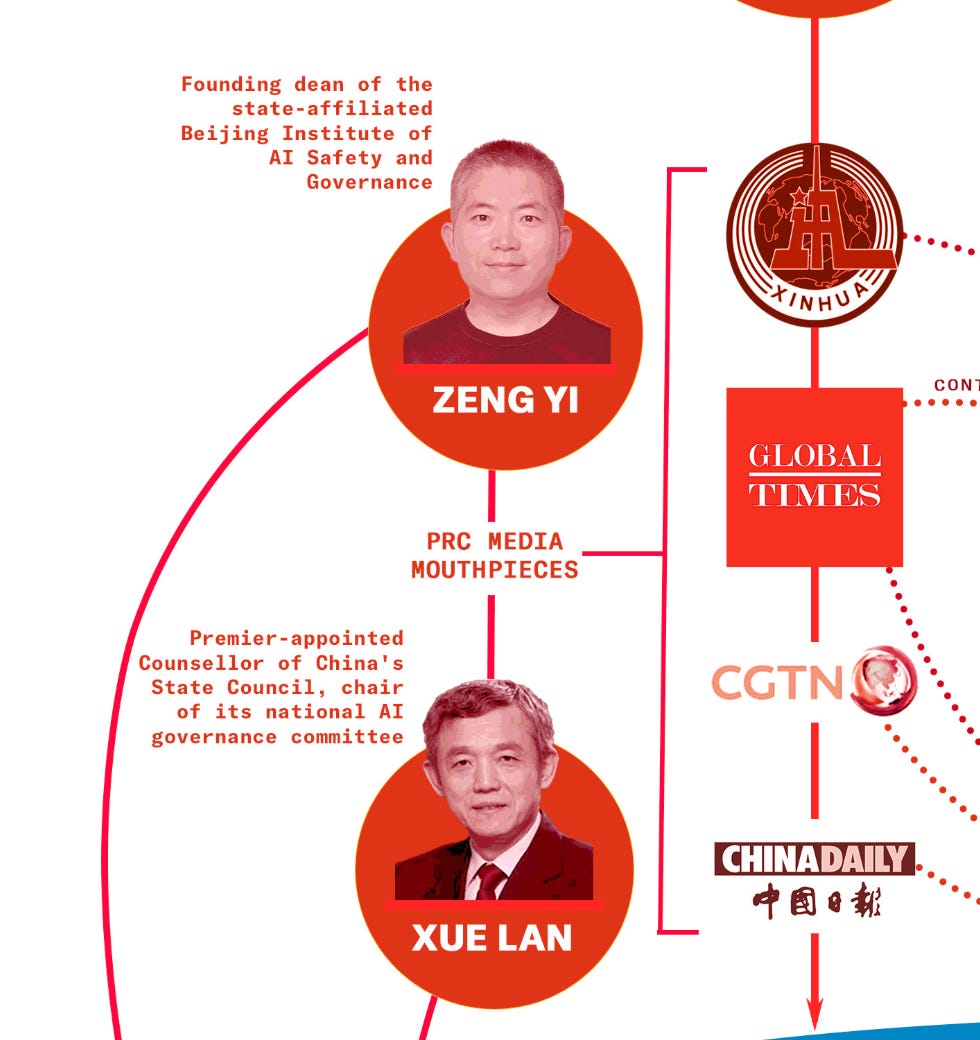
These are Yi Zeng and Xue Lan, the two Chinese AI-governance researchers Bernie Sanders invited to a panel on existential risk from AI on April 29th. The report describes the event as “the culmination of an influence campaign.”
Both men are widely respected outside of China for their AI safety and governance work. Zeng was on the UN Secretary-General’s AI Advisory body for a year, he addressed the UN Security Council’s first-ever session on AI in 2023 to warn about existential risk, and made the Time100 AI list in 2023. He served on the expert advisory panel of the international AI safety report led by Yoshua Bengio. Xue is the dean of Schwarzman College at Tsinghua (the college that hosts Schwarzman Scholars), did his PhD at Carnegie Mellon, and co-authored the 2024 Science paper “Managing Extreme AI Risks amid Rapid Progress” with Bengio, Geoffrey Hinton, Stuart Russell, and Andrew Yao. He chairs the Ministry of Science and Technology’s New Generation AI Governance Expert Committee and is a Counsellor of the State Council.
Many researchers in AI safety and governance, despite being wary of China, believe that some basic coordination with the CCP will be necessary to avoid catastrophic risks, in the same way we coordinate over other global risks. You can disagree with this, but it’s ridiculous to imply that anyone who believes that some kind of cooperation over what they see as incredibly dangerous new technology would be good must be bought off by China.
What else does the report offer?
Both men do at times seem to parrot or at least share the opinions of the CCP. Zeng wrote pieces for China Daily using language associated with official Chinese foreign-policy messaging. Xue has argued that US chip controls can be counterproductive. The report uses Xue’s opposition to US export controls as evidence of alignment with the CCP. But Sanders’ Artificial Intelligence Data Center Moratorium Act would prohibit exports of advanced computing hardware to countries that don’t have equivalent AI safeguards, which would include China. If Xue’s opposition to export controls is evidence that Sanders’ panel and bill is the result of a foreign influence campaign, the bill’s contents seem like much stronger evidence in the other direction. More broadly, the report lists as evidence that they’re mouthpieces for the CCP their appearances in Chinese state media like CGTN, China Daily, and Global Times. But all major Chinese media are state-owned or party-supervised, and two of the country’s most prominent academics will obviously appear in them.
These are two of the most internationally known Chinese scholars on AI governance. If you want to understand the Chinese perspective on AI risk, these are the people you go to! If I were running a panel on global AI governance, I’d want to invite these guys, and I don’t need to be funded by China to say that. Both men regularly appear in AI safety and governance conversations. China would not have needed to fund anything to make a panel focused on global AI governance interested in having them join. Their presence alone isn’t evidence at all that China’s run a successful influence campaign here. The panel wasn’t even about data centers. It was about existential risk, unemployment, and Sanders’ idea of an international AI treaty modeled on Cold War nuclear agreements, which Max Tegmark (one of the panelists) has been pushing for a while.
The report doesn’t even explain how Sanders’ selected these guys or why this is the “culmination of an influence campaign” besides the fact that these are Chinese researchers who sometimes share the opinions of the CCP, and a very tenuous connection between China and the anti-data center letter US environmental groups signed.
Sanders’ Artificial Intelligence Data Center Moratorium Act was introduced on March 25, 2026, but he had first demanded a moratorium in December 2025, four months earlier, after a large group of US environmental groups wrote a letter demanding a national moratorium, as shown in the graphic.
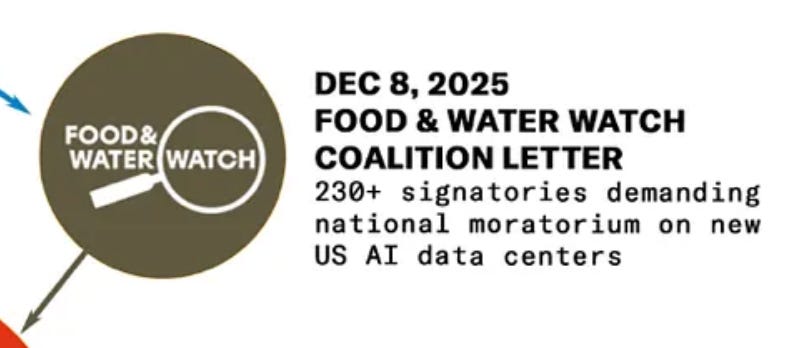
The timing is consistent with the environmental letter inspiring Sanders’s moratorium push and with his later emphasis on AI safety and governance. The report’s already implied that this coalition letter was influenced by foreign billionaires with some kind of tie to China, but we’ve already seen that that doesn’t hold up. This was a coalition of normal US environmental groups mad about the environmental impact of data centers. You can look at the letter with the full list of orgs here. I found two orgs who have a credible tie to the CCP-aligned Singham group (discussed below):
The Institute for Policy Studies, whose 2015 annual report thanks its donor community and includes Neville Roy Singham in the individual donor list. IPS’s fiscal 2024 IRS filing lists Jodie Evans as a trustee. Evans is Singham’s wife and cofounder of CodePink.
The Progressive Democrats of America, whose current advisory board page lists Medea Benjamin, a CodePink cofounder. A 2009 PDA release also named Jodie Evans among its board members.
So out of 231 organizations, I found 2 that had loose ties to a CCP-aligned network. Doesn’t look much like a successful CCP influence operation to me.
The report says that Sanders’ data center moratorium was introduced 107 days after the coalition letter, and concludes that “That kind of efficiency typically distinguishes coordinated advocacy infrastructure from spontaneous grassroots opposition.” Does it? 3 and a half months is a long time.
So to recap, Sanders was originally motivated by US environmental groups, only 2 of 231 seem to have any ties to China at all, to propose a data center moratorium, then talked a lot with the AI safety community, got more worried about extinction risk, promoted Max Tegmark’s specific view of global AI governance, and invited the two most prominent and respected Chinese AI governance researchers to a panel on said global governance. This doesn’t look like a foreign influence campaign to me at all.
So I’ll knock all these off the chart as well. What’s left?
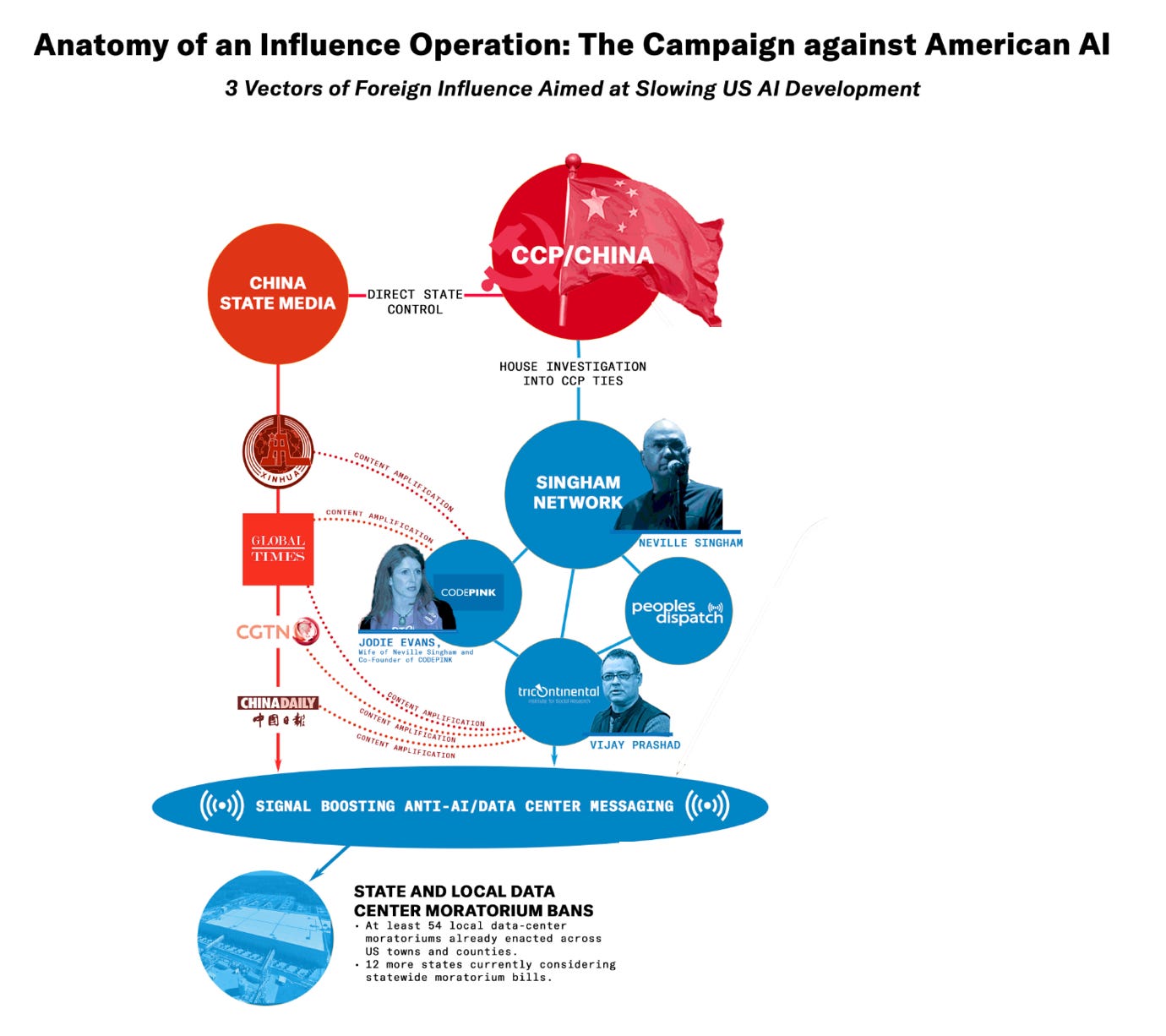
We’ve got the Singham Network, and Chinese State Media. I agree with the report that both of these have shown interest in slowing the data center buildout and have tried to influence American attitudes toward data centers, so the question is how successful each has been.
First of all, the Singham network is in fact incredibly skeevy, CCP-aligned, and capable of influencing some US discourse. It is a coordinated group of nonprofits funded by Neville Roy Singham, a Marxist billionaire who lives in Shanghai and is married to CodePink co-founder Jodie Evans. A 2023 New York Times investigation found US and international organizations producing content closely aligned with the CCP on major geopolitical issues, sharing staff and office space, and cross-posting one another’s material. Singham works from a Shanghai office shared with a Chinese media firm whose mission uses the CCP’s same slogan for overseas propaganda, and he attended a party workshop on promoting the CCP internationally shortly before the Times story ran.
From 2017 to 2023, the Singham network moved about $278 million into six US nonprofits: including more than $167 million to the People’s Support Foundation, more than $68 million to the Justice and Education Fund, and more than $22 million to The People’s Forum. This is currently being investigated by the government.
So this is a real case of a powerful CCP-aligned actor trying to influence American thinking. The question is how influential the Singham Group’s been in the data center debate. Here’s what the BPI finds:
Tricontinental published a dossier criticizing Big Tech in 2021 and a paper in March 2026 arguing China is overcoming US export controls.
Code Pink published a piece in January 2026 attacking Meta’s data center projects in Louisiana and Wyoming and framing them as part of a new Cold War on China.
Peoples Dispatch ran a piece attacking American AI firms by name.
Liberation News (the paper of the Party for Socialism and Liberation, more on them further down) has been covering data centers and electricity bills since at least July 2025.
The report describes this as the network seeding anti-data center talking points, but almost all of the data-center-specific material came out after people were already fired up and didn’t seem to add new talking points. The five year old dossier is just Tricontinental commentary arguing that the United States should let advanced chips flow to China. This is unrelated advocacy for Chinese access to compute for a small audience, and doesn’t suggest any kind of local NIMBY opposition to data centers. The only media here focused on data centers shows up in mid-2025 or later. By then, local opposition had already blocked or delayed $64 billion in data center projects, and electricity bills purportedly linked to data centers were a major American news story. There’s no new information here that the groups seeded, and I haven’t seen evidence that they inflamed the debate much. It doesn’t look like anything here got much readership.
The report notes that Chinese state media is warning Americans about data center energy costs while subsidizing the energy costs of its own data centers. I agree that the CCP seems to clearly not mean what they say about the US data center buildout, but I need to see more evidence that this all has actually had an effect.
I’ve seen a lot of people share this graphic as solid evidence that China’s playing a big role in the data center backlash, but when you poke at almost any part of it, this reading seems to fall apart.
Second Report: The Singham Ground Game
BPI published this second report in June. I think this is a clear improvement on the first, but is still far from showing that China’s played a meaningful role at all in the data center backlash.
This second report looks at 21 local anti-data center campaigns across 14 states where the Party for Socialism and Liberation (PSL) showed up to fight data centers via door knocking, petitions, protests, and showing up to city council chambers. Two things about PSL:
Their leadership heavily overlaps with the executives at Singham’s nonprofits.
They also attempt to join basically every popular mainstream protest to recruit new members. As a veteran of protests in DC myself, basically every large one I went to had a PSL presence. When I showed up at a march after Roe was overturned I remember them running around yelling about how we need to abolish the Supreme Court. I felt like maybe getting into an epic debate with them about how this would have also ended Roe, but decided it wasn’t worth it. I did once had a longer conversation with a member who alternated between telling me about the Hands Off North Korea movement and about how almost every night he had a dream about peeing his pants. Anyway…
The report finds that these campaigns were involved with 10 local moratoria, 1 permanent ban, and 4 rejected or withdrawn data centers, adding up to $23.6 billion in delayed or blocked investments. The report also repeats that “the American opposition to data centers is real and mostly homegrown.”
My general impression of PSL is that they’re mostly ineffectual and just ride along on other protests, so the question is whether they were actually responsible for any of these shutdowns. It looks like there’s one clear case where they were. In Prince George’s County Maryland (right near me!) the local NPR station described the PSL as leading the county’s data center fight, and talked about how the chapter trained local residents to canvass and ran a petition that got 20,000 signatures. They turned out crowds large enough that the county executive paused data center permitting.
Most of the other cases don’t manage to show that PSL caused the shutdown or delay. In DeForest, Wisconsin, the lead organizers were a normal local residents’ group, PSL “provided support,” and the data center was blocked after local opposition and a Wisconsin Watch investigation exposed details of the NDAs. Tucson’s $3.6 billion Project Blue was rejected by the city but moved to unincorporated Pima County land, where it is proceeding, and BPI counts it as delayed in part by PSL.
On top of all this, the report doesn’t even find that Singham actually funds the PSL. There are lots of linked people, but we don’t know which way the causality runs. PSL was founded in 2004 as a split from the Workers World Party, way before Singham himself started funding his network. The report relies on the public statements of James “Fergie” Chambers, a disaffected Marxist millionaire who used to organize alongside Singham. He says The People’s Forum and BreakThrough News are wholly controlled by the PSL. So this claim seems to be that Singham’s money is flowing into a Marxist scene that already existed independently. It’s possible that without Singham’s money flowing into these other orgs, PSL might be similarly active. I don’t know. Again, this definitely seems like the clearest case of bad behavior from a CCP-aligned group. Its scale still appears small. The Maryland campaign is the clearest example, although BPI also documents substantial PSL organizing in Charlotte. It’s unclear how much either campaign changed the outcomes.
But meanwhile, Gallup found in March that 71% of Americans would oppose a data center in their own area, 48% say they would “strongly oppose” one. The PSL in Maryland could have only mustered this opposition by drawing on a pre-existing very negative public sentiment that doesn’t seem to have been influenced by the Singham network.
OpenAI’s report
On June 10, OpenAI published the report “PRC-linked influence operations are targeting AI debates in the US” which describes how and why they banned two clusters of ChatGPT accounts that seemed to be operating out of China (the operators prompted the model in Chinese and connected through VPNs, since OpenAI doesn’t allow access from China). The first cluster, which OpenAI nicknamed the “Data Center Bandwagon” campaign, generated short English-language comments and images claiming that AI data centers were pushing up electricity prices for ordinary American families, and fake accounts posted them on Twitter. The second, “Tech and Tariffs,” generated comments and political cartoons attacking US tariffs, and was connected to a network of fake Twitter accounts pushing false claims that ChatGPT user data had been breached.
OpenAI concluded that the operators were likely connected to a private Chinese company that conducts public-opinion work for provincial government clients. So this may have originated in China, but we don’t have solid evidence that China’s central government directed it. The disinformation researcher Darren Linvill made a point here that if the Chinese government were serious about covertly shaping the data center debate, they probably wouldn’t run an operation like this using OpenAI’s own product.
Most of the posts received little or no engagement, and OpenAI found “no evidence of meaningful breakout beyond its own activity.” The report therefore shows likely China-origin operators testing and amplifying existing narratives, with no observed meaningful reach.
So twitter bots originating in China shared comic strips about electricity prices based on American reporting that the public was already following. The bots didn’t get meaningful attention. They were designed to amplify a pre-existing panic, and failed. They behaved in ways that don’t seem consistent with a state-led operation, among other things using OpenAI models. That’s what we know from this report.
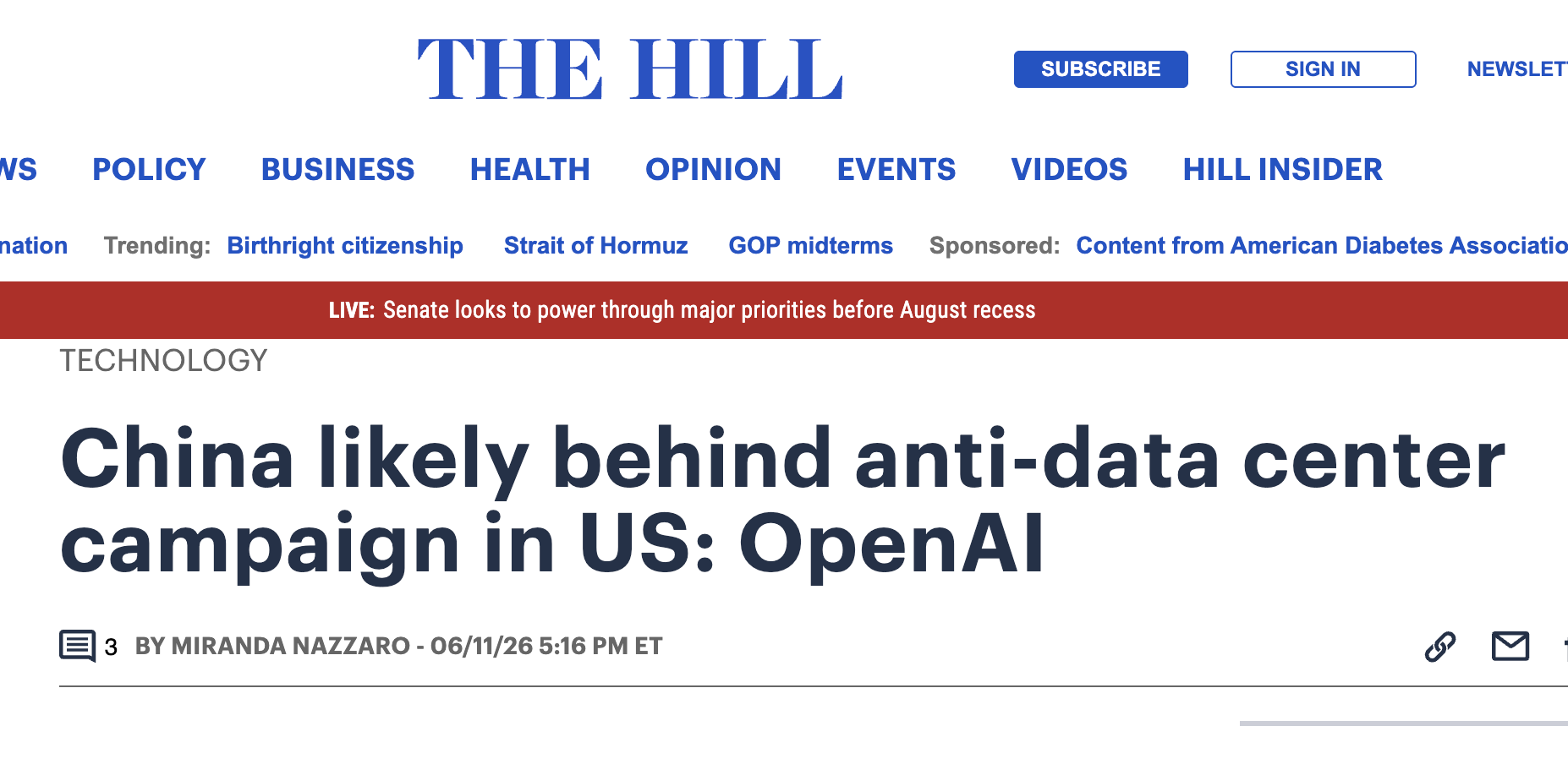
This report has generated a lot of goofy headlines, like this from The Hill:
Sure, people likely based in China were behind one specific, extremely small anti-data-center campaign in the US. But readers might understand this headline as saying OpenAI found that the CCP itself was behind the campaign, or that the full anti-data center movement was coming from China.
Kevin O’Leary’s claims
After Kevin O’Leary’s proposed 9 GW data center in Utah met with intense opposition, he announced that his team had discovered evidence that China was behind a lot of it. He claimed that his team had traced much of the opposition back to the Alliance for a Better Utah, a progressive advocacy group, and that the group’s IRS Form 990 filings showed ties to Chinese-linked funding channels connected through an organization called Arabella. He said that there was a spike in misinformation about the data center on Instagram and X stemming from IP addresses connected to these organizations. On Fox News he suggested that this is China because there’s only one adversary who would want to stop America from building its grid and its compute capacity. In a later Fox appearance he implied that specific people were working with China, including Alliance for a Better Utah founder Josh Kanter, Gabrielle Finlayson of Elevate Strategies, and Taylor Knuth. He called locals “proxies for the Chinese government,” and said data scientists had established the link.
I can’t find any evidence anywhere that these organizations or people are linked to China. And it turns out O’Leary can’t either. On June 25, O’Leary posted a statement saying he has “no evidence” that Alliance for a Better Utah, Elevate Strategies, Finlayson, Knuth, or Kanter are funded by China or the Chinese Communist Party, and Fox News later issued an on-air correction. Everyone he listed besides Knuth went on to sue him for defamation.
He managed to dump gasoline on the fire of public opposition by telling local activists that they were funded by China, and confuse the debate by creating lots of news stories implying China might be involved without any real evidence.
The Alethea report
This report is the most serious evidence of foreign interference I’ve seen. The New York Times reported on it on July 9th.
The NYT says that between January and June, Alethea found about 700 mentions of data centers in Chinese, Russian, and Iranian state media, a small fraction of each country’s AI coverage. They found Russia-linked Storm-1516 publishing two fake stories about Firebird’s Armenian data centers, and the pro-Kremlin Rybar network separately pushed anti-data center stories. The Chinese and Iranian examples in Alethea’s public report were mostly overt state-media coverage, not covert operations.
The report did not show that any of this activity materially changed American opinion. Much of the Chinese material was triumphalist propaganda apparently written for domestic readers. Alethea also found what looked like engagement farming around anti-data-center slop posted by Facebook pages anonymously run from Bangladesh. Russia appeared to be using data centers more aggressively as a wedge issue, while the evidence involving China was mostly overtly state-media. Again, I’m left without a strong case that China’s having significant influence here.
And that’s basically what we know about Chinese influence on the data center debate!
This thin evidence is being inflated in policy discussions
Trump suggested China's playing a big role in the data center backlash recently, saying "A big part of it is China" and claiming the communities giving developers a hard time are “China-oriented” and that Beijing is spending heavily to promote not building because the US is winning the AI race.
Secretary of the Interior Doug Burgum has made similar claims:
On Mornings with Maria, he called the buildout an arms race with China and that some opposition is “geo-targeted” propaganda.
At an industry event called “Harnessing American Power,” he told the crowd the data center opposition wasn’t organic and local and that some of it was foreign-sourced dark money.
On Fox Business in late May he said the debate was “bombarded with foreign-directed propaganda”, and called it “another attack on the U.S. and our ability to be competitive.”
Members of Congress have seemed to overreact to the evidence we have. The House Energy and Commerce leaders wrote to FBI Director Kash Patel and PCAST co-chairs David Sacks and Michael Kratsios saying there was “evidence that strongly suggests foreign influence campaigns,” demanding a briefing by June 18, and the evidence was mainly BPI and Power the Future reports (Power the Future’s report is on the European billionaires funding progressive groups, not China). The letter said the possibility that CCP-backed entities are influencing data center decisions shows how serious a fight the US is in. I don’t think these reports demonstrate that level of seriousness. I think investigation into possible influence campaigns makes complete sense, but it doesn’t make sense to imply that we have strong evidence of meaningful campaigns.
Tom Cotton wrote another letter to Acting AG Blanche that alarming reports indicate “a network of foreign actors, led by the Chinese Communist Party” is manipulating US policy and opinion on data centers, and his letter uses the $2 billion number from BPI (which, remember, is a decade of publicly disclosed general climate philanthropy from Europeans, and some of the groups funded signed an anti-data center letter). Here’s the full text of the letter:
Dear Mr. Blanche,
I write requesting the Department of Justice (DOJ) investigate foreign influence efforts targeting the buildout of American AI infrastructure. Alarming reports indicate that a network of foreign actors, led by the Chinese Communist Party (CCP), is attempting to manipulate U.S. policy and public opinion on data centers. Maintaining America’s AI advantage is vital to American economic strength, diplomacy, national security, and military power. Americans certainly have valid concerns about potential rising energy costs and strains on natural resources related to data centers, and we should implement common sense regulations and legislation to protect communities from adverse effects. But we can’t allow any effort by foreign adversaries to extort these fears and undermine our technological development.
A recent report uncovers a multi-year campaign waged across multiple vectors of foreign influence. Among them is a network of U.S. nonprofits funded by Neville Roy Singham, a Shanghai-based American expatriate under U.S.-government scrutiny for his ties to the Chinese Communists. For years, Singham’s network has been producing content opposing the development of American AI infrastructure, and various investigations have found that the Chinese government is the network’s ultimate paymaster. All while the Chinese government promotes its own AI ambitions at home, where sentiments are overwhelmingly pro-technology.
Foreign-funded charitable entities tied to this campaign have reportedly funneled more than $2 billion into U.S. advocacy organizations, with a significant portion going to groups that are driving the campaign against U.S. data centers and influencing policymakers. Just one month ago, Senator Bernie Sanders hosted a 75-minute panel on “the existential threat of AI” where two of the four panelists were Chinese government affiliates. This included a professor from Tsinghua University, a crown jewel of China’s Military-Civil Fusion strategy and a host to multiple defense research laboratories.
Several of these matters are already under congressional review. Yet no entity in the network has been charged under the Foreign Agents Registration Act (FARA). I therefore request that the DOJ launch a full investigation into these matters.
Sincerely,
Tom Cotton
United States Senator
“This campaign” is doing a lot of work here. Cotton appears to mean the broader very general campaign against American data centers that includes all opposition to them, but the wording can easily be read as connecting the $2 billion directly to Singham’s network or China. BPI’s $2 billion number is entirely about European donors sending lots of money to lots of US progressive and climate orgs over a 10 year period, some of whom went on to oppose data centers. The way this is used in the letter strongly implies this money is either coming from China or a significant fraction of it was meant to be for anti-data center stuff, or that it somehow influenced Sanders’ decision to host Chinese panelists. In fact it’s all unrelated giving from European progressives to American progressive orgs.
Also, I think I’ve established above that the evidence doesn’t suggest Sanders’s panel resulted from Chinese influence.
I think it’d be good for the government to look more into foreign influence in the data center debate, so I’m not opposed to Cotton’s overall interest here. But the evidence he’s working from is weak, and the letter (and reporting on it) strongly imply that we have much better evidence than we do that China’s influencing the debate.
One good result of these reports is that they’re prompting more government scrutiny of the Singham network. My worry is just that their actual effect on the debate is being inflated.
Evidence against
People who study foreign influence campaigns professionally haven’t said much about data centers so far. Darren Linvill’s Clemson Media Forensics Hub, which tracks foreign influence campaigns, says “We haven’t found much.” China’s bot armies aren’t talking much about this topic, and Chinese state media appears more intent on promoting China’s own data centers. Graham Webster of Stanford told WIRED the BPI’s examples don’t resemble documented Chinese influence campaigns, and Graphika analyst Dina Sadek said that research shows domestic US actors are leading the online anti-data center reaction.
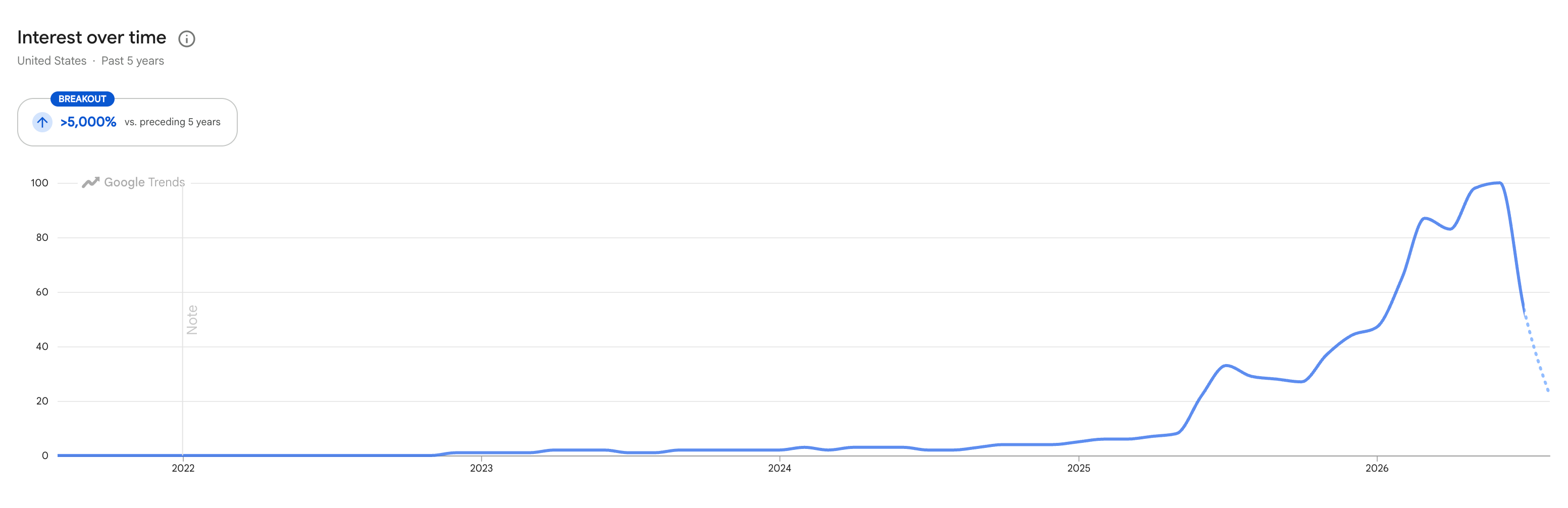
I have to say, for most talking points people use against data centers, it’s always very easy for me to trace the game of telephone to a confused American source. Take people’s professed biggest issue with data centers: water. Google searches for “AI water” spike for the first time in May 2025.
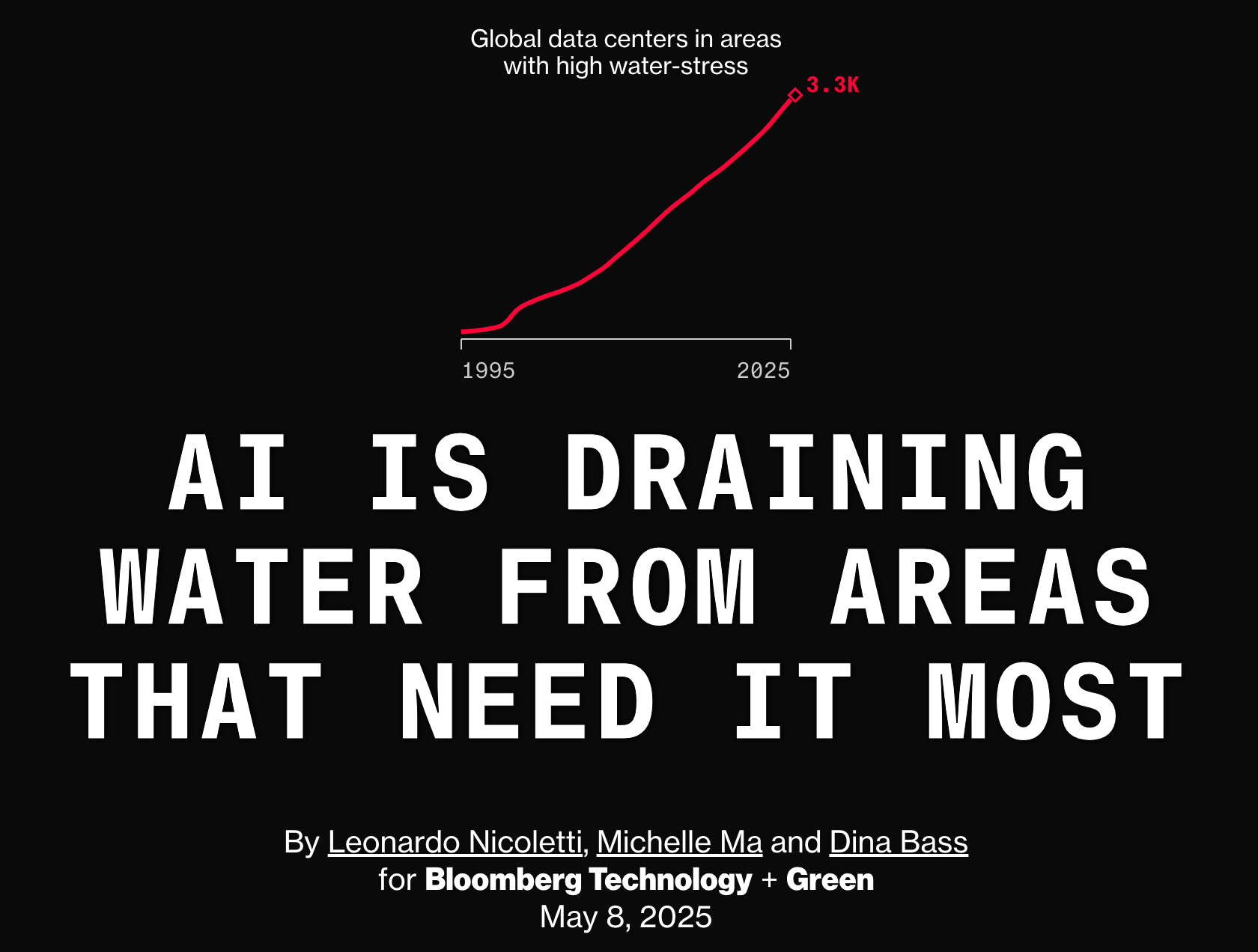
Early that month, Bloomberg published this:
Followed shortly after by this from the New York Times:
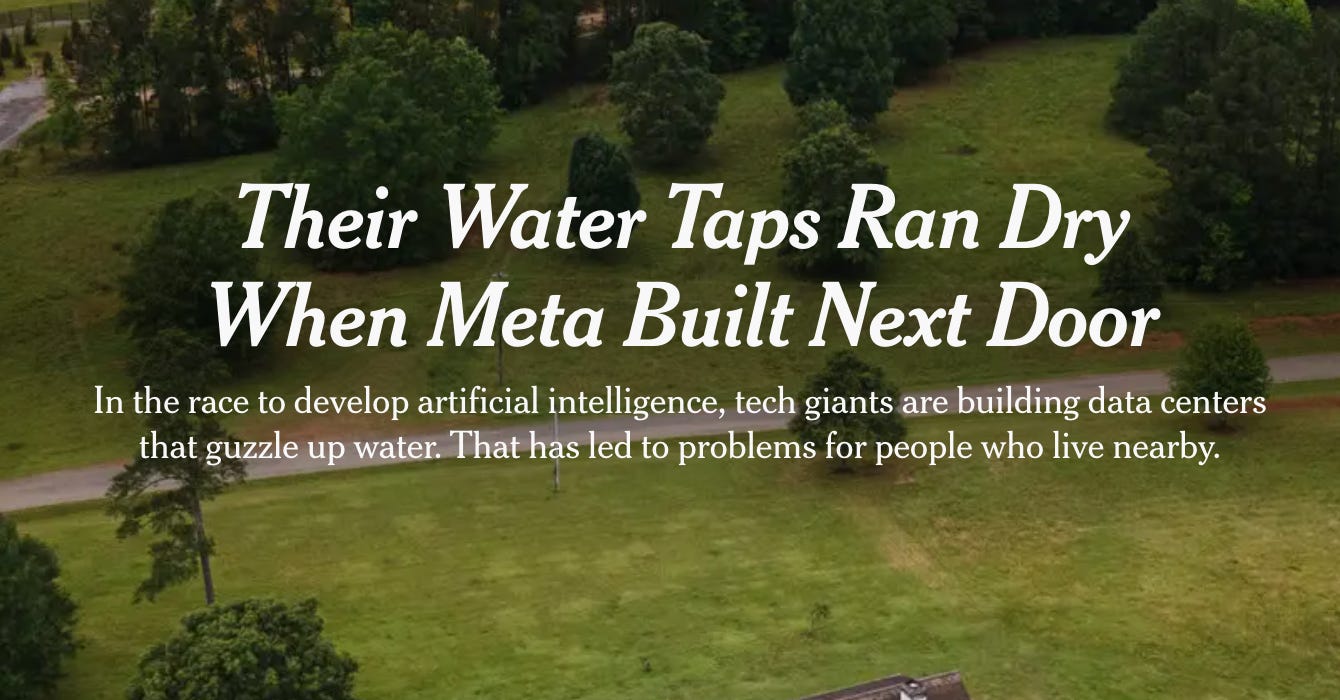
Entirely anecdotal, but in conversations I’ve had about data centers and water, someone has almost always brought up one of these two articles.
We have some recent examples of China trying to influence US politics, and they were mostly duds. For example, in 2022 China ran fake accounts pretending to be Texans to oppose rare earth processing facilities in Texas and Oklahoma, claiming they’d cause radioactive contamination, cancer, and birth defects. An assessment by Mandiant (a cybersecurity firm) found that this wasn’t really effective and got pretty limited engagement. Maybe all the most effective Chinese psyops remain secret to us, but I can’t find any that we know about that had a meaningful impact on American thinking.
I often hear people suggest that TikTok might be boosting anti-data center videos for propaganda reasons. Maybe? I don’t know, anti-data center stuff is ridiculously popular across all social media platforms, and anti-data center creators don’t seem to do any worse on Instagram.
Some people bring up that a lot of the most popular anti-data center posts on websites like Twitter seem to come from foreign bots. Here’s an example:
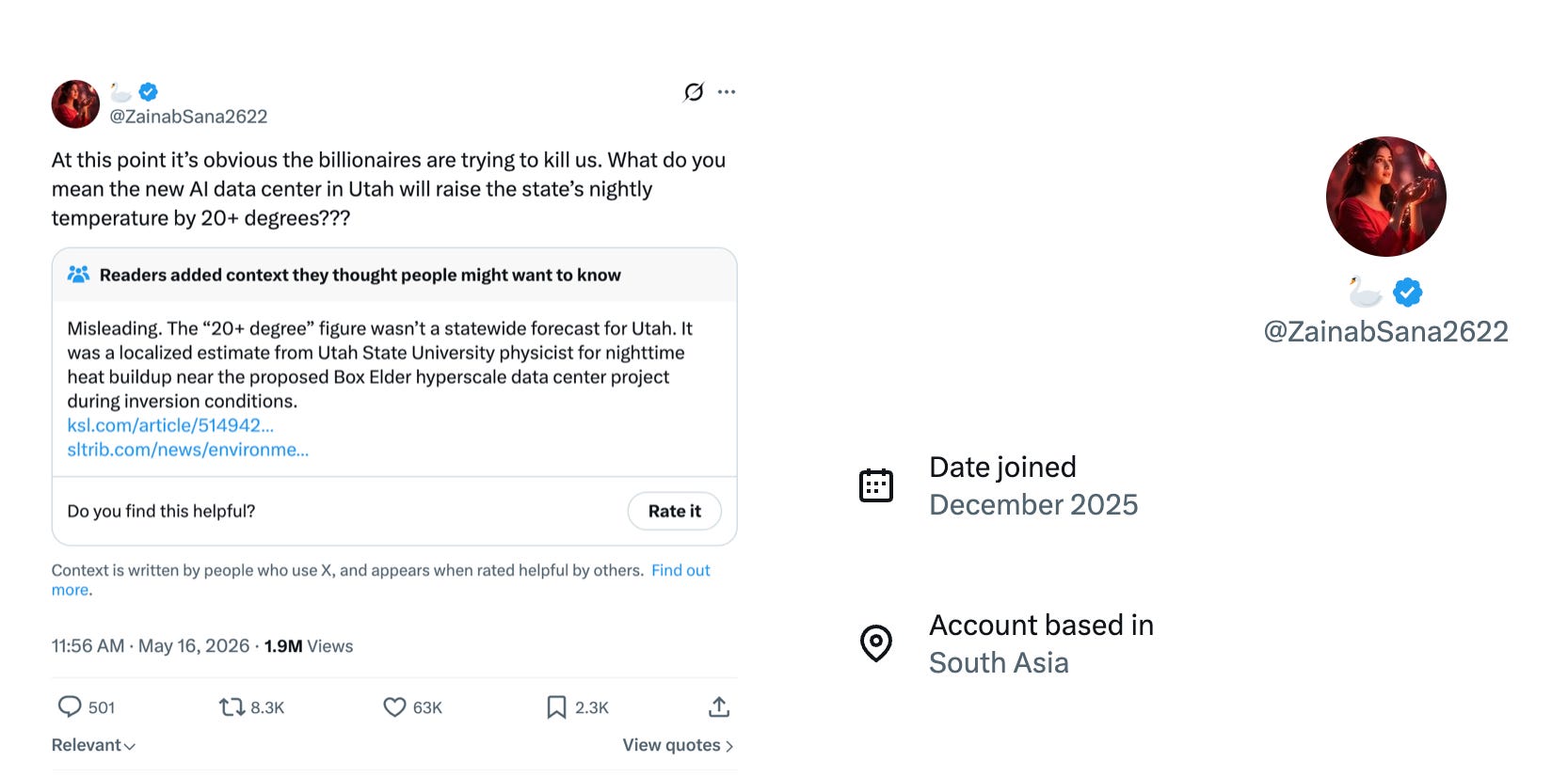
True, but there’s no pattern in where these are coming from, and it seems more likely that the people managing the bots know that data center stuff is likely to get a lot of attention right now and are doing it for money.
One other interesting pattern here is that while data centers have received a lot of absolute pushback, they might not relatively receive more pushback than other building. About 30% of proposed solar and wind projects are also cancelled, because of a mix of community opposition, zoning, and interconnection problems. I’d like to do a deeper dive on this comparison, but would like it even more if someone who knows more about it beats me to it! I’ve recently been following opposition to solar farms in very liberal parts of Massachusetts near where I grew up. Even people who hate climate change often hate new buildings more.
I’m far from an expert on our understanding of foreign influence campaigns more broadly, but summaries I read of them consistently leave me skeptical that they have as much influence as is often attributed to them. To play a meaningful part in the data center backlash, a Chinese influence campaign would need to be much more successful than the ones I’m aware of.
I’m separately writing a series on the history of the data center panic here. I’m more convinced by the story I describe in Part 1 than the idea that China’s involved. I think it was basically predictable that Americans would feel negatively about big new buildings they don’t understand associated with the tech industry, badly reported on by rushed journalists looking for clicks and being built at a rate and scale most of us have never seen before.
Conclusion
There’s still a lot we don’t know about the data center panic, and maybe some new evidence will emerge that China or other countries have somehow had a surprising amount of influence over American attitudes toward data centers. But so far the evidence that’s been produced hasn’t given us any sign of significant Chinese influence. So far the big upside of all this has been more scrutiny on the Singham network and their buddies, though I suspect the main victims of groups like the PSL are the members of the PSL. I personally just feel like I know a lot of my generation and Gen Z’s attitudes well enough to have predicted that there would be mass opposition to data centers (or any significant amount of new building or energy use on a contentious product), and the opposition seems surprisingly aligned to opposition to other building at the same scale, so my gut says this is overwhelmingly homegrown. I’m open to evidence to the contrary, but I haven’t seen it yet.
Basically any time someone is connecting the dots across multiple links of influence, you can tell they’re reaching!
Any claim that someone is playing a real-world game of 4D chess... or 3D chess... or even just plain chess, should be taken with an enormous grain of salt. Even the most amoral political operator knows that "too clever" moves can easily backfire in unexpected ways.
In this case, the likely boring reality is the more depressing one: "when a bad idea gains sufficient momentum, it becomes received wisdom".