

I’ve built up a public image pushing back against misconceptions about data centers and AI’s general environmental impact, but like others into effective altruism I’m separately very worried about risks from advanced AI. A lot of people will ask me why I’m not just nodding along to the misconceptions here for the sake of AI safety. These are my not-super-confident opinions on how the data center backlash relates to AI safety and where I see myself in the conversation. This is way more speculative than what I usually write.
My basic argument here will be that at its best, the data center backlash is a good opportunity to invite lots more people to think more seriously about AI, but it doesn’t seem likely to be useful for safety on its own, and there are lots of reasons people in AI safety should not (and to my knowledge are not) promote the goofy statistics driving a lot of it.
Contents
Effective altruist AI safety as a place where we won’t abjectly bullshit you
What is AI safety?
I buy the basic effective altruist story of why AI is a uniquely big deal:
There is nothing fundamentally magical about the human brain. Our intelligence was produced by an algorithm (evolution) interacting with the world. There’s no reason in principle that machines couldn’t also eventually have what we mean by intelligence. Talking about the possibility of future machines that can “outthink” us should feel about as normal as talking about machines that can outlift us. We have a strong internal bias against thinking this is possible, maybe for evolutionary reasons to avoid thinking about objects as members of our social groups. But by any reasonable definition, humans are themselves intelligent biological machines, which already proves that machines can in principle be intelligent. We are not heavenly observers looking into the physical world from outside.
Machines that can do most or even all of what the human mind can do seem possible (and even likely) sometime in my lifetime. This is commonly called artificial general intelligence, or AGI. The definition of AGI is incredibly fuzzy, but a concept can be fuzzy and still point to something cataclysmically important. Most people have a fuzzy idea of the Industrial Revolution. Before the Industrial Revolution, it would have been reasonable to theorize about some point where more and more complex machines could accomplish the physical labor of many thousands of people at once. People could have theorized about the abstract concept of machines that could do the work of farmers or horses. They could even have theorized about when these machines’ effects on the world would start to compound, with each new efficiency spilling over into the others and speeding up technological progress, until we entered a period of change so strange and rapid that someone could have lived to see both the start of the Civil War and the dropping of the atomic bomb. People living before the Industrial Revolution might not have been able to pin down exactly when something like it would happen, what would qualify, or what the long-term effects would be, but that fuzziness doesn’t make the concept useless, or any less the main story on Earth over the past 250 years. That 80-year timespan from the Civil War to the atomic bomb is about the same as the time between when the world’s first programmable electronic general-purpose computer (the ENIAC) was revealed to the public and when the US government ordered Anthropic to cut off access to Fable and Mythos over the models’ cybersecurity capabilities. The current AI paradigm may not get us to AGI, but it’s becoming hard for me to see how we don’t get there with another 80 years of AI progress. We got from the ENIAC to here in that time.
AGI could be wild, because human intelligence has been the main force shaping the planet for the past 10,000 years or so, as we’ve found ways to collaborate with each other in more and more complex ways. Some might point out that it’s not necessarily the raw intellect of individuals, but rather the collective intelligence of society that has been the real player here. Sure, I believe that too, but AIs are also able to communicate with each other and interact with the world. They could form collectives and markets, or even mimic whole societies, and access and aggregate the same amount of dispersed knowledge that human society does now. We’re all so used to societies built out of complex systems of communication between human minds that it’s easy to forget how truly strange and new their effects are. I mean really, look at this factory!

AAAHHHHH!!!! (but neat). The main question about advanced AI is what would happen if we suddenly and massively scaled up the amount of general intelligence in the world, given that this same force has already reshaped the planet into something much more alien (yet also much more human) than early humans could ever have imagined. Would we be able to control it, and what would the long-term result be? Pontificating about this might be about as useful as hunter-gatherers pontificating about what the agricultural revolution would be like, or medieval societies pontificating about the Industrial Revolution. But whether or not you think we have any mental handholds to grab onto, it does seem likely that we’re heading toward a future where massive numbers of generally intelligent agents are widely available, and that this could make the world at least as weird and alien to us as our current lives would look to a medieval peasant. Maybe much more? Regardless of whether it’s even possible to think about what would happen, I’d like to at least think about whether we can think about it, to try to look for the handholds. Holden Karnofsky’s Most Important Century blog series does a good job of getting across these intuitions.
When I try to think through the biggest risks of AGI, a few obvious candidates come up. Each one is either almost certain, or impossible, or somewhere in between, depending on facts about science, philosophy, and economics that smart people all seem to disagree with each other about:
Advanced AI tools could be used maliciously by humans. Maybe having swarms of hundreds of thousands of genius agents is like having access to nuclear weapons.
Society could come to be governed more and more by AI processes that humans can’t follow. As AI moves further ahead of human intelligence, it starts to resemble the other major forces structuring our lives, such as the market, that we can get hints about but can’t fully predict or understand. Eventually this might amount to a gradual AI takeover that leaves us at the mercy of systems we barely understand.
AI could enable extreme power concentration and lock in a stable totalitarian global government.
The AIs themselves could develop their own goals and override ours, potentially rearranging the world in such a way that we die. Just as humans don’t factor the wellbeing of ants into construction projects, AIs with the collective intelligence of thousands of human societies working together might just not see us as especially worth protecting.
Are these risks real or fake? Can we know? Can we do anything about them, and if so, what? Figuring out the answers to these three questions and then acting accordingly is the main project of AI safety from an effective altruist perspective.

Maybe this is all hype? Maybe this is all an elaborate social game? Could be, but if you’re willing to entertain the idea that mimicking the human mind is both possible in principle and reasonably likely within the next 100 years, it’s difficult not to think that crazy things could happen that we should entertain and think through now. A lot of people who believe this may have their thinking warped by their own social and economic incentives, but that doesn’t mean the right move is to wall your mind off from the question and focus exclusively on the here and now so as not to be turned weird by it yourself. You might disagree with every major case for serious AI risk, or for advanced AI capabilities in the first place, but we’re getting to the point where it’s probably time to calmly step back from whatever counts as the cool opinion in your immediate circles and spend some time working out what you actually concretely think.
So how does the data center buildout relate to this? If I’m worried about this unique cluster of risks from advanced AI, why have I spent time pushing back against misconceptions about data centers? Maybe I should just nod along with the crowds angry at them. After following the debate for a year and a half, I see a lot of reasons not to.
My initial motivations
When I wrote my first post about AI’s environmental impacts I wasn’t expecting much of a response. My main thoughts on the debate at the time were:
A lot of adults seemed really confused about how tiny an amount of energy “10 Google searches” actually is compared to everything else they do. They were comparing an AI prompt to one of the least energy-intensive things we do and fixating on the relative difference, rather than asking how much the prompt actually adds to their total emissions. I’d been following climate debates since college and this seemed like a terrible way to think about where to cut, and I wanted to articulate why.
I was disappointed by the environmental politics implicit in these conversations. I said so here in the original post.
I was surprised by how many people I was meeting who hadn’t actually played around with chatbots yet, and their reason was almost always that they were “so bad for the environment.” This felt akin to people ignoring the early internet for similarly confused reasons (which were also being given at the time). It seemed sad that they were missing out on how good the tools already were, and it also seemed bad for AI safety, because the easiest argument for taking risks from advanced AI seriously is just watching how quickly the models are improving, and people who won’t touch them never see that.
So making the case felt like a win-win-win for my personal climate politics, my interest in AI as it already existed, and broad public education about future threats from AI. The case was just that worrying about 10 Google searches’ worth of energy for the sake of the climate is like stopping your microwave a few seconds early for the sake of the climate, and everything I’ve learned since has only reinforced that. See my full post on that for all the arguments I was making at the time. Above all else, it felt like living in a strange dream reality to have grown adults speak so grimly to me about the equivalent of 10 Google searches, and my initial writing was partly an attempt to wake up from that.
For a while I was nodding along to what a lot of the people I was reading were saying about data centers. My initial explanation for how they could be bad while individual prompts were fine was extremely simple: data centers concentrate huge numbers of individually tiny prompts in one place, so they could plausibly have a big impact on the places they were built. I only realized a few months later that the discourse about data centers was at least as confused as the discourse about individual prompts (probably more so), and got kind of obsessed with how universally strange the media coverage of data centers was. It was somewhat shocking to realize that almost every popular story about them had some incredibly simple twist that completely undermined what most people were taking away from it. For example, take what might be the most influential headline ever written about data centers:

The story is about the construction of a data center, not its normal “guzzling” of water. The subtitle refers to a separate story in the second half of the piece about how Arizona’s going through a drought, which has forced the state to slow home building, and oh hey, data centers are being built there too, so maybe, possibly, that’s related to the home building? We never get any numbers to check for ourselves.
It seems basically impossible for an intelligent person in a hurry to read this headline and subheading and come away believing anything other than that the data center’s normal operational water use (“guzzling”) is what made the taps run dry. There are headlines like this for almost every problem people associate with data centers. I felt like I was living in a dream where I was one of the only people poking at them and getting any attention for it, while most educated adults were getting lulled into a make-believe picture, stitched together from confusing headlines and isolated statistics, of what I expected to become the most consequential and fastest-growing kind of building of my lifetime. Growing an audience who agreed and could pass these arguments on felt like a way of waking up from the dream together.
But given my broader worry about AI risk, I wasn’t sure how to think about the actual value of my newfound role commenting on data centers for my niche audience. Before I stumbled on the Empire of AI error, I had actually decided to pause data center writing for a bit, partly because I wasn’t sure whether what I was doing was good for the world at all, or potentially drastically bad. After thinking about it a lot more, I remain uncertain but have leaned much more toward thinking that the data center backlash is neutral to somewhat negative for AI safety, and that there are a lot of reasons for AI safety people (or at least one of them) to plant a flag and say “We will not be one of the groups abjectly bullshitting you about simple statistics in order to trick you into worrying about AI.” The rest of this post is my explanation for why.
I’m unsure, but suspect the extreme data center backlash is neutral for AI safety, and I see a lot of ways it could be harmful
I’m pretty deeply unsure about the overall effect the data center backlash is having on AI safety, but I see some clear ways it could harm it on net. To be clear, this could all be drastically wrong, and I stand ready to revise any of my takes if I see good arguments against them.
The data center backlash seems to be mostly about data centers, not AI
I think the polling we have so far strongly implies that most people getting angry about data centers are motivated by the object-level claims being made about their environmental and economic impacts. See my post here for a much more in-depth argument:
I think the data center backlash is mostly about data centers

This Heatmap poll has generated a lot of discussion on Twitter in the last few days:
Importantly, when given the option to write out as much as they’d like about why they personally oppose data centers, very few people choose to list anything that could be called part of the AI safety worldview:
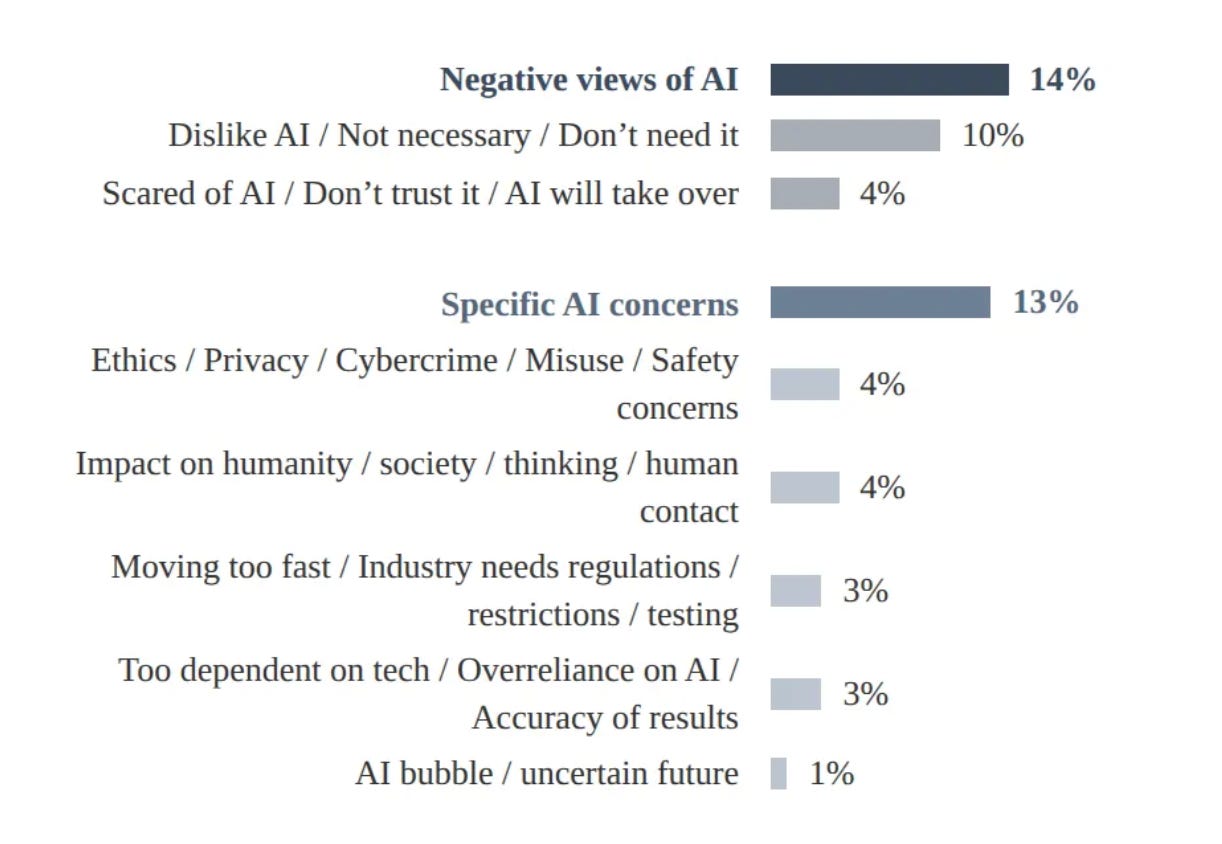
This doesn’t at all mean that they’re not potential allies, it just means that the data center backlash does not look to me like a groundswell of public demand for AI-safety type stuff. It doesn’t seem like someone’s beliefs about data centers can tell us much about what they think about risks from advanced AI, and there’s no reason to think the backlash will naturally trend toward people making better decisions for safety more broadly.
Extreme environmental reaction to data centers often reinforces the “AI is fake and useless” view, which prevents people from thinking seriously about current and future capabilities
A big dividing line in AI discourse is whether AI is dangerous because it’s very capable, or dangerous because it’s very stupid. The “AI is dangerous because it’s stupid” view is maybe best represented by On the Dangers of Stochastic Parrots, the most influential AI ethics paper ever written. Many critics on this side correctly point out that people worried about extinction risks from AI and uncritical AI boosters share the same underlying view, that AI is already pretty capable and could become much more so, and that this shared assumption actually puts them both on one side of a broader debate about whether AI is or ever will be that capable in the first place.
I agree that this broader divide exists, and have three thoughts about it:
AI models today are more capable than a lot of their critics believe. The original criticisms in Stochastic Parrots don’t seem to apply to current models (see here for a list of what’s changed), and my impression is that the authors have resorted to adding more epicycles to their theory of why AIs in the current paradigm are not and never will be especially capable or even useful. That’s looking less and less tenable in 2026. It would be really good if people in the AI debate actually understood what the models can do right now.
The future of AI is pretty uncertain and I don’t feel equipped to judge things like whether the current paradigm of AI will scale to AGI, or whether we’ll need many more breakthroughs that could take decades. Because smart, well-informed people seem to radically disagree on this, the most important thing is to keep the debate rigorous and open so that we learn more and the stronger arguments rise to the top. This isn’t perfect, but it’s the best we have. Beliefs that are false and that also keep people from engaging seriously with this debate in the first place seem pretty harmful.
There’s a lot of social reward right now for locking into overconfident beliefs about AI capabilities. I could definitely be rewarded in a lot of AI risk spaces for expressing more confident beliefs than I actually have. At the same time, I see a lot of people get a LOT of social reward for refusing to even consider that AI might already be capable (“this tech is stupid and if you think otherwise everyone will say you’re an idiot”), or to seriously enter the debate about how it might become more capable in the future and whether that would be dangerous. In my experience this is often downstream of people becoming convinced that individual AI prompts are terrible for the environment. It’s hard to believe both that spending 10 Google searches’ worth of energy on a prompt is incredibly wasteful and that the same prompt is doing something shockingly powerful and different from a normal search. I’m worried that a lot of the weird environmental misconceptions about data centers really lock in this mindset of “I cannot ever entertain that these models might be powerful” because that gives some status to these otherwise evil stupid buildings. I want people to just consider the arguments and form their own conclusions, and for that to happen their opinions about AI can’t just immediately calcify into “it’s always bullshit and dumb” based on background social pressure and confused ideas about data centers rather than reasoned thought. Politely pushing back on the environmental misinformation going around seems like one way to help with that.
Anything short of a national moratorium and strong export controls doesn’t seem likely to slow AI progress much
There’s a gigantic amount of capital behind data centers, and data centers used for training mostly just need power and empty land. America has a lot of both, even if most states end up banning data centers. All data center buildings in 2028 will together take up as much space as Disney World. The most important bottleneck is power, but even here data centers rejected from one county usually have others competing for them. It seems like the result of most state-level data center opposition will be just moving where data centers are built.
My impression is that the big AI companies mostly don’t bother fighting local opposition, they just go somewhere else. They don’t seem to spend much as a portion of their revenue on countering the data center backlash in general, which I think tells us something about how worried they are about it.
Even state-level moratoria might not do much. Arvind Narayanan estimates that a state banning data centers for a year probably delays AI progress by about 5 to 10 hours, and that’s assuming none of the blocked data centers get built anywhere else, which is pretty unrealistic.
Frontier training (where most of the dangerous capabilities show up) happens at maybe a dozen specific data center campuses. A restriction on one of those would matter more, but to my knowledge no data center block has hit one of them yet.
There’s also a big difference between slowing AI progress and reducing AI usage, and people who are part of the data center backlash may not see it or react to it. Restrictions on new data centers mostly seem to harm deployment rather than capabilities. They make AI slower, more expensive, and less available to everyday people, but leave the training runs I’m actually worried about mostly unaffected. That seems like a bad trade from a safety perspective! The models keep improving while the public’s hands-on sense of what they can do falls further behind.
The data center backlash might cause voters to reward and prioritize the wrong moves against AI companies
Suppose that there are two candidates. One wants heavy regulation on the AI industry itself to avoid catastrophic risks. The other wants to ban data centers. Which will voters see as the “toughest” on AI? I’m worried that right now the answer’s clearly the second. In a lot of political conversations about AI, a lot of people are starting to frame data center moratoria as the “tough” position against the companies, and regulating AI models themselves as something more friendly to big tech. This seems like a pretty bad disaster for getting public approval for governing advanced AI.
This one I really don’t know about. But I’ve seen more and more political commentary where candidates who want data center moratoria are framed as the “most tough” on AI that they can be. If you don’t believe that state-level moratoria will do much good at all for safety, this seems like a dangerous distraction.
This could be a simple both-and situation, where the public gets data center moratoria and serious model regulation. I’m worried that voters just don’t actually think enough about AI for that to be guaranteed to happen, and as long as a politician checks the “Doing something about AI” box that might be seen as enough, and a data center moratorium on its own checks that box. A politician who’s passed or even just advocated for a moratorium has satisfied the public demand and collected the credit, and the next person proposing frontier model regulation is now proposing a second AI bill that might be seen as unnecessary. Public attention on an issue is a scarce resource, and more of it being spent on the data center backlash might start to compete with good legislation.
Navigating through advanced AI safely would probably require voters not thinking of data centers as demons
I’m pretty unsure about the specifics of AI risk, and therefore unsure about what would make things go well, but it seems unlikely at this point that managing AI well will be helped by the average person thinking about data centers as radiating evil. In very extreme AI safety scenarios like AI 2040, data centers eventually manage the vast majority of all economic activity on Earth. Is this good? I don’t know. It’s one of many visions of where the risks and benefits of AI are and how to react. But in this world, everyday people will need to know what’s actually going on with data centers, and having a country reacting to them as if they’re demons seems like it’ll mostly override reasoned sober decision-making.
It might be that it’s preferable to have the data centers we want to eventually govern all in one country (or maybe that’s bad because of power concentration? Oh no). The data center backlash pushing out more data centers to other countries instead of America increases the amount that AI companies can do and train outside the US’s reach. This could be bad, or good? But making that decision again requires citizens with clear-eyed views about the actual trade-offs.
It’s in some ways very lucky for the governance of AI that frontier models currently require a small number of gigantic physical campuses with a huge heat footprint. It’s good to know where this is happening, and massive data centers make that somewhat easier. Any pressure to scatter the computing into smaller buildings (or blast it into space) makes it somewhat harder to know where frontier training runs are happening.
Conclusion
So it looks to me like the data center backlash is mostly just shuffling around where inference data centers specifically are built, and isn’t affecting the data centers used for training, which are often built pretty far from where lots of angry locals live who would block them (with the exception of xAI’s Colossus in Memphis). Even state-mlevel data center moratoria maybe only slow AI progress by hours. The backlash gives political reward to politicians who focus more on “governing AI” via what looks like a purely symbolic move against the AI companies that leaves their most dangerous capabilities completely untouched, and rewards the idea that AI is such a waste because it’s useless and stupid rather than dangerous and powerful. It removes people’s ability to think seriously about the trade-offs of running data centers in their area, which will be pretty important if we manage to get to the point where we’ve avoided the risks and are capturing the benefits of advanced AI.
The main simple way I could be really wrong here is if this all builds to a national moratorium with strict export controls to limit China’s ability to catch up. That strikes me as within the window of possibly good governance of AI. I don’t know. But unless it leads to that, we get all these negatives and basically none of the potential positives.
And separately, the backlash is just fundamentally mistaken and wrong. People aren’t mistaken to worry about data centers and AI, but they are blatantly, consistently mistaken about how data centers actually affect local communities, and I’m more convinced than ever that if they just knew the full economic trade-offs of the buildings themselves, the full list of costs and benefits on either side, they would usually choose to allow data centers to be built. More broadly, I see the general politics driving the backlash as disturbingly illiberal. As Alex Tabarrok notes, they’re a loss for the open access order. I would like liberalism to survive a potential intelligence explosion.
I think the data center backlash leaves a lot of room for AI safety people to build bridges with everyday people. I’m not saying here that we should just shun them. But I also think we should talk to them (and everyone) as if they were intelligent friends we respected who we thought were getting one question wrong but really wanted to get on board with a broader idea. I think treating people respectfully often involves saying what our own beliefs are clearly. This next section will be more on how I think these basic ethics of discourse are important to building a community of real thinking on AI safety.
Effective altruist AI safety as a place where we won’t abjectly bullshit you
I’ve been very happy to plant a flag for what I see as the great aspects of EA thinking on a specific topic, as part of broader behavior I want others to replicate. To be clear, I think EA mostly already does all this very well. I’m writing all this as “this is what I want to authentically show the world that EA is already doing” rather than “I wish people in EA did this, because they’re currently not.” I haven’t had anyone in EA suggest lying about data center water use or scold me for telling the truth. We’re not the ones pushing this stuff, and I have high confidence that we’ll stay that way.
Societal resilience to speculative future risks requires strong healthy epistemic communities of debate and disagreement
Suppose you were living in the 1930s. One day the neutron is discovered, and you infer from this that nuclear weapons are possible and could appear within a few decades. You want to understand where the actual risks are, what to do about them, and how to build institutions that could avoid them. What do you do?
One move that doesn’t seem promising is deciding that everyone needs to believe your very specific account of exactly how nuclear weapons will be dangerous, or of how countries will behave once they have them, when you aren’t completely confident that your answer is the one all reasonable people would agree with once they saw the argument. If you start using emotional or rhetorical tricks to win over people who wouldn’t have assented to what you were saying if you’d treated them like rational friends you respected, you’re going to quickly discover that a lot of other people have plenty of legitimate reasons to use their own emotional and rhetorical tricks to override your team with their beliefs. The debate about this incredibly dangerous new technology would slowly wall itself off into angry islands of belief that don’t communicate with each other, and new people would sort onto these islands based on a roulette wheel of the contentious beliefs a rational person could hold given limited evidence. Society would become brittle and inflexible, and by the time the threat appeared, people would be too invested in their own team to adjust quickly and work together based on how things were actually playing out.
So the basic ethics of discourse become monumentally important as part of the collective project of moving society toward a place where it can respond well to a gigantic new risk. It seems very likely to me that future AI systems could pose gigantic risks to civilization, and also very likely that I, as just some guy thinking about it, have an unbelievable number of blind spots, overconfidence I don’t notice, and social incentives that warp my thinking in bad ways. The only way to deal with this is to directly welcome any and all reasonable people into debates about AI safety, at a high level where we aren’t slinging cheap rhetorical tricks at each other. Preserving this fragile state requires treating people who disagree with almost everything we believe, and who are engaging seriously in the debate, as respected and equal participants. Trying to lure them in with ideas and statistics we know are wrong, like the claim that data centers are also destroying local water supplies, or with overconfidence about our own specific risk case, basically tricks them into positions in the debate they might not otherwise have assented to. This is a way of burning the commons. It was good that debates about nuclear weapons happened across academia and government, with wild disagreements, rather than each side trying to override the debate and just vying for power. Managing the nuclear era involved a lot of complex, counterintuitive moves that couldn’t have been reduced to simple slogans. It was good that serious thinkers were able to plant flags of high epistemic integrity in that debate early on.
We’re already making extreme, wild claims about AI and need to otherwise respect the epistemic commons to have them taken seriously
I think the core ideas of AI safety are both surprisingly intuitive (it seems likely that we’ll make significant AI progress over the next 80 years, and if you sit with the idea of replicating human intelligence in machines and really internalize it, the wild implications are easy to see) and very aversive to think about (it all sounds so weird and sci-fi, like a trick big tech is playing on you). The basic argument is that AI could get so powerful within our lifetime that we need to start getting our footing now on what that would actually imply and how society would manage it, instead of just sitting back, thinking “wow, wild,” and feeling like we’ve done our part. For an intelligent person to actually receive that argument and think it through, it has to come with a lot of careful acknowledgement of how incredibly complex and uncertain the problem is. The space of possible reasonable opinions on AI risk is so varied, and so full of rival views that would each be incredibly consequential if true, that it seems easy for anyone to adopt whichever beliefs are most convenient for their immediate social status games, and then lord them over everyone else because those beliefs are so consequential. People correctly recognize that extreme beliefs are often social crutches for overriding normal social rules, and unfortunately every possible belief about AI risk is somewhat extreme, because all possible views about humanity’s future are wild. Because we’re trying to figure out and debate our extreme beliefs together, it seems especially important to be clear that we won’t use them to justify breaking unrelated social rules, which includes not lying about relatively simple questions about AI. Debates between people who hold rival extreme beliefs about the future are only really possible if neither side is using those beliefs to justify burning the simple epistemic bridges between them.
A lot of the broader intellectual culture seems incredibly averse to thinking about even the near-term future. Basically everything outside our immediate field of vision gets treated as a convenient distraction from the real, immediate problems of the world. I think this hyper-distrust of thinking through what the future could actually be like has become intellectually incapacitating for a lot of otherwise very smart people. Hyper-skepticism that treats every truth claim as really just a move in some secret status game locks us into a situation where nobody has any incentive to care about what will actually have good effects on the world, and everyone just tries to get to the top of their own immediate status system. That’s not a healthy place for an intellectual culture to be as AI becomes more capable. I agree that a lot of skepticism is warranted, and I’m pretty cynical myself about all of our motivations when we go out purportedly seeking truth. But there’s a difference between being skeptical of people’s motives and refusing to think about the future at all.
To preserve even the possibility of articulating and refining our views about what the near-term future with AI could be like, we need to be really, really careful to show over and over that we’re not letting those views license us to break other social rules. Breaking them sends too strong a signal that we’re either holding the views for exactly that reason, or that we’ve shut ourselves off from rationally adjusting them when other people argue with us, since we’d be demonstrating that we think rival views are so worthless they need to be steamrolled with lies and misleading statistics. This is the core reason I’m happy that effective altruist AI safety scenes have (to my knowledge) not indulged in lying or hyping up clearly misleading claims about data centers and the environment, and why I’m happy to be both a face of effective altruist AI safety and someone pushing back against what I see as basically a minor mass moral panic over unrelated problems with AI that don’t hold up to scrutiny.
The broader societal backlash to AI is often based on obvious simple lies because people are having a visceral emotional reaction. AI safety needs to distinguish itself from this backlash
It’s becoming more and more socially fashionable to hate AI, often for confused reasons, like the mistaken idea that each prompt uses a bottle of water. Negative reactions to AI are understandable, but there’s a growing gulf between people who understand the technology and people who are clearly running on rumors they picked up on social media, and who are ready to believe those rumors because they already see AI (maybe correctly) as a bad guy for other reasons. It seems very easy for serious people to lump risks from advanced AI into this same bucket of fake beliefs, and to assume that it comes from the same general negative emotional reaction and isn’t any more substantive. I think AI safety is clearly separate from these confused ideas, and we need to find ways to make that clear. One way to do that is to distinguish ourselves by pushing back on the bogus ideas.
The single most painful sentence I heard last year was at a discussion about EA and AI with people who mostly didn’t know much about either. A panelist asked, “So is EA just hopping on the AI bandwagon now that more people are worried?” I started worrying about AI in 2016 and put up with a lot of sneers and scorn for it, as did most people I know in AI safety, and hearing that made it feel like all of that had been for nothing, and that most people now saw us as just one more part of the vague angry backlash to ChatGPT specifically. Because most people still don’t know much about EA or AI safety, it seems useful to plant a flag and say something like: “We agree that some general worries about AI, like its long-term effects on jobs and economic power, are real and important. But we’re not here to nod along with just anything that’s anti-AI. We have a specific, coherent argument for why AI could be dangerous, and we didn’t get memed into it because worrying about AI recently became high-status.”
The arguments we give to the public will affect who gets involved
I think if you want to build a complex movement of people working together to figure out what’s true, it’s going to need to not rely on memes the people in it know to be false for community building. The AI safety debate shouldn’t be diluted by very lazy thinking, and I think indulging and making knowingly lazy arguments with bad statistics will attract people who are being somewhat lazy in how they think about AI, especially if they’re so ideologically brittle they’re unwilling to question the statistics. This would be bad for our core coalition. AI safety is entirely about judgment under radical uncertainty and being willing to follow clear arguments and evidence where they lead. Relying on goofy ideas for growth seems like it’ll massively dilute the quality of thinking.
Again, I wanna be clear here that I don’t mean we should shun people originally taken in by the bad statistics about water, that’d be ridiculous. People’s minds can change, and we’ve all been taken in by goofy ideas at some point. We just shouldn’t use the bad statistics and lies as an active outreach strategy. I will say that to my knowledge no AI safety group is actually doing this, and most I know will patiently explain to people why the water stuff specifically is a little off if asked. I’ve never been asked by anyone high up in AI safety or EA to shut up about the stats to slow down AI.
A lot of other spaces discussing AI seem interested in using bullshit stats about data centers to fire up their base for unrelated political wins. Effective altruists and the broader AI safety community can set ourselves apart by simply not doing that
I’ve lost a lot of patience for sitting through lectures or monologues by people who seem to be speaking in fake social memes that don’t actually relate to anything real. I’d rather be around people and scenes that don’t blatantly bullshit me. And luckily there are a lot of these in the world, with certain scenes within EA being one of many.
For example, I think specific 80,000 Hours problem profiles are some of the very best writing on the topics they cover, because they’re trying to give you a complete, no-bullshit overview (as they see it) of a massive global problem that they actually want you to take concrete action on. To me this is one of the best things about good writing influenced by effective altruist ideas. It’s basically designed to be the rapid but comprehensive rundown you’d want to give a smart friend on a topic you want people to act on.
Of course none of this means that those of us in effective altruist or AI safety communities can’t unknowingly bullshit ourselves or other people. The human tendency to truly start believing things based on the status we subconsciously expect them to confer is incredibly powerful. In many ways it’s the original sin of human thought (partly because our higher-level thinking likely evolved to win social games with each other, so when we acquire fake but socially useful beliefs we’re doing exactly what our higher cognitive capacities exist to do). It could be that all the beliefs in this post are themselves downstream of my desire to make the data center backlash fit conveniently with my AI safety beliefs. Effective altruist spaces can be insular, and at some point we can’t fully guard against the chance that we’re acquiring beliefs this way too. But separately, I almost never encounter in EA communication the kind of knowing bullshit that seems to permeate so much of the broader discourse on AI, where people seem to know that data centers make useful political enemies regardless of whether the specific claims about them are true. I think there are a lot of people like me out there kind of wandering in the desert, desperate for direct, honest, high-level debates about this technology with such mind-shattering but uncertain potential, who don’t want to see the tech immediately devolve into a cudgel used to win completely unrelated political and social games without any regard for the truth. There are plenty of scenes having those debates, but a scene where people uncritically share lots of wild, goofy claims about data centers is a pretty bad sign. It goes a long way when a scene simply makes it clear, “Hey, we’re going to be careful about what we say about AI, and we’re going to express our honest (and sometimes very extreme) opinions about the situation as we actually see it. We’re not going to get you hyped up about every little AI thing just because we’re having some general emotional reaction to it and want to lash out. We’ve been thinking about this for years or decades and have landed at this cluster of positions in the debate. Here’s what we’ve got, take it or leave it as you react honestly to the arguments and evidence.”
Some recommended media on AI safety
The 80,000 Hours series on specific AI risks:
Skeptical takes from 1a3orn, especially On Those Undefeatable Arguments for AI Doom
Cold Takes, on the weird historical situation we find ourselves in
We refuse to listen to you as the mouthpiece for your billionaire overlords, Andy!
;-)
Andy, you’re one of the good guys. I deeply appreciate your commitment to epistemic humility and lack of bullshittery.
I may not agree with you on everything, but your insistence on facts and arguments made in good faith is very welcome and, sadly, rare on both sides.
Keep up the good work, it is noticed and making a difference.